2.8.2 Northern region
The Northern region of Victoria is also known as the 'food bowl' of the state and encompasses Victoria's share of the River Murray and its Victorian tributaries - the Kiewa, Ovens, Broken, Goulburn, Campaspe and Loddon River systems. Victoria's 'food bowl' contributes significantly to the nation's prosperity through the production of food and fibre. The region's agricultural industry contributes about $3 billion a year to the Victorian economy.346 The area supports both dry land and irrigation farming; it is a vast patchwork of grains, livestock, dairy, horticulture and wine grape enterprises ranging from small four-hectare properties to broad acre farms. This region roughly corresponds to the Audit regions of Hume, Shepparton, Bendigo and parts of North West.
The major water authorities for this region are Goulburn Murray Water (bulk supply), Lower Murray Water, Coliban Water, Goulburn Valley Water, Central Highlands Water and North East Water. The catchment management authorities (CMAs) responsible for the area are Mallee, North Central, Goulburn Broken, and North East. The region is part of the Murray-Darling Basin and water management is subject to the provisions of the Murray Darling Basin Plan.347
Based on the annual average yield and unrestricted annual demand calculations undertaken by the five water corporations for their urban water supply systems, while there is a combined annual surplus of 30.8 GL, about a third of the systems are in supply shortfall.348 Climate change and variability are the biggest threats to water availability in the Northern region. Scenario planning to 2055 conducted by the Victorian Government349 indicates that, under the most severe climate change scenario, the western catchments such as the Campaspe and Loddon are likely to be harder hit than eastern catchments such as the Kiewa and Ovens, as shown in Figure 69. There is a risk that, in some years, there will be insufficient water to run the channel system and deliver water to irrigators and domestic and stock customers. More restrictions on the use of groundwater and more frequent, extended water restrictions in urban areas are likely.
Figure 69: Forecast availability of total inflows for the Murray system to 2055 (Scenarios A to D compared with the long-term average)
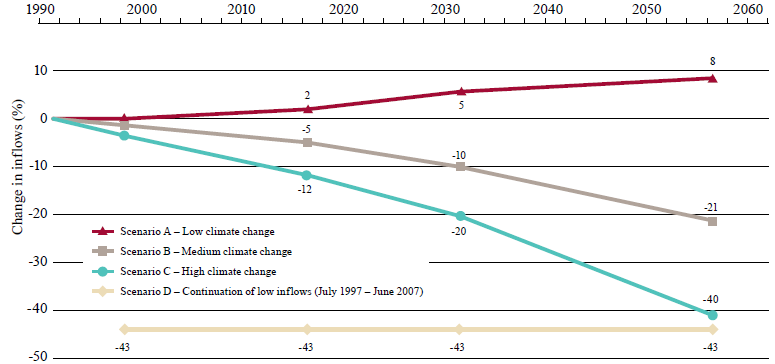
Note: * Refers to total Murray system, not just Victoria's share.
Source: Victorian Department of Sustainability and Environment (2009)
___________________________________________________________________________________________________
346. Victorian Department of Sustainability and Environment (2009)
347. Murray-Darling Basin Authority (2012)
348. Based on average yield of 136. 5 GL per year and unrestricted annual demand of 105.7 GL per year.
349. Victorian Department of Sustainability and Environment (2009)