8.5 Remote Indigenous services in the Northern Territory
As discussed in Section 5.1.3 in Volume 1, infrastructure provision is a critical issue for remote Indigenous communities, with many areas lacking even basic services. Improving the delivery of infrastructure to these areas can bring considerable social benefits in terms of access to services and economic opportunities, and is fundamental to the governments' broader agenda of Closing the Gap in Indigenous Disadvantage.
The NT has hundreds of remote Indigenous communities across the territory, many in very isolated locations and without reasonable transport access to the economic centres of Darwin or Alice Springs. This reinforces the need for considerable investment in essential infrastructure to ensure Indigenous people in these areas have access to services that can support better health, education and employment outcomes in their communities.
NT Power and Water Corporation's not-for-profit subsidiary, Indigenous Essential Services, currently provides electricity, water and sewerage services to 72 remote communities and 66 outstations (as shown in Section 5.1.3 in Volume 1). Provision of services to these geographically isolated communities, in both tropical and arid environments, requires design service levels equal to similar-sized urban centres, with resilience and adaptability to the changing climate. Eighty-five per cent of potable water is sourced from groundwater, from 250 production bores through 160 water storage tanks and 650 km of reticulation. A multi-barrier approach is taken to providing drinking water consistent with Australian Drinking Water Guidelines. Chlorination and ultraviolet systems are used as appropriate. Fifty-six towns and communities have full water-borne sewage disposal systems with waste stabilisation ponds. The remainder have individual onsite systems maintained by the community.
Figure 111: Map of Indigenous community electrical, water and sewerage services in Northern Territory
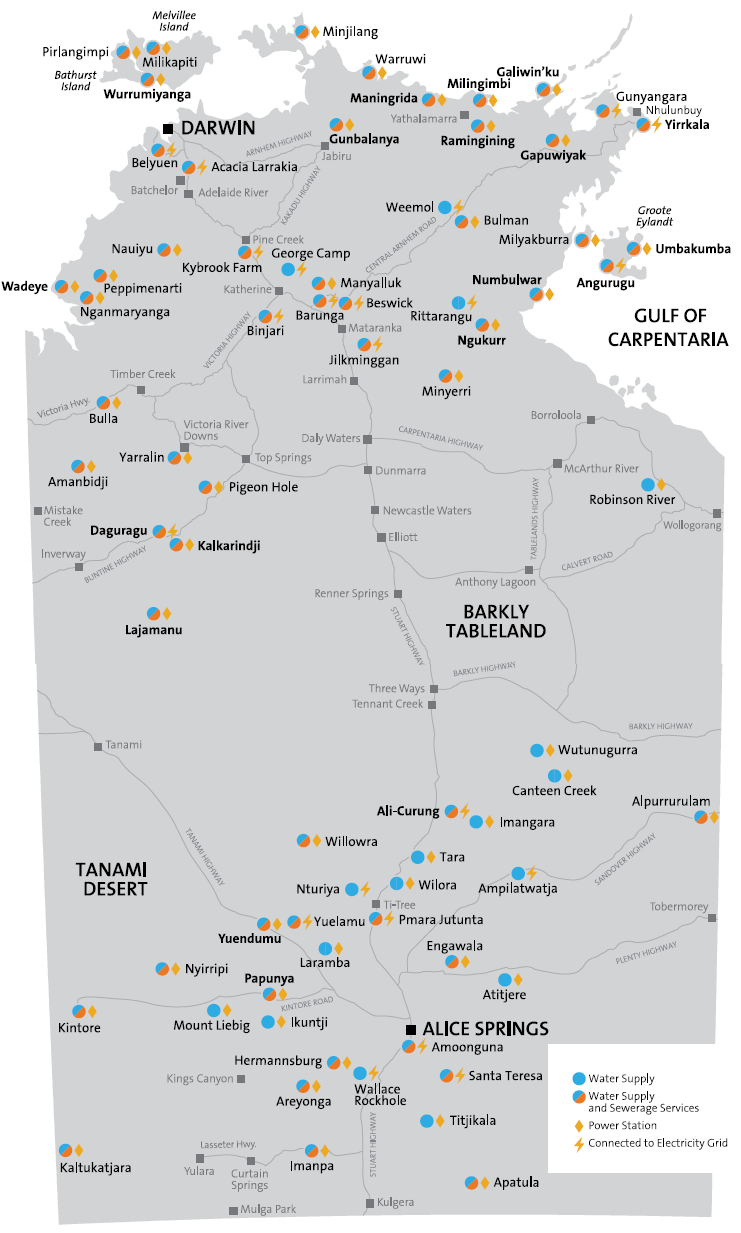
Source: Northern Territory Power and Water Corporation (2014)