The problem
1 Ninety-five per cent of government policies are delivered through major projects. Successful project delivery is therefore essential to government delivering its promises and objectives. The 191 projects in the Government Major Projects Portfolio are, together, worth £354 billion. Yet we frequently report on major projects that fail to deliver the outcomes expected. Historically, the majority of major projects in government have not delivered the anticipated benefits within original time and cost expectations.
2 There are many reasons why projects fail to meet expectations, such as poor project management and the impact of external factors beyond the control of those responsible for the project. However, the challenges of delivering government projects are compounded by the endemic over-optimism which characterises decisions to commit to projects and the subsequent management of them. This undermines the likely success of a project, often leading to substantial cost overruns, delays in completion and failure to deliver the benefits.
3 The Civil Service Reform Plan recognises that the consideration of policy and the practical implementation of it need to be brought together - "too often policy draws from too narrow a range of views and evidence, and does not ensure that policy is capable of practical implementation" and "policy makers should have a clear understanding of what works based on robust evidence".1
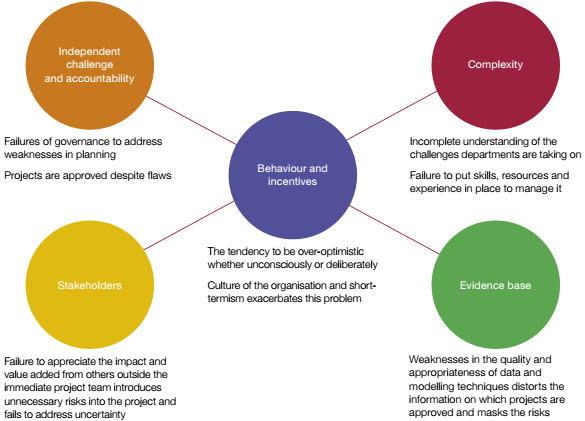
4 These views are supported by our back catalogue of reports, which clearly illustrate that over-optimism is widespread and has many causes and adverse effects. This report sets out some of the contributory factors: they are neither exhaustive nor mutually exclusive - over-optimism typically has multiple causes (Figure 1).
| Figure 1 Factors that contribute to over-optimism
Source: National Audit Office analysis |
______________________________________________________________________
1 www.civilservice.gov.uk/wp-content/uploads/2012/06/Civil-Service-Reform-Plan-acc-final.pdf