The findings of our 2008 report
2.5 The reviews commissioned by government in response to the G4S and Serco overbilling revelations found systemic weaknesses in its contract management (Figure 8 on pages 32 and 33). Many of the findings echo issues raised in earlier NAO reports. In particular, the 2008 NAO report Central government's management of service contracts found that government:
• had not prioritised contract management enough;
• had allocated insufficient skills and resources;
• had not used penalties to encourage good performance;
• had weak risk management;
• had variable measures to improve contracts;
• had not widely carried out a supplier relationship management programme (less than half of organisations); and
• needed to do more to support central government organisations.
2.6 The 2009 Committee of Public Accounts report that followed made 9 recommendations to improve government contract management. The government accepted them. The Office for Government Commerce (OGC), then part of HM Treasury, set up a programme to 'build an active community that is incentivised and encouraged to build its professional capacity and capability' across central government. However, the OGC struggled to influence departments and progress in improving contract management was slow.29
Figure 7 Contracting out public services has increased since the 1980s Examples of major themes in contracting 1982 to 2014
Notes 1 Organisations referred to in the figure include: MOD - Ministry of Defence; OGC - Office of Government Commerce; DfT - Department for Transport; DWP - Department for Work & Pensions; HMRC - HM Revenue & Customs; DVLA - Driver and Vehicle Licensing Agency; NS&I - National Savings & Investments. 2 The ASPIRE and STEPS contracts were originally let by the Inland Revenue, which is now HMRC, and the PRIME contract was originally let by the Department for Social Security, which is now the Department for Work & Pensions. Source: National Audit Office analysis of value for money reports, 1982 to 2014 |
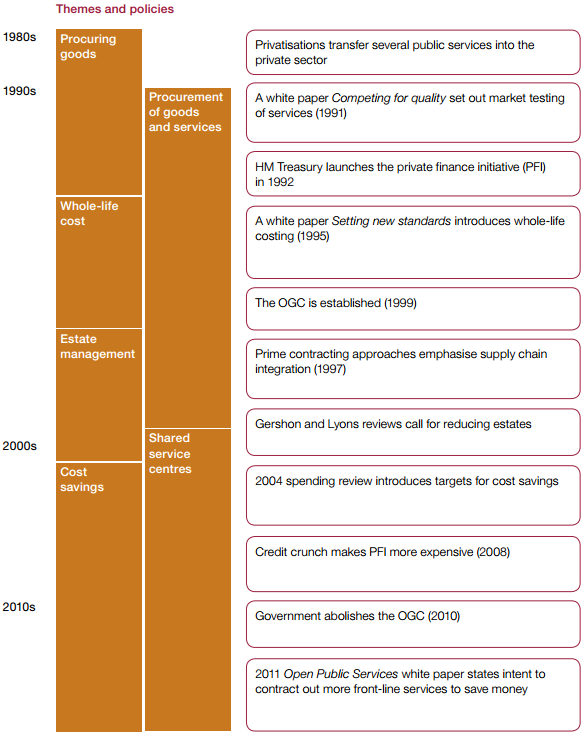
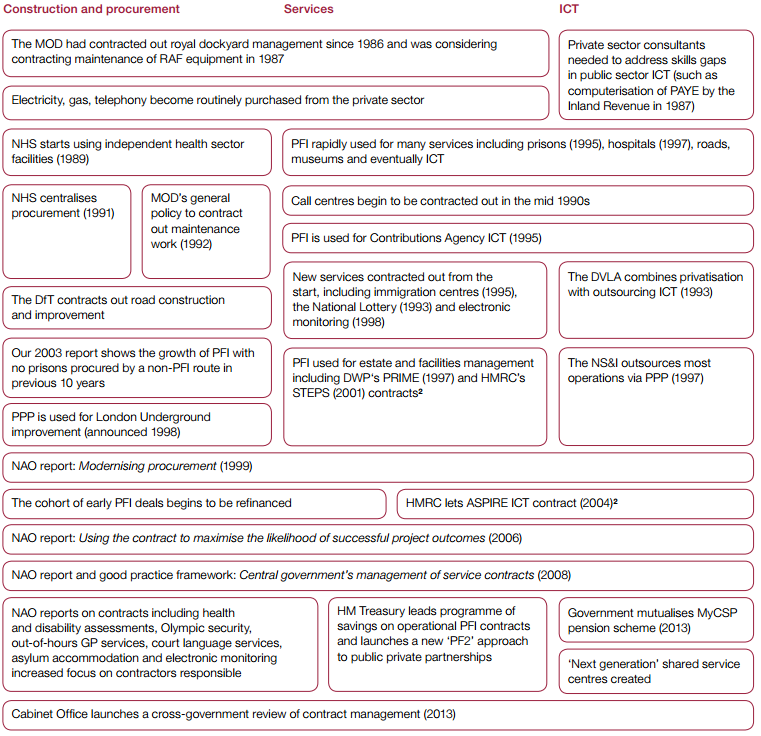
Figure 8 The findings of the 2013 government reviews echo earlier work | ||
NAO good practice areas | NAO findings (December 2008) | Committee of Public Accounts recommendations (April 2009) |
Planning and governance | Poorly prioritised contract management There was often no single individual with overall responsibility for contract management across an organisation, and no documented plan for managing individual contracts in more than a quarter of cases. Where plans did exist, supplier input was limited | Assign responsibility to a single individual. (Including contract governance and creation of documented contract management plans) |
People | Insufficient skills and resources 27% of commercial directors or heads of procurement rated the level of resources allocated to contract management as poor. Few contract managers hold any formal commercial qualification | Review and put in place appropriate contract management resource |
Administration | Lack of central guidance and support The OGC had focused its work developing guidance and training primarily on the ICT sector, rather than on contract management more broadly |
|
Payment and incentives |
Organisations did not always use the performance information they collected from suppliers. 38% of contract managers did not always invoke payment deductions when supplier performance was below the specified standard | Performance deductions should be enforced (except under very exceptional circumstances supported by guidance) |
Managing performance | Performance measures should be in place, and adapted to requirements | |
Risk | Weak risk management 37% of contracts did not have a risk register and 56% did not have contingency plans for supplier failure | Risk management processes and contingency plans should follow good practice, and be supported by guidance |
Contract development | Lack of focus on improvement Departments were not always using benchmarking to improve value. Only 53% of contract managers had a formal plan for supplier improvement and development | Value for money testing at least every 3 years and for all significant changes |
Managing relationships | Lack of supplier relationship management Ways in which day-to-day working relationships might be improved include defining more clearly the expected behaviours of both parties throughout the duration of the contract | Central guidance, including monitoring major suppliers |
Source: National Audit Office analysis of detailed review findings and audit papers | ||
Government review findings (2013-14) | Examples from the recent contract management reviews | Consequence |
Problems on 38 out of 73 contracts including: • a general lack of visibility of contracting at board or executive level; • lack of senior involvement; and • missing or insufficient contract management plans. | The Home Office immigration caseworking contract had no contract management plan | Departments lack good strategic understanding of how contracting can deliver |
Problems on 40 out of 73 contracts including: • insufficient numbers and capability of staff allocated to contract management; and • limited knowledge of the detail of the contract among contract operations staff. | Inadequate capability contributed to the Ministry of Justice's contract management problems. The team responsible for the Electronic Monitoring contracts shrunk from 8 to 5 between 2007 and 2012. Following a bottom- up assessment of contract management requirements, staffing has now risen to 7 | Departments have reduced knowledge of how their contracts work, and how services are delivered |
Problems on 39 of 73 contracts including: • weak interactions between the finance, commercial and contract management functions. | Serco and G4S had not deducted agreed amounts from invoices for the Home Office's immigration removal centres. The amount was small but larger errors may also not be detected | Departments are unable to detect or prevent overbilling |
Problems on 48 of 73 contracts including: • levels of deductions allowed by the contract insufficient to incentivise contractor performance; and • lack of use of 'open book' clauses. | Ofsted had only one payment retention mechanism available in its inspection contract with Serco. The grounds for this financial remedy were subjective, not well linked to delivery and the potential financial penalty was small | Contracts are not used to incentivise good performance |
Problems on 50 of 73 contracts including: • over-reliance on performance data provided by suppliers; and • key performance indicators misaligned with the intended contract objectives. | Performance on the Ministry of Defence's facilities and engineering support contract at RAF Cranwell was only assessed by subjective measures such as complaints | Departments are losing the ability to influence the quality of public services |
Problems on 47 of 73 contracts including: • lack of evidence of comprehensive risk assessment on contracted services. | The Foreign and Commonwealth Office Afghanistan security contract with G4S had no risk register and had not been signed | Departments do not understand the level of risk that they have retained |
Problems on 50 of 73 contracts including: • changes being made to contracts at an operational level in isolation from other service areas, risking unintended consequences to other contracts or to the overall strategic intent of the contract. | Changes to the Ministry of Defence's facilities management contract for the Defence Academy campus (Serco) had been agreed and put in practice, but not formally recorded as contract changes | Departments are not able to change contracts to reflect changing circumstances |
Problems on 31 of 73 contracts including: • lack of meaningful incentives to strongly encourage either the department or the supplier to innovate; and • reluctance of departments to move away from the original contractual terms. | The service specification for the Ministry of Defence's contract with Serco for marine support services at naval bases specified services was based on old data which did not reflect changes in vessel specifications or current levels of activity | Departments are not well placed to innovate in contracted-out services |
____________________________________________________________________________________________________
29 For example, in Commercial skills for complex government projects (Session 2008-09, HC 962, November 2009), we reported that "there has been a lack of departmental engagement with some OGC initiatives".