Governance
3.2 The civil service culture needs to change so that senior officials take contract management more seriously. Like most programmes aimed at starting a cultural change, government is starting with its governance structures, roles and responsibilities. Departments need to establish systems of governance and oversight that enable senior officials to manage contracted-out services before problems arise. This includes clear ownership of contracts, processes of issues escalation, and senior challenge and scrutiny of contract management teams and contractors.
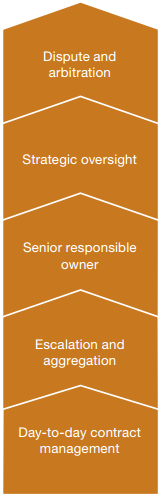
3.3 There are 5 levels at which departments need to govern contract management. Individuals' accountabilities and authority to make decisions need to be clear at each level. Departments and the Cabinet Office are improving governance at all 5 levels (Figure 9 overleaf):
• Day-to-day contract management
Departments are reviewing their contract management processes to improve governance. The Department for Work & Pensions (DWP) commissioned an external review to identify good practice in its contract management and improve consistency. The Ministry of Defence has commissioned reviews of contract management in contracts not covered by the cross-government review.
• Senior responsible owners
Departments have recognised they must assign every major contract a senior responsible owner (SRO). The Department of Health is reviewing its data to make sure ownership information is up to date. It is also strengthening its guidance for SROs.
• Escalation routes
There need to be ways of those managing the contract day-to-day to escalate issues to SROs. There has sometimes been too wide a gap between an SRO and the day-to-day manager, meaning that issues are not escalated. The DWP is improving escalation routes by ensuring that all contracts have SROs within the most suitable procurement categories. For example, all facilities management contracts' SROs will report to the head of estates.
• Strategic oversight
Commercial directors will be made responsible for contract management as well as procurement. Many departments are also strengthening senior groups responsible for strategic oversight. For example, the Ministry of Justice has established a new commercial and contract governance committee, which has a wider remit and greater seniority than its previous procurement board. Departments are also starting forums to share lessons at working-level with other departments that share common contractors and sometimes have shared the results with crown representatives.
• Dispute resolution and arbitration
The Crown Commercial Service (CCS) complex transactions team has started to provide central support to departments with contractual disputes. The team supports departments, at their request, with contractual disputes and complex contract issues. For instance, it recently supported the DWP to close Atos's medical assessment contract for the Employment Support Allowance.
3.4 Departments are generally taking a risk-based approach to governance and so less attention has been given to smaller, less risky contracts. Departments will need to ensure that improved governance is rolled out to these proportionately.
Figure 9 Five levels of governance over contract management Features of good governance | |
| • Crown representative appointed for key suppliers • Appropriate use of arbitration, mediation and negotiation with expert support, such as the Crown Commercial Service's complex transaction team |
• Board-level champion for key contracts • Senior management forum to discuss supplier relationships, overall strategy, issues across multiple contracts or at a service- rather than contract-level, continuous improvement of contracts with good performance | |
• Ensuring each contract has a senior responsible owner with appropriate seniority to negotiate • Regular contact with supplier even on non-problematic contracts • Accountable to senior management forum | |
• Clear procedures for escalation of problems • Clear delegation of authority • Aggregation of performance data for senior scrutiny | |
• Using open book access, real-time data, site visits, co-location of staff with the supplier to ensure good visibility of performance • Contact point for end-user feedback | |
Source: National Audit Office | |