Increasing transparency and assurance
3.17 Government must create a situation where it can rely on contractors to deliver, even when it is not deploying its best contract managers to oversee them. This requires the contractor to take greater responsibility for the accuracy of the data it supplies, and for providing a control environment which will maintain ethical behaviour and public service standards. We believe government should get written representation from contractors on the integrity of the services they supply. Senior managers would sign statements which, while not necessarily carrying additional legal implications, would have symbolic and reputational importance, and give Parliament clear accountability.
3.18 Ensuring contractors live up this responsibility requires better transparency and assurance to ensure controls are working. The cross-government review highlighted the extent of reliance on supplier performance data, while our work on the NHS out-of-hours GP services in Cornwall showed how performance data can be manipulated.42
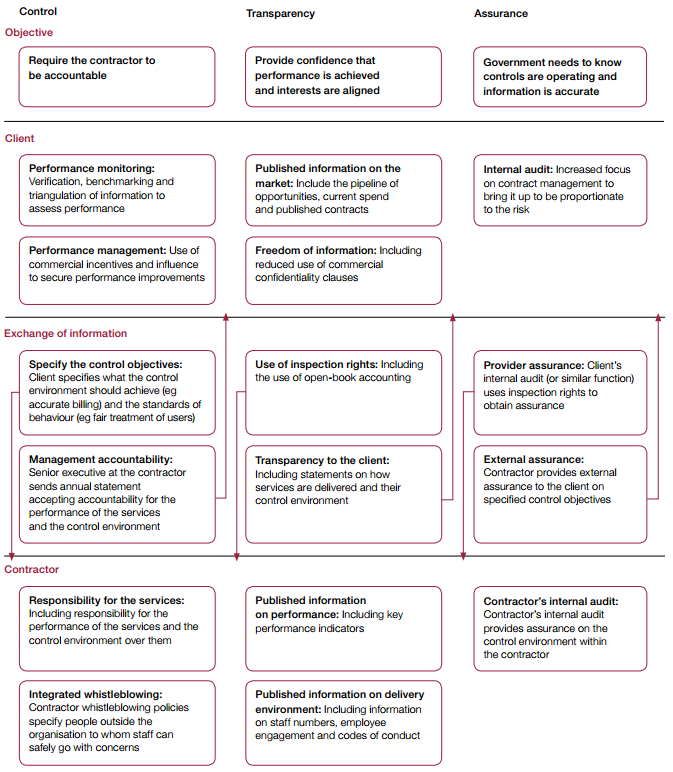
3.19 There is a growing consensus about the need to improve transparency over government contracting. The Committee of Public Accounts report of March 2014, the Confederation of British Industry (CBI) and the government have all called for improved transparency. The Cabinet Office and the CBI have started discussions about what this means in practice.43 However, government has not set a vision for how control, transparency and assurance will be integrated as a system. The Cabinet Office has said that this is the responsibility of departments,44 while we view it as a central responsibility. A stronger system (Figure 12) would require:
• Monitoring and control
The means to understand and manage contractor performance and value for money. Government should set clear standards and objectives for its contractors.
• Transparency
The ability to see through the contractor's organisation, performance and costs; and the knowledge that others can raise issues on your behalf.
• Assurance
Reason to be confident of the supplier's controls; and know that services provided meet the required standards.
3.20 Meanwhile, departments are to improve assurance on contractor data:
• Strengthening internal audit
The cross-government review recommended increasing internal audit focus on contract management and several departments have started to do so. For example, the Ministry of Justice will increase its contract management work from 3% to 15% of the total. Eight departments share a cross-departmental internal audit service, which plans to spend nearly 10% of its audit time on commercial issues in 2014-15.
• Some departments are requiring contractors to provide assurance
The Department for Work & Pensions will require major contractors to commission external reviews to give independent assurance on performance and on the control environment of the contractor. Government also needs to require transparency to the public. Although it is improving its Contracts Finder database (paragraph 3.6), this only covers contracts at the point they are signed. It does not include performance information or subsequent changes to contract terms.
| Figure 12 A model of an integrated system of control, transparency and assurance
Source: National Audit Office |
________________________________________________________________________________________
42 Comptroller and Auditor General, Memorandum on the provision of the out-of-hours GP service in Cornwall, Session 2012-13, HC 1016, National Audit Office, September 2013.
43 Available at: www.gov.uk/government/news/government-and-cbi-meet-with-industry-to-discuss-improvements-in-contracting-for-public-services, 2 May 2014.
44 HM Treasury, Treasury Minutes: government responses on reports from the Committee of Public Accounts, Cm 8871, June 2014.