CCS has helped its customers save money
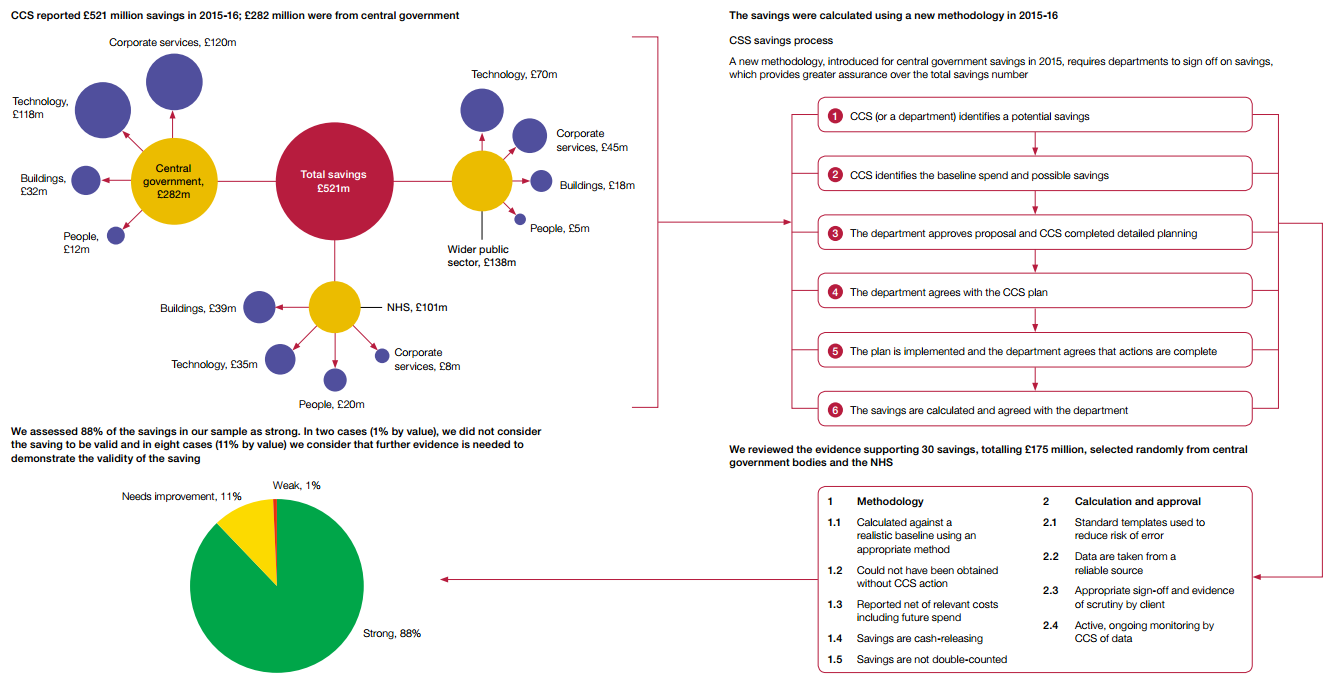
2.4 CCS reported that in 2015-16 it had helped customers to make demand and cost savings of £521 million on common goods and services (Figure 11 on pages 34 and 35). The savings consisted of £282 million for central government, £101 million for NHS bodies and £138 million for other wider public sector bodies. The main categories were:
• £311 million (60%) from purchases using CCS frameworks - for example, by using the CCS Media Buying Framework the Department of Health saved an estimated £6 million; and
• £206 million from direct procurement and other CCS services, made up of £114 million (22%) from reducing the amount of goods and services purchased - for example, CCS helped the Ministry of Defence reduce its use of pool and rented commercial vehicles, saving an estimated £6.2 million; and £92 million (18%) from helping departments to negotiate with suppliers - for example, CCS helped Ofsted to negotiate software licences, reducing the suppliers' demands by £17 million.
Figure 10 |
CCS delivers more services to customers in central government
Central government departments have access to more services than the wider public sector. Wider public sector organisations make use of frameworks, policy guidance, and customer relationship management.
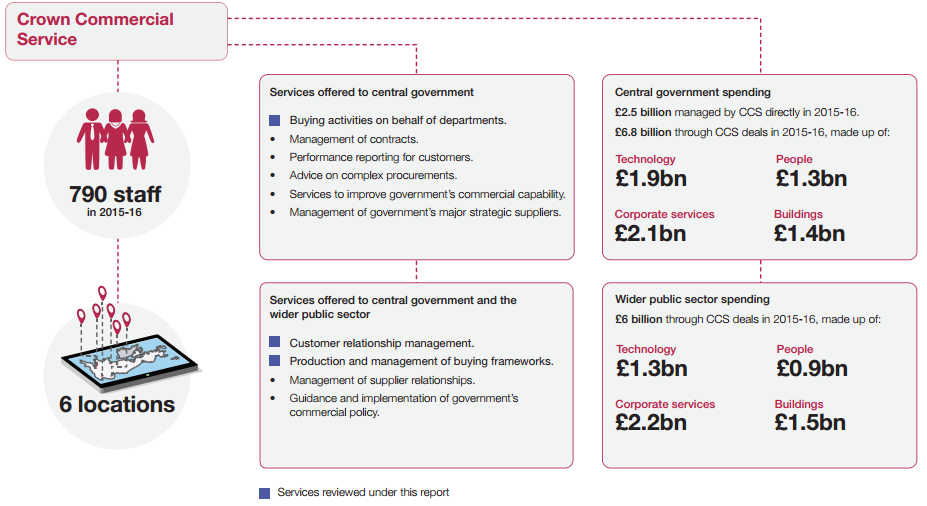
Notes
1 Rounding means spend through CCS deals do not match totals.
Source: Crown Commercial Service |
Figure 11 |
Savings reported by CCS in 2015-16 are well-evidenced
Source: Crown Commercial Service and National Audit Office |
2.5 The £282 million savings reported for central government were calculated using an improved process that CCS introduced for 2015-16. The process requires CCS and departments to work together to identify possible savings. It helps them to identify reliable data on baseline expenditure, which allows them to calculate subsequent changes in spending. The process also requires customer departments to review and sign off the savings at an appropriately senior level. The savings CCS reported in 2015-16 were substantially lower than the savings reported in 2014-15, when CCS estimated savings against a 2009-10 baseline.8
2.6 To evaluate the 2015-16 savings, we examined a random sample of 30 savings, totalling £175 million from central government bodies and the NHS. We assessed 88% of the savings in our sample as strong (Figure 11). This is a clear improvement on previous assessments. We have previously found that some savings reported by government departments are not always supported by sufficient evidence or calculated appropriately. For example, in 2013-14 we assessed the savings reported by CCS's predecessor could be improved in some categories as there was insufficient supporting evidence and they may not represent genuine saving.9
2.7 While this new savings methodology is an improvement on previous methods, and we have assessed 88% of our sample as strong, it has its limitations. Determining the savings from a centralised procurement service is not straightforward. It can be difficult to clearly attribute savings to CCS or departments and it is often not possible to predict what would have happened if CCS had not been involved.10 For example, departments might have taken action to secure the savings being reported. In addition, CCS does not routinely track prices and volumes for all goods and services in its portfolio. Savings may therefore be overstated as CCS only measures the areas that are believed to show efficiencies. Rises in prices or demand in other areas may not be recorded. Finally, due to the number of organisations involved, savings reported for the wider public sector and NHS are not agreed with the body and are therefore not as well-documented.
________________________________________________________________________________
8 In 2013 NAO reviewed this methodology. Comptroller and Auditor General, Improving government procurement, Session 2012-13, HC 996, National Audit Office, February 2013.
9 Comptroller and Auditor General, The 2013-14 savings reported by the efficiency and reform group, Session 2014-15, HC 422, National Audit Office, July 2014.
10 During our review, we were informed that a saving of £10.2 million, which was attributed to CCS, was generated by a department without assistance from CCS. This amount was not in our sample.