Customer satisfaction
2.8 CCS surveys its customers every quarter, to assess how likely they are to recommend CCS to colleagues.11 Customers' individual ratings are then used to produce an overall score, which can be negative or positive. A negative score indicates that, typically, customers would not recommend CCS, and a positive score means that, typically, customers would recommend CCS. This survey is sent to customers from central government departments and the wider public sector. It aims to assess overall customer satisfaction, not how satisfied customers are with the various roles CCS performs.
2.9 In 2015-16, CCS had a score of -27% (Figure 12). Central government customers have been consistently less positive towards CCS than other customers. Our analysis suggests that this is because of the failed transition programme, service issues and failures, and CCS's inability to meet the expectations set by the ambitious business plan. Since the end of 2015 both central government departments and the wider public sector have become more positive towards CCS. In the first quarter of 2016 wider public sector customers became more likely to recommend CCS.
2.10 CCS calculates its overall satisfaction score using a methodology that gives greater weight to the scores of customers who are negative towards CCS. This methodology disregards customers who are neutral or mildly positive about CCS. We analysed the survey responses from 2015-16 and found that just over one in three customers were either neutral, dissatisfied, or very dissatisfied with CCS overall, and six out of 10 customers were either satisfied or very satisfied with CCS overall.
| Figure 12 |
Satisfaction of customers in central government and wider public sector
In 2015-16 central government customers are substantially less satisfied than wider public sector customers
Net proportion of customers prepared to recommend CCS (%)
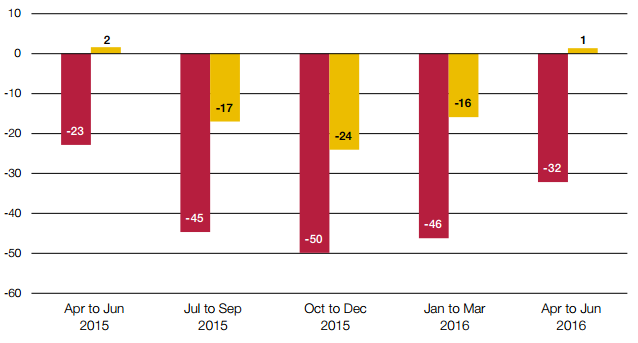
 Central government departments
 Wider public sector
| Source: Crown Commercial Service |
2.11 We conducted our own survey with departments to better understand customer satisfaction and to test the gradual improvement that can be seen in Figure 12. Despite the negative scores in CCS's own survey, 11 out of the 15 departments we interviewed agreed that CCS currently adds value to their department. Departments praised the knowledge and skills of individual CCS staff and told us that they see the value in centralising the buying of common goods and services to reduce government costs. Departments said that CCS's frameworks cover a wide range of common goods and services. However, they highlighted problems with several specific agreements. For example, we previously reported on the use of consultants and temporary staff in central government. We found that departments appoint only about half of their consultancy and temporary staff through CCS's Consultancy One and Contingent Labour One frameworks. Departments reported that these frameworks generated limited competition for both consultancy and temporary staff assignments.
2.12 However, 11 out of the 15 departments also agreed that CCS could add more value. In particular, departments thought that CCS could improve the way it manages frameworks.12 They felt that CCS had frequently extended frameworks beyond their original expiry date, and might be at risk of not getting the best deal on the market. Departments also expressed concerns about the inconsistency of the service and the lack of communication.
2.13 Based on the feedback from CCS's survey and feedback from departments to us in interviews, we decided to further analyse CCS's performance in its:
• framework deals;
• internal processes and control environment; and
• standard service offering.
________________________________________________________________________________
11 CCS uses the Net Promoter Score as a proxy measure for customer satisfaction. This method groups promoters (people who are very likely to recommend CCS) and detractors (people who are not likely to promote CCS) and calculates a composite score. The Net Promotor Score is weighted towards negative scores because of the disproportionate impact that dissatisfied customers can have on a business's reputation.
12 The 11 out of 15 departments in paragraph 2.11 are different from the 11 out of 15 departments in paragraph 2.12.