CCS's internal processes
2.15 Part One described CCS's difficult launch, which required it to set up service improvement plans for two departments that had transferred their spending to CCS. In 2016 departments told us that the weaknesses have not yet been resolved. Departments said that the quality of services remains inconsistent and depends on individual staff. CCS also acknowledged that service delivery has not always been in line with service agreements. To further analyse the causes of service failures, we held in-depth interviews with three departments that transferred their spending to CCS. We also reviewed the agreements between CCS and departments and considered roles and responsibilities, internal audit reports and CCS's board minutes.
2.16 We would expect good process management to include a strong focus on customers, effective leadership and management, an end-to-end view of the process and using information to improve systems and processes.15
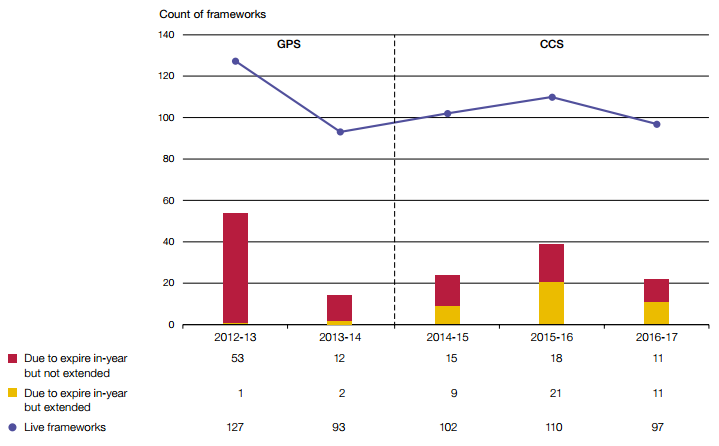
Figure 13 |
Trends in extensions of CCS procurement frameworks
Up to 2016, CCS increasingly extended its frameworks
Note
1 Data for 2016-17 are the frameworks which were live or due to expire between 1 April 2016 and 31 July 2016.
Source: National Audit Office analysis of Crown Commercial Service data |
2.17 Our work in summer 2016 found that CCS's management of its services has not supported consistent quality and value for money:
• Customer focus and effective communication: Our review was consistent with CCS's customer survey data (Figure 12). We found that CCS does not consistently listen and respond to customers' needs. Examples include CCS repeatedly advising a department to use a framework designed for purchasing estate services when the customer was purchasing consultancy services, and CCS not including departmental requirements when it created a new purchasing framework and then failing to discuss this with the department.
• Departments have said that communication from CCS is often poor and that this can lead them to doubt CCS's capability to deliver quality services. Departments told us that initially CCS did not provide regular performance reports. They also said that they do not receive enough information about new procurement framework requirements. CCS is working to improve how it communicates with customers. In 2016 it implemented an executive sponsorship scheme for central government customers. This scheme means that each department has a named member of the CCS senior management team who liaises directly with them. CCS also regularly publishes customer updates and newsletters for its customers outside of central government.
• Management and leadership environment: We found that CCS's leadership and management have consistently aimed to deliver high-quality services and have wanted to create an environment where CCS staff can perform well. However, CCS has experienced significant turnover in its senior management and has changed its organisation structure and reporting arrangements. Elsewhere in this report, we note that these changes may have improved CCS's overall capability. However, these changes have meant that CCS staff have not had a consistent or stable environment to perform well in.
• End-to-end perspective: CCS has recently put in place standard operating procedures that set out how it carries out many of its own key processes. However, these procedures focus on CCS's performance and do not describe how CCS and departments work together to manage the end-to-end procurement process. This is important because procurement activity starts and finishes in departments. If a procurement process is not understood and managed from end to end, this can lead to work being repeated and time lost. When procurement is managed from end to end it can lead to significant cost savings (Figure 14 overleaf).
• Using information: CCS is not systematically giving departments the information they need to understand the service they are getting or where improvements can be made.
Figure 14 |
Understanding and managing procurement from end to end helps to reduce costs
Procurement of mini-buses for users with special needs
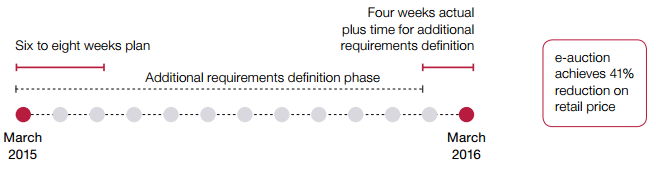
Context | The Department for Transport (the Department) had a ministerial-level priority to increase community transport for people with identified needs (eg elderly, rural, people with disability). To support this, the Department set out to procure mini-buses for users with special needs. Funding of £25 million was allocated in early 2015. |
Initial commitment | Following discussions between Crown Commercial Services (CCS) and the Department, CCS initially stated that a procurement could be completed in six to eight weeks using framework RM1070. |
Actual performance | The procurement took around one year to complete. The Department's requirements were not fully developed. Following intervention by the Department's commercial directorate, a new phase was added to the procurement to further develop the requirements. Ministerial priority to support community transport - £25 million allocation
|
Stakeholder view | The Department reports that, once the requirements were defined and procurement commenced, the CCS process ran smoothly and achieved a significant reduction against the recommended retail price, using an e-auction procedure. The Department reports that CCS recommended the use of e-auction, which was central to achieving the cost savings. |
Lessons | CCS did not effectively assess the quality or completeness of the customer input, leaving it exposed to time overruns. CCS and the Department initially treated the procurement as a simple transaction. As they both moved to an end-to-end perspective and worked collaboratively, they achieved significant success and cost savings. |
Source: National Audit Office |
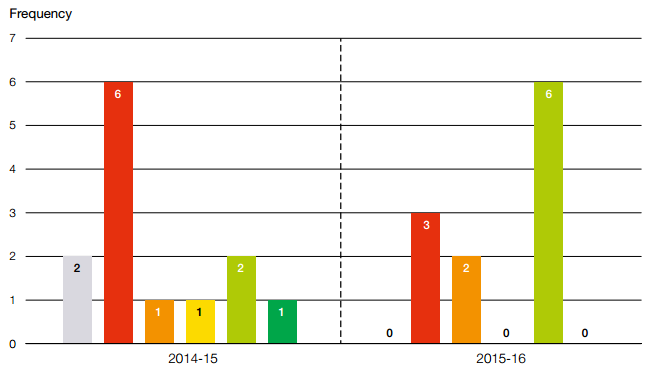
2.18 CCS's internal audit conducted 11 reviews of CCS's governance, risk management and control arrangements in 2015-16. It reported limited assurance for three reviews, limited to moderate assurance for two reviews and moderate assurance for the remaining six reviews (Figure 15). The limited assurances relate to business planning and control over operations. It concluded that for the 2015-16 year, there were significant weaknesses in the framework of governance, risk management and control. In 2014-15, CCS's internal audit conducted 13 reviews. They reported moderate or better assurance levels in only three of these reviews. They found weaknesses in stakeholder engagement, market and business intelligence, and supplier and contract management. More recently, through our external audit engagement, we have found clear improvement in CCS's governance, risk and control environments.
Figure 15 |
Some CCS governance, risk and control processes are limited
Internal audit findings 2014-15 and 2015-16
 Unsatisfactory
 Limited
 Limited-moderate
 Unsatisfactory-moderate
 Moderate
 Substantial
Source: Crown Commercial Service |
__________________________________________________________________________________
15 National Audit Office, Managing business operations what government needs to get right, September 2015.