The public sector has not had a good track record in project delivery
1.5 Given the likely scale and value of government projects undertaken at any one time, delivering projects successfully is key to achieving value for money. However, in the past the public sector has not had a good track record in doing this. We have reported frequently on projects not being delivered on time, going over budget or not achieving their intended outcomes.
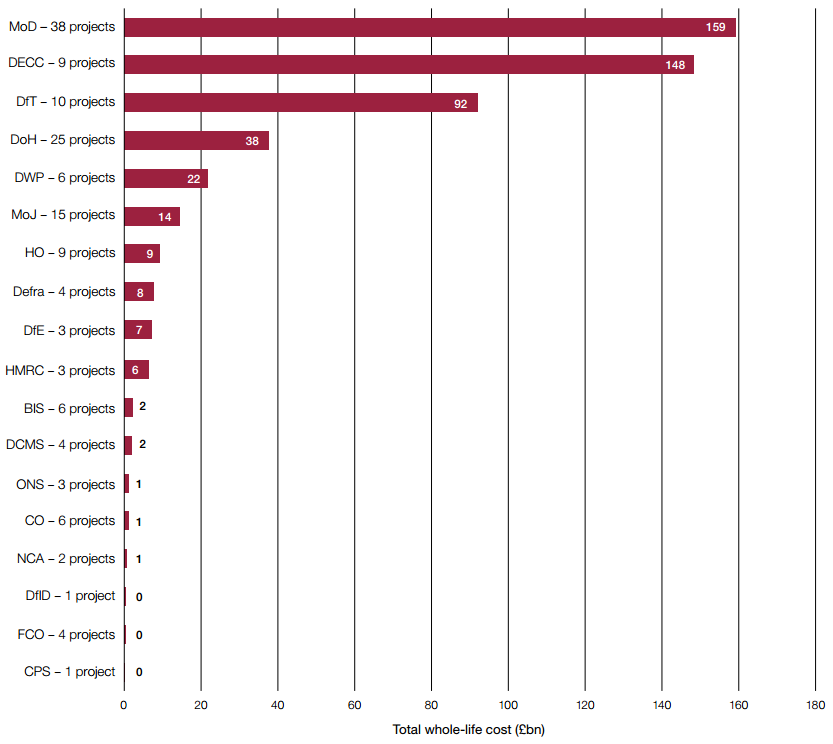
Figure 2 Total whole-life cost of projects in the Portfolio by department (June 2015) The Ministry of Defence, Department of Energy & Climate Change, and Department for Transport accounted for most of the total whole-life cost of the Portfolio
Note 1 MoD = Ministry of Defence; DECC = Department of Energy & Climate Change; DfT = Department for Transport; DoH = Department of Health; DWP = Department for Work & Pensions; MoJ = Ministry of Justice; HO = Home Office; Defra = Department for Environment, Food & Rural Affairs; DfE = Department for Education; HMRC = HM Revenue & Customs; BIS = Department for Business, Innovation & Skills; DCMS = Department for Culture, Media & Sport; ONS = Office for National Statistics; CO = Cabinet Office; NCA = National Crime Agency; DFID = Department for International Development; FCO = Foreign & Commonwealth Office; CPS = Crown Prosecution Service. Source: June 2015 departmental data provided to the Major Projects Authority |
1.6 In the previous Parliament we published 56 reports on government projects. We found that progress had been made in some areas: for example, our reports on the Defence Equipment Plan and Major Projects show that in-year costs have stabilised, and our report on major rail programmes showed that the Department for Transport has learned lessons from these programmes. Some underlying issues remain, which prevent more general improvement across government:
• Measuring costs and benefits - departments often could not track costs and benefits or measure the impact of their projects.
• Early planning - projects did not appraise options against realistic alternatives, made unrealistic performance projections, and could have used piloting and testing more effectively. For example, the Better Care Fund was a challenging initiative that ministers paused and redesigned after the early planning and preparations did not match the scale of its ambition.
• Portfolio management - departments did not have integrated strategies to give them a clearer view of the interdependencies between projects and how to prioritise them. For example, the Committee of Public Accounts found that the value for money of new train procurements was undermined by lack of certainty at the start of the procurement process. As a result, it asked the Department for Transport to develop an integrated strategy covering infrastructure, rolling stock and franchising. The Committee looked for HM Treasury to take ownership and responsibility for overseeing the Portfolio, and ensure that decisions about whether, and how, an individual project should proceed would be based on the project's impact on the Portfolio's value and risk, and the relevant department's delivery capability and existing portfolio of projects.
• Capability - our 2011 report on central government's skills requirements identified very significant shortages in project and programme management skills. Since then, we have found that some of the departments with the largest portfolios have gaps in commercial and digital expertise and senior project leadership, and rely on contractors to fill these gaps.
• Accountability - projects sometimes lacked a senior responsible owner with beginning-to-end responsibility for the projects. The senior responsible owner was sometimes responsible for a range of different projects, and did not always have full responsibility for delivering the project within an agreed budget, or the authority to direct those involved in delivering the project.2
__________________________________________________________________________________
2 See Appendix Three.