Many government bodies play a role in project delivery
No one organisation has a view of the whole portfolio of government projects
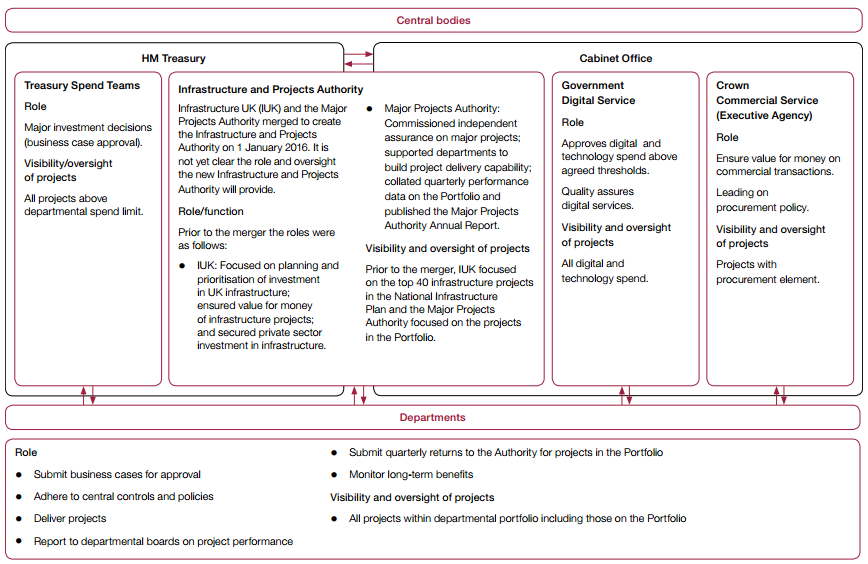
1.8 Departments have a number of responsibilities for approving, assuring and seeking improvements in the delivery of major projects. For example:
• Above certain limits, departments need to get approval from HM Treasury to proceed with projects. The limits are specific to each department and range between £5 million and £600 million for the main government departments.
• For the highest-profile projects (typically, those costing more than £1 billion), HM Treasury and the Authority jointly run the Major Projects Review Group to advise ministers on funding decisions.
• The Government Digital Service and the Crown Commercial Service promote policies in their areas of expertise, advise on specific aspects of projects and in some cases approve spending (Figure 4 on page 17).
1.9 The scale and complexity of the projects that the government undertakes mean their implementation often cuts across departmental boundaries; they also raise issues about capacity and capability. The Committee of Public Accounts therefore looked to HM Treasury to take responsibility for overseeing the Portfolio to ensure that decisions about whether, and how, individual projects should proceed were based on their impact on the total Portfolio's value and risk, the relevant department's delivery capability and its existing portfolio of projects.3 The government accepted this recommendation in 2014 and has worked with departments to improve their portfolio management.
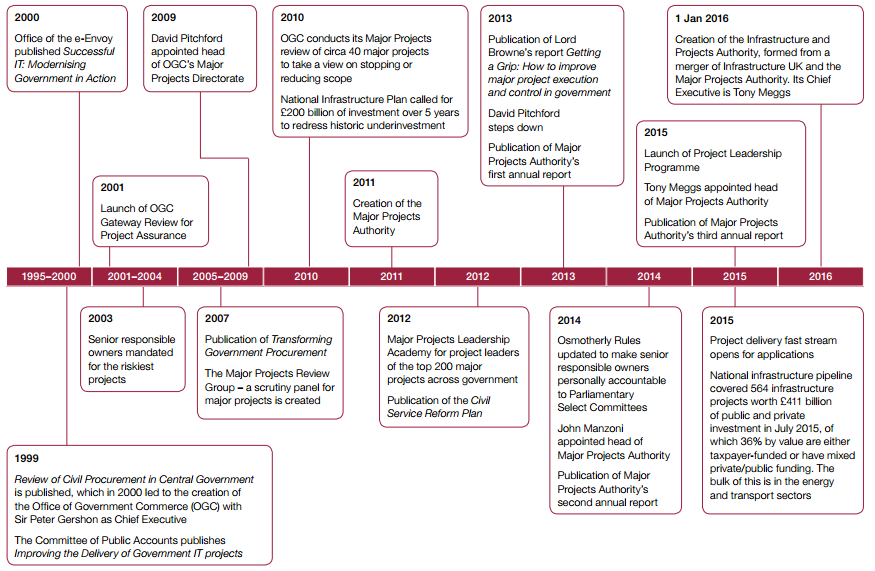
| Figure 3 Timeline of developments to improve government project delivery
Source: National Audit Office review of government announcements, policy documentation and other public documents |
| Figure 4 Several different central bodies are involved in improving the performance of major projects but none has a central overview
Source: National Audit Office review of publicly available information and information from interviews |
1.10 There is still a lack of central oversight around prioritisation between departments. Spending Reviews are the main mechanism through which funds are allocated and prioritised between departments, but we found in 2012 that the system was less effective at supporting informed prioritisation and that mechanisms to compare the value of spending between departments were weak.4 While the National Infrastructure Commission will recommend future priorities for infrastructure, there will still be a gap in relation to service delivery projects.
_______________________________________________________________
3 See Appendix Three.
4 See Appendix Three.