Steps have been taken to improve capability but there are barriers
3.1 When it was first formed, one of the Major Projects Authority's (the Authority; now the Infrastructure and Projects Authority) main roles was to improve the capability of project leaders. It introduced the Major Projects Leadership Academy to build the skills of senior leaders to deliver complex projects. The Civil Service Reform Plan (2012) set a target for the senior responsible owner and project director of all projects in the Government Major Projects Portfolio (the Portfolio) to commence training at the Major Projects Leadership Academy or have equivalent qualifications or experience by December 2014.
3.2 The Authority launched the Project Leadership Programme in June 2015 for project leads working on projects that fall just outside the Portfolio. It is facilitating a new civil service fast stream for project delivery professionals and a number of fast-track apprenticeships. We have also seen evidence of the Authority intervening directly to support 14 projects. This includes identifying experts to join the project team, and recruiting interim senior responsible owners and project directors for 6- to 9-month periods where departments are unable to recruit the right individual quickly for a permanent position.
3.3 Departments are also undertaking a range of activities to develop capability:
• Each department has appointed a head of profession for project delivery although most are not full-time in this role.
• Departments are issuing internal guidance and delivering a variety of training events to improve project delivery capability. For example, HM Revenue & Customs runs a Programme Delivery Leadership Academy that is offered across government at a cost of £6,000 per participant; the Department for Communities and Local Government offers, among other courses, an introduction to project and programme management aimed at policy professionals; the Department for Business, Innovation & Skills told us it is offering commercial skills training to around 200 staff; and the Department of Energy & Climate Change has a programme of capability-building events including courses on business cases, benefits management and risk management.
• Civil Service Learning now has a project delivery curriculum.
• Departments have established project delivery communities and are starting to conduct skills assessments within these. In the run-up to the Spending Review, they were not yet able to quantify the project delivery skills they would need for the future.
3.4 Despite this work, departments and the Authority told us there were still a number of barriers to progress.
• There is no formalised competency framework in project delivery yet. Clearly defined roles and competencies would allow more transferability of project delivery professionals across departments and the civil service.
• Attracting talent from the private sector is still a challenge as remuneration is typically lower in the civil service.
• Departments are not resourced for this activity - for instance, heads of profession typically have full-time leadership roles on specific projects.
• There are shortages of skills in specific areas needed to deliver the complex infrastructure and transformational change projects now in departments' portfolios such as digital, legal, analytical, risk management and behaviour change skills.
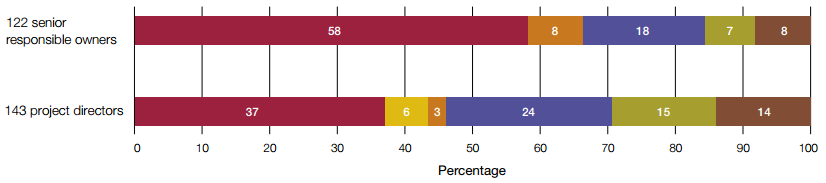
3.5 At 1 October 2015, 380 project leaders had been enrolled in the Major Projects Leadership Academy and 161 of these had graduated. A further 197 project leaders working on projects just outside the Portfolio had enrolled in the Project Leadership Programme. We examined whether the senior responsible owners and project directors of the Portfolio projects as at June 2015 were attending the two programmes, and found that most had been enrolled or were committed to attending, or had equivalent experience (Figure 11).
3.6 Around a quarter of senior responsible owners and project directors will not attend the Major Projects Leadership Academy or Project Leadership Programme. This group includes contractors, those who are leaving the role shortly and those with limited capacity to attend. There is sufficient capacity on the programmes to meet the Civil Service Reform Plan target, but the high level of change in the Portfolio (paragraph 2.8) means it is likely that there will be a continuing need to train new project leaders to maintain this position.
Figure 11 Senior responsible owners and project directors of the Portfolio's projects in June 2015 and their attendance at the Major Projects Leadership Academy and Project Leadership Programme Most senior responsible owners and project directors had been enrolled or were committed to attending the two programmes, or had equivalent experience
| |
| Attending Major Project Leadership Academy |
| Attending Project Leadership Programme |
| Have the equivalent experience and does not need to attend Major Project Leadership Academy or Project Leadership Programme |
| Will not attend the Major Project Leadership Academy or Project Leadership Programme |
| Eligible, awaiting sign-up to Major Project Leadership Academy or Project Leadership Programme |
| Other |
Notes 1 Senior responsible owners 'other' includes: 3 where it is still to be determined whether they will attend the Major Projects Leadership Academy; 1 participated for selected modules in the Major Projects Leadership Academy; 1 programme has no senior responsible owner as it has been completed; and 3 are not known. 2 Project directors 'other' includes: 17 where the status is not known; 1 project lead was being recruited; 1 project was awaiting organisational restructure; 1 had not applied at this time. 3 Figures do not sum due to rounding. Source: National Audit Office analysis of departmental data provided to the Major Projects Authority | |


3.7 The cost of the Major Projects Leadership Academy is £30,000 per participant - a total cost of £11 million to September 2015. The cost of the Project Leadership Programme is significantly lower at £8,600 per student (£1.3 million to September 2015). The Authority has told us that this reflects differences in the duration of the respective programmes. Feedback from the Academy participants we interviewed is largely positive: they cited wider benefits of attendance including mentoring, participation in assurance reviews, running learning events, establishing networks across government for sharing best practice and talking a common language, and movement of project leaders between departments. Evaluating a return on investment is difficult but the Academy asks participants to complete an assignment reporting on the impact it has had on their project. As well as improvements in leadership and their ability to deal with external stakeholders, some have cited substantial improvements in the financial position of their project.
3.8 The Authority runs events for Major Projects Leadership Academy graduates but does not have up-to-date information on the whereabouts of every graduate. However, departments have told us that numbers of Major Projects Leadership Academy graduates leaving the civil service is very low. The Ministry of Defence, which has more attendees on the Major Projects Leadership Academy than any other department, has retained the majority of its attendees and graduates. Of the 76 attendees who enrolled while in the Ministry of Defence, 7 have left the Department, 4 have transferred to other government departments and 3 no longer work in government. Of the remaining 69, all but 2 work in a leadership position in the department that will influence significant projects or programmes. For other departments that provided information, 1 of the Department of Energy & Climate Change's 13 graduates, 1 of the Department for Work & Pensions' 26 graduates and none of the Ministry of Justice's 14 graduates have since left the civil service.