Standards
4.7 One major role of GDS over the last five years has been in establishing common standards across government for digital services and technology. GDS has developed two sets of principles to guide a consistent approach to standards:
• The Digital Service Standard describes principles for building digital services. GDS has assessed services against the standard since April 2014. Services with more than 100,000 transactions annually are assessed at three stages in their development before being accepted on to the GOV.UK website as a live service.
• The Technology Code of Practice sets out broad principles for how departments should develop their technology architecture to make sure that what they do is sharable, easy to maintain, based on users' needs and not reliant on a single external supplier. It was first introduced in 2013.
_________________________________________________________________________________________________
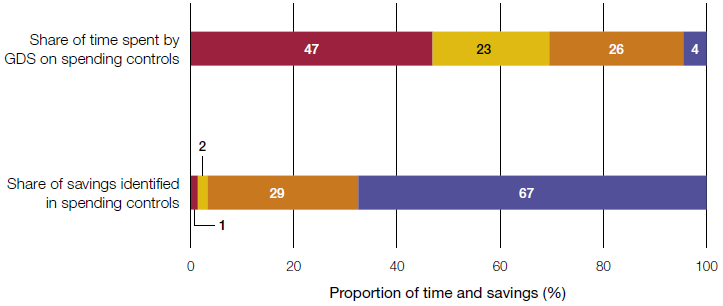
Figure 11
Comparison of time spent on spending controls and source of financial savings by request size
Smaller applications - many relating to digital projects - take up nearly half of the GDS spending controls team's time but most financial savings result from review of larger applications
|
| Less than £1 million |
|
| £1 to £5 million |
|
| £5 to £50 million |
|
| £50 million or more |


Notes
1 Share of time spent by GDS's spending controls team on spending controls by size of request is based on GDS records of spending approval requests received between April 2014 and October 2016.
2 Share of savings identified in spending controls is based on spending approval requests for which savings were claimed in the 2015-16 financial year.
3 Spending applications are reviewed by a team of eight people within GDS's Standards Assurance team.
4. Categories within bars may not sum to 100 due to rounding.
Source: National Audit Office analysis of Government Digital Service data
_________________________________________________________________________________________________
4.8 The use of common standards (enforced by spending controls) has helped to ensure greater consistency between services. Between April 2014 and December 2016, GDS completed 283 assessments under the Digital Service Standard and departments achieved a 66% pass rate.
4.9 However, the application of standards has raised several concerns:
• Uncertain interpretation
In our interviews with departments, they noted that it can be hard to anticipate how GDS would interpret their performance against the standards, given the broad nature of the principles and lack of detailed guidance.
• Lack of clear framework for technology
The Technology Code of Practice is not supported by a comprehensive framework that both explains what government technology should look like and gives detailed guidance on how departments should implement technology change (Figure 12).
• Overlapping guidance and version control
The technical guidance that is available does not have a rigorous structure or version control, which makes it less accessible and risks it being seen as less credible. For example, guidance on application programming interfaces - which allow computers to talk to one another - can be found in the Government Service Manual, briefly in the Technology Code of Practice (under the principle of making things interoperable) and in at least 11 blogs since 2012. Our review of the GDS webpages found that some guidance had been removed and links broken within technology blogs.
4.10 In May 2016, GDS established a new technology policy team to oversee the code of practice, and develop supporting guidance and monitor how it is implemented. GDS also aims to strengthen its future technology support to departments through sharing best practice, particularly in replacing existing technology and reusing technology.