Struggling to achieve targets
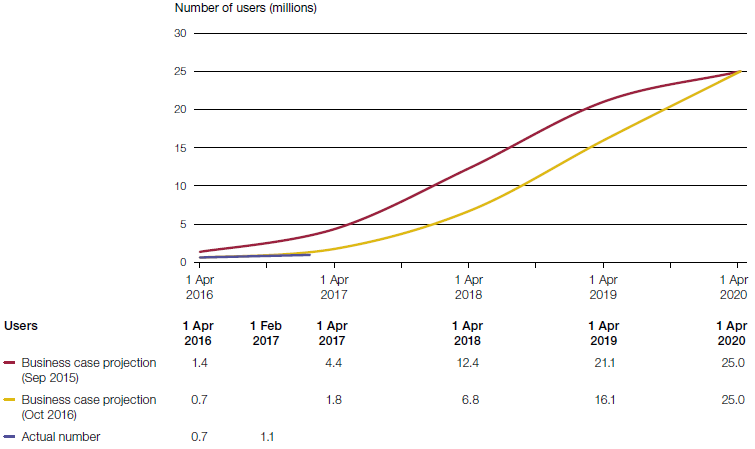
4.23 To achieve the target of 25 million users by April 2020, GDS needs the profile of users to increase at a much sharper rate from April 2019. The September 2015 business case predicted 4.4 million users by the end of March 2017. This projection was reduced to 1.8 million in the October 2016 business case. As of February 2017, Verify had 1.1 million user accounts (Figure 13 overleaf).
_________________________________________________________________________________________________
Figure 13
Projected GOV.UK Verify take-up
Take-up projections in the most recent business case are significantly more backloaded
Note
1 The actual number of users includes 185,000 basic accounts created as part of a trial in July 2015. Basic accounts are unverified and do not allow account holders to access live services.
Source: National Audit Office analysis of Government Digital Service information
_________________________________________________________________________________________________
4.24 Verify has not achieved the volume of users in the central forecast of the business cases, in part due to slower development of digital services across government, and fewer than expected services being ready to adopt Verify as the primary access route. In 2014, GDS expected over 100 departmental services to be using Verify by 2016. In October 2016, GDS predicted that 43 services would be using Verify by April 2018. In February 2017, 12 services were using Verify.30 None of the nine services that were in the pipeline for connecting to Verify during the remainder of 2016 was ready to do so by that date.
4.25 Even services that do use Verify are continuing to use alternative methods to access services online. Of the 12 departmental services connected to Verify as of February 2017, nine also allow access by other means including, for one department, an enhanced version of the existing Government Gateway.
4.26 Reduced take-up means that Verify will need to be centrally funded for longer, and reduces the incentive for the identity providers to lower their prices over time.31 It is not clear how or when GDS will determine whether continuing with Verify will achieve projected benefits.
4.27 The use of multiple routes to accessing services online undermines the business case for Verify. In October 2016, GDS modelled the scenario of no additional HMRC users and found that this would reduce benefits by £78 million over four years leading to a net cost of £40 million.32 It also modelled that failure to achieve sufficient volumes to reduce the commercial costs of the service in 2018-19 could lead to a net cost of £70 million in present value terms over four years. Although GDS has estimated a large positive net present value once indirect benefits and a longer time frame are included, the business case is highly reliant on assumptions about savings in departments, and it is not clear whether these are reasonable.
_______________________________________________
30 Verify Service Dashboard, GOV.UK, available at: www.gov.uk/performance/govuk-verify.
31 GDS pays each identity provider a set fee for each successful confirmation of identity, and recoups a contribution (currently £1.20) from any government body where a verified identity is subsequently used to access a departmental service during the year.
32 GDS included this as a specific scenario in its sensitivity analysis as, at the time, GDS estimated that HMRC would contribute over a third of Verify's users by March 2017.