Legal challenges to the procurement process
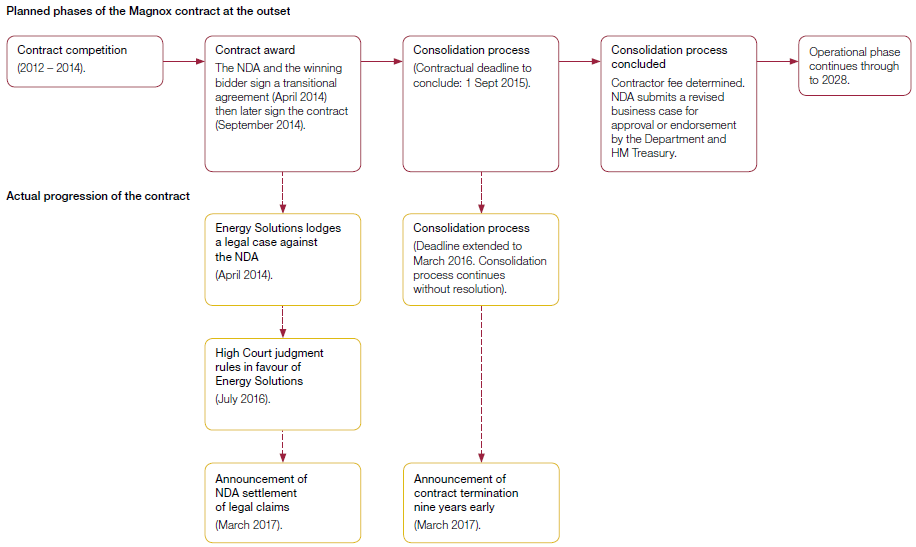
1.8 Energy Solutions (as part of the RSS consortium) wrote to the NDA on 6 April 2014, expressing concerns about the evaluation process. A series of letters between the NDA and Energy Solutions were exchanged during a 14-day 'standstill' period. The standstill period is defined in public procurement law as the period of time after notification of intention to award a contract. Energy Solutions issued a legal claim for damages after the standstill period.3 The claims alleged that the NDA had breached public contracting regulations during the evaluation process. Energy Solutions contended that, had it not been for these breaches, RSS would have been awarded the contract, and that it was therefore entitled to its share of the fees RSS would have earned. Energy Solutions also claimed for other costs such as loss of reputation.
| Figure 5 Planned phases of the Magnox contract and actual events
Source: National Audit Office analysis |
 Planned phases of the Magnox contract
 Actual progress of the contract
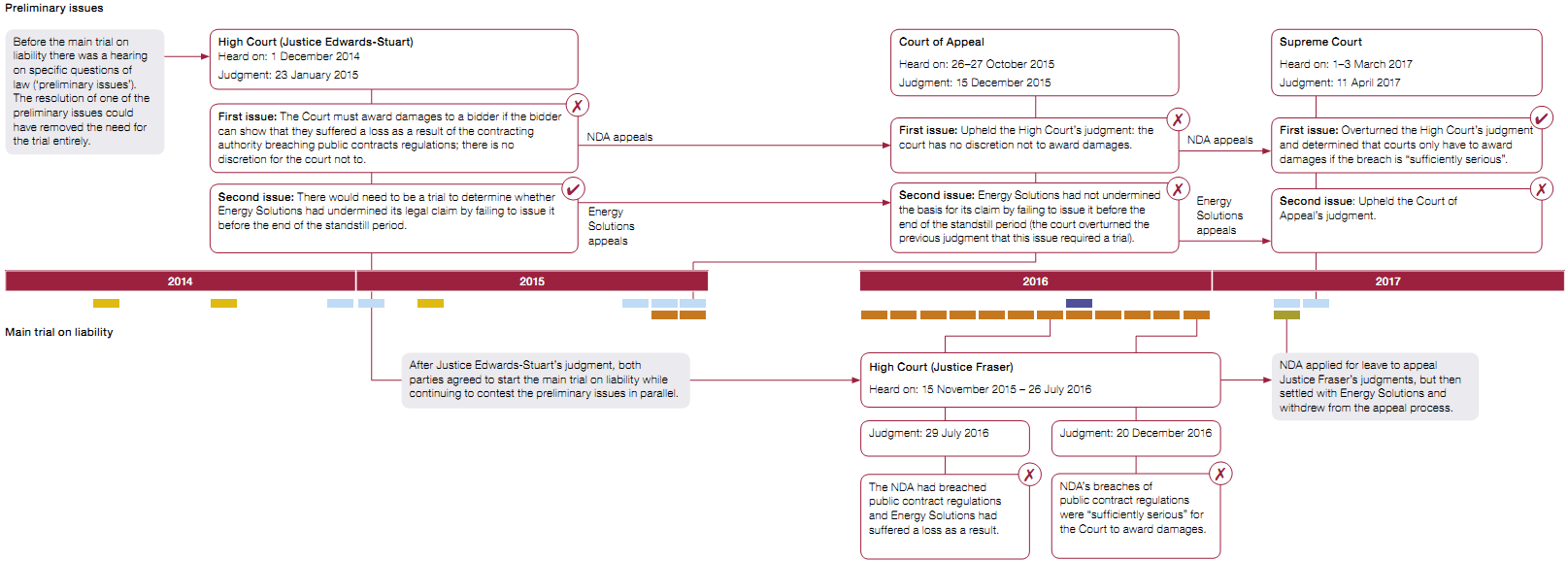
1.9 The NDA recognised the risk of legal claims following the end of the procurement process as early as July 2012. However, NDA executives believed that the evaluation process was robust; after taking ongoing legal advice on its prospects of success and of the associated risks, the NDA decided to defend the claims in court. A series of hearings took place over two and a half years. The Department, UK Government Investments (UKGI) and HM Treasury were kept informed of the progress of litigation through regular reporting (Figure 6 on pages 20 and 21).
1.10 In July 2016 the High Court found that the NDA had wrongly decided the outcome of the procurement process. In summary, the judgment found that:
• the NDA had made manifest errors in the application of its evaluation process;
• had the NDA applied its evaluation criteria correctly, the winning bidder (CFP) would have been excluded from the competition;
• NDA staff were aware that their criteria implied that this bidder should be excluded, but manipulated the evaluation in order to avoid that outcome; and
• the NDA sought to limit the permanent record of what occurred during the evaluation to the absolute minimum of information, contrary to the legal duty of all contracting authorities to act in a transparent way.
1.11 The Court found that the NDA had not correctly applied pass/fail criteria known as 'threshold requirements'. These requirements exclude bidders from the competition for failing to include specific details (such as graphics) in their bid. The Court found that the NDA's evaluation team realised that the effect of applying the threshold criteria would be to exclude CFP from the competition. Therefore, the team manipulated the scores to avoid that outcome. The NDA told us that the evaluators believed they had the discretion to amend the scores lawfully at the time.
1.12 The judgment also criticised the NDA for its approach to record-keeping. It found that the NDA had made no notes of conversations detailing the evaluators' approach to threshold criteria, and that these conversations were pivotal in determining the outcome of the competition. The judge also found that the NDA restricted its record-keeping as it was "acutely aware" of the possibility of unsuccessful bidders challenging the outcome of the competition. NDA officials told us they believed their approach to record-keeping was in line with best practice at the time.
| Figure 6 Summary of the litigation process
Note 1 Points of law have been simplified for the sake of brevity. Source: National Audit Office analysis |
 Claims issued by Energy Solutions
 Claim issued by Bechtel
 Hearings on preliminary issues
 Trial on liability
 Settlement
 Issues lost in court by
  Issues won in court by
______________________________________________________________________________
3 Public contracting regulations stipulate that if a legal claim is issued within the standstill period then the contracting authority cannot enter into the contract until a decision has been made in court. Legal claims issued after the standstill period can only be claims for damages.