Delays in the consolidation process
2.3 By January 2015, CFP had notified the NDA that the degree of change on the sites was much greater than it had been told to expect. By March 2015, CFP had not submitted any change control requests with cost implications, and the NDA's chief executive and NDA Board became aware of the risk that CFP would miss the contractual deadline to complete the consolidation.5 Because of the magnitude and complexity of the changes required, the NDA agreed to extend the deadline for completing consolidation to 31 March 2016, provided that it received all of CFP's change controls by that date. CFP complied with this request, submitting 95 change control requests with cost implications.6 The NDA later estimated the value of these change controls at £1.9 billion. In addition, CFP requested a further £0.3 billion, which was attributed to omissions in CFP's bid. These change control requests were treated differently for the purposes of calculating the fee.
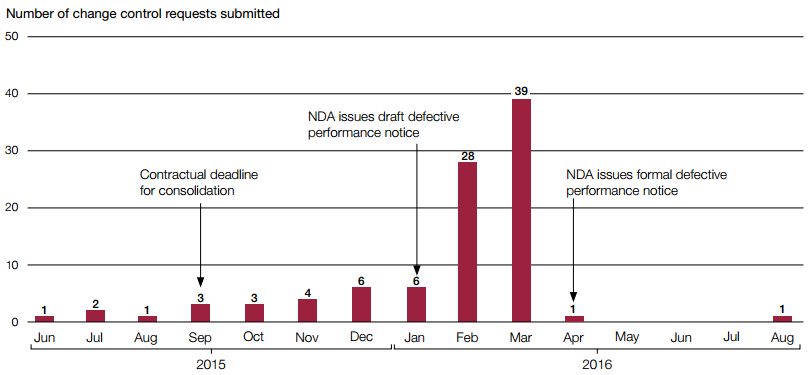
2.4 In April 2016, the NDA formally issued CFP with a defective performance notice (DPN) after sharing a draft version in January 2016. The DPN was the primary measure for dealing with performance issues as set out in the contract. The draft notice cited: a failure to maintain an accurate and complete change control programme; failure to adhere to consolidation timescales and deadlines; change control proposals that did not meet requirements; and a failure to address concerns raised at working level. In a letter dated 27 April 2016, CFP rejected the NDA's premise for issuing a DPN. The number of change controls submitted by CFP increased after the draft DPN was issued, but the consolidation process continued unresolved for more than a year as the NDA and CFP failed to agree on CFP's fee (Figure 8).
2.5 NDA executives then pursued an approach they termed 'conditional approval'. This enabled the NDA to accept all change controls, subject to reaching agreement on outstanding issues such as CFP's contingency estimates. An assurance review commissioned by the NDA in April 2016 advised NDA executives against this approach on the grounds that the contract only allowed for it in a limited way. NDA executives told us they wanted to avoid terminating the contract, which was the only contractual option left at the NDA's disposal, because they believed CFP was making good progress on the sites.
2.6 In June 2016, NDA executives reported to the NDA Board that they had reached an informal agreement with CFP to conclude consolidation through which CFP could resubmit its change controls and come to an agreement on its fee. They advised that some details still needed to be finalised. The NDA subsequently decided not to finalise this agreement after the High Court judgment in July 2016 caused the organisation to reduce its risk appetite. In December 2016, NDA Board minutes noted the risk associated with "reaching an agreement which is not in line with the mechanisms envisaged in the contract" (see paragraph 2.11).
Figure 8 Cavendish Fluor Partnership's (CFP's) progress with submitting change control requests CFP submitted the majority of change controls requests in February and March 2016
Note 1 This figure only shows the change control requests submitted by CFP that had an impact on decommissioning costs and/or fees. Other change controls that did not have cost implications were also submitted. Source: National Audit Office anlaysis of Nuclear Decommissioning Authority data |
______________________________________________________________________________
5 A number of cost-neutral change control requests were submitted before March 2015.
6 Cavendish Fluor Partnership submitted two change control requests after 31 March 2016 with NDA's agreement.