Increases in the cost of the contract
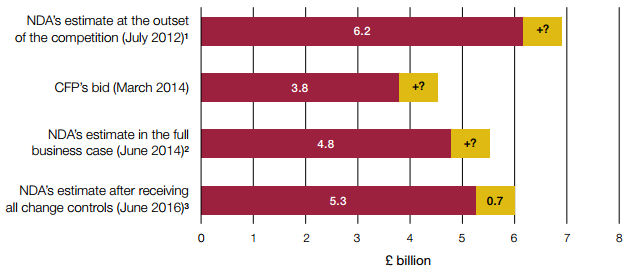
2.7 At the outset of the competition, the NDA estimated the value of the contract at £6.2 billion. CFP's winning bid estimated the cost of decommissioning the Magnox sites at £3.8 billion. The other three bidders' estimates ranged from £4.1 to £4.4 billion. The NDA expected all bidders' cost estimates to increase; the competition business case highlighted the risk that bidders could bid low and subsequently revise their cost estimates upwards through the consolidation process. When it awarded the contract in September 2014, the NDA estimated that costs could be £4.8 billion (not including waste and asbestos), based on CFP's bid cost plus £997 million in contingency funding. Of this contingency total, the NDA estimated that it would require £417 million to cover differences in the state of the sites compared with the bidding assumptions, plus £180 million for central contingency. The remaining £400 million of contingency related to future phases of the contract.7
2.8 By March 2017 the NDA's estimate of the costs had risen to £6.0 billion (Figure 9). The difference between this figure and CFP's bid of £3.8 billion consists of:
• £0.3 billion relating to work that CFP should have identified when performing site visits as part of the competition, but erroneously overlooked. The NDA will pay for the cost of performing this work, but will not pay CFP a fee for it, in line with the contractual arrangements for bid omissions;
• £0.7 billion relating to uncertainty about the volume of waste and asbestos on the sites. The NDA says that these costs were expected and would have materialised regardless of the winning bidder as it is not possible to identify an accurate value at the time of contracting; and
• £1.2 billion relating to the NDA's over-optimistic assumptions about the state of the sites when it tendered the contract. This was £0.2 billion more than NDA's previous contingency estimate for extra scope, which was £997 million. Sites were in different states than bidders had been told to expect, with six out of the 12 sites behind schedule. For example, the Bradwell site was four years behind schedule at the time the contract was awarded. One site, Wylfa, continued to generate electricity for a year longer than expected, creating additional revenue for the NDA.
2.9 The NDA did not independently assure its assumptions about the work required to decommission 10 out of 12 sites before it put the contract out to tender in 2012. In June 2014 a report by the Major Projects Authority (MPA) noted the risk of errors in these assumptions and the risk of the incumbent contractor leaving 'outstanding activity' on the sites.8 The site-facing team responsible for assuring performance information from the incumbent PBO had been partially diverted to help with the procurement of the new PBO. The NDA does not know whether the cost increase stems from its inaccurate assumptions about the state of the Magnox sites in 2012 when the contract was let, or from under-performance on the sites before it awarded the Magnox contract in 2014.
2.10 Despite the increase in estimated costs, the NDA is confident that the contract will still meet HM Treasury's savings target of at least 10%. As of March 2017, it estimated that the contractor's total costs would be £6.0 billion, and that this was £0.9 billion less than it would have been under the old contracts (a 13% saving).9 We have not audited this.
Figure 9 The NDA's estimate of the costs of decommissioning Magnox at different points in time Estimated decommissioning costs increased significantly after Cavendish Fluor Partnership (CFP) won the contract
Notes 1 It is against this funding profile that HM Treasury specified its 10% cost saving requirement. 2 For the full business case, the NDA added £1.0 billion of contingency to CFP's bid to cover extra scope, taking the total from £3.8 billion to £4.8 billion. 3 After receiving all change controls, the NDA's cost estimate increased by £0.3 billion to correct for omissions in CFP's bid, and a further £0.2 billion increase was made for extra scope not covered in the contingency estimate. In addition, by June 2016 the NDA had established that a further £0.7 billion would be needed to clean up waste and asbestos. The NDA's business case had anticipated that extra money would be needed for waste and asbestos, but did not estimate how much, as the volume of waste and asbestos on the sites could not be quantified until work to remove it started. Source: National Audit Office analysis |
 Decommissioning costs
 Costs of waste and asbestos
 Unknown costs of waste and asbestos
______________________________________________________________________________
7 The Magnox contract was designed to be delivered in two phases over 14 years. In its contingency budget, the NDA estimated that it might require £597 million to cover unexpected costs in phase one, and £400 million for phase two.
8 In January 2016, the Major Projects Authority merged with Infrastructure UK to form the Infrastructure and Projects Authority.
9 At the outset of the competition, the NDA estimated that continuing with the old contracts would have cost £6.9 billion. This estimate did not include the costs of waste and asbestos, which were later valued at £0.7 billion.