Accountability and transparency
Government departments and their accounting officers remain accountable for the services they contract out. This includes ensuring that arrangements for contracting-out contain appropriate accountability for using public funds. But the quality of the service is dependent on the provider, and the provider's systems, people, controls and culture. Holding the client contract manager to account for the service is not sufficient. To an extent, the provider must also be accountable for the services they undertake to deliver.
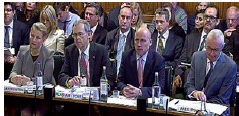
The system of accountability is starting to change to reflect the way accounting officers delegate responsibility for delivery to the provider. This delegation leaves both accountable. In November 2013, for the first time four major providers - Atos, Capita, G4S and Serco - appeared before the Public Accounts Committee to answer questions about their public sector business as a whole. This was part of a wider trend of providers appearing before the committee to account for their performance on specific projects and contracts.
Much of our work looks as much at the provider's performance in the delivery of a service as it does that of the department which contracted them. We aim to 'follow the pound' to ensure Parliament is able to hold whoever is responsible for delivery of the service to account.
Providers' accountability is greatly enhanced through increased transparency. Contracting creates the opportunity for enhanced transparency over public services because it creates management information over performance and the costs of a service. This can be made available to contract managers through the use of open book clauses, as highlighted in our July 2015 report Open book accounting and supply-chain assurance.
Information can also be made more widely available through public transparency measures. While performance for some contracts, such as DWP's Work Programme, is already published on a systematic basis, the Public Accounts Committee have often commented that too much information is censored on the basis of commercial confidentiality.
In 2015 government produced its policy paper Transparency of Government and Suppliers to the Public. This set out the need for common transparency standards and approaches across government contracts with a presumption in favour of disclosure over the 'vast majority' of commercial information. For contracts worth over £20 million per annum, government is seeking to make available transparency data over revenue levels and profit margins.
Although Government's aim is to be transparent, it is not clear it has the ability to be. Its ambition and ability to publish transparency information remains hampered by weak information systems that mean that contract information, spend data and performance information cannot easily be brought together.
|
| "There needs to be far greater visibility to government, parliament and the public about suppliers' performance, costs, revenues and profits." Public Accounts Committee, 2014 |
|
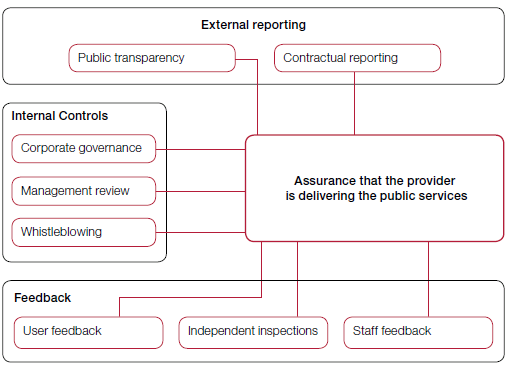
Source: Figure 22, The role of major contractors in the delivery of public services, National Audit Office, November 2013 " …all businesses delivering public services need to do more to build a trusting relationship with the public." Confederation of British Industry, 2014 | |