Using new commercial models
With £225 billion of outsourced spending, providers have the potential to contribute enormously to the reform of public services and in helping to respond to austerity and overall reductions in public expenditure.
However, the traditional outsourcing model of contracting-out an existing service to a provider aiming to deliver the same thing on a more efficient basis will only take this so far. Generally such outsourcers accept very low levels of risk and are paid low margins as a result.
Government is aiming to try out different commercial models with different incentive structures and ways of working. These include:
• Payment by results (PbR) - which focuses payment on the successful delivery of outcomes rather than inputs;
• Contracts for difference - which pay providers in accordance with the difference made to the value of an asset or business;
• Joint ventures - where government and providers jointly own a service-providing business;
• Mutuals and social enterprises - not-for-profit organisations which may be 'spun out' from existing public sector organisations, or newly competing in markets for government services;
• Management insertion - which embeds private sector staff within the management of public sector organisations and pays them by results; and
• Social impact bonds - a means of attracting up-front private finance to support providers looking to transform services on a payment by results basis.
Our work has provided early reports on the success and failures of new commercial models and highlighted the need for purposeful experimentation - when trying something new, it is important to capture the learning and assess whether it works.
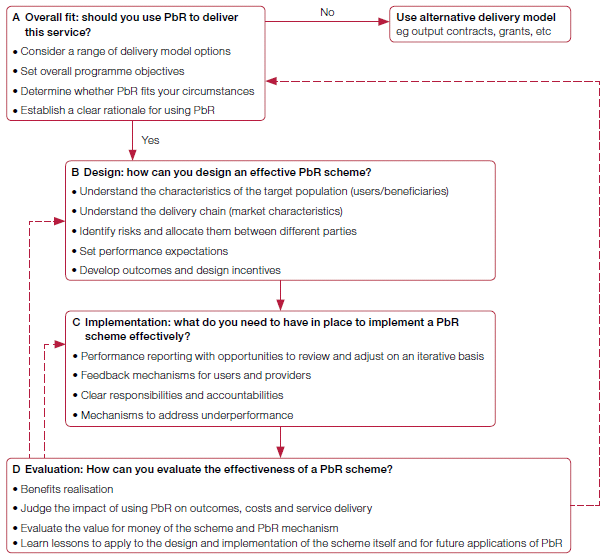
Payment by results: analytical framework Commissioners should consider evaluation needs at the design stage, and feed back learning throughout the scheme life cycle, rather than treating evaluation as a discrete stage at the end of the scheme
Source: National Audit Office, Payment by results: analytical framework for decision-makers, Figure 2, June 2015 |