Government targets
1.10 In 2010, the government announced an aspiration for 25% of central government's contracts to be awarded to SMEs. In February 2015, it announced that 26% of central government spending reached SMEs in 2013-14, achieving the aspiration a year early.
1.11 In August 2015, the government announced a revised target for 33% of government spending to be with SMEs by 2020. Based on current spending, this would represent a further £2.7 billion.
1.12 Both targets:
• are measured by the value of contracts and not by volume or number of contracts;
• include departments' supply chains ('indirect' spending); and
• include centrally managed procurement, central government departments, their agencies and their arm's-length bodies.
1.13 Government measures its target using two types of data on spending, which are reported by the CCS on behalf of central government:
• direct: the public sector awards a contract directly to an SME; and
• indirect: the public sector contracts with a larger provider and SMEs are appointed as subcontractors in the supply chain.
1.14 The CCS first reported direct spending with SMEs in 2010-11 as 6.8% (£3.2 billion). It first reported indirect spending a year later in 2011-12, at 6.5% of spending. Government reported year-on-year increases in these estimates. In 2013-14, it reported that it had met the 25% target for the first time.
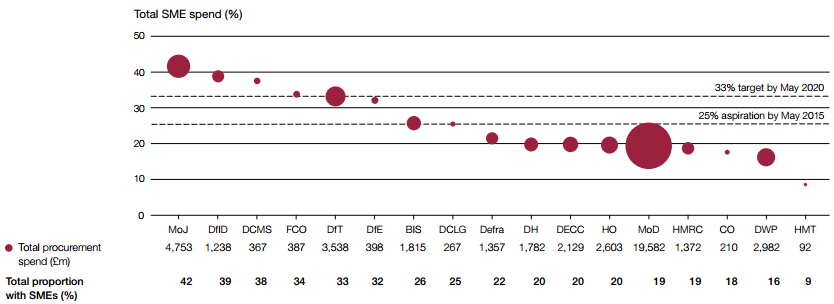
1.15 The latest figures, for 2014-15, show 10.9% direct spending (£4.9 billion) and 16.2% indirect spending (£7.3 billion), making a total of 27.1%. Most of the increase is in indirect spending, which now accounts for 60% of reported SME spending. Across government, departments reported significant variation in performance, ranging from 8.6% (HM Treasury) to 41.6% (Ministry of Justice) (Figure 2).
Figure 2 Government surpassed its 25% aspiration in 2014-15; MoD spent more than any other department
Notes 1 Total government procurement spending: £45 billion (27.1%, £12.1 billion with SMEs). 2 Departments take different approaches to collating spending figures, for example MoD only includes spending from the core department whereas other departments include some agencies and arm's-length bodies. 3 In addition, suppliers reported indirect spending of £1,490 million for central government with no departmental association. The value of this spend accounts for 12% of total SME spending and 3% of total procurement spending. 4 MoJ = Ministry of Justice; DfID = Department for International Development; DCMS = Department for Culture, Media & Sport; FCO = Foreign & Commonwealth Office; DfT = Department for Transport; DfE = Department for Education; BIS = Department for Business, Innovation & Skills; DCLG = Department for Communities and Local Government; Defra = Department for Environment, Food & Rural Affairs; DH = Department of Health; DECC = Department of Energy & Climate Change; HO = Home Office; MoD = Ministry of Defence; HMRC = HM Revenue & Customs; CO = Cabinet Office; DWP = Department for Work & Pensions; HMT = HM Treasury. Source: National Audit Office analysis of Crown Commercial Service data. Available at: www.gov.uk/government/uploads/system/uploads/attachment_data/file/482638/Publication_of_1415SpendUpdate__1___1_.pdf |