Government's developing approach
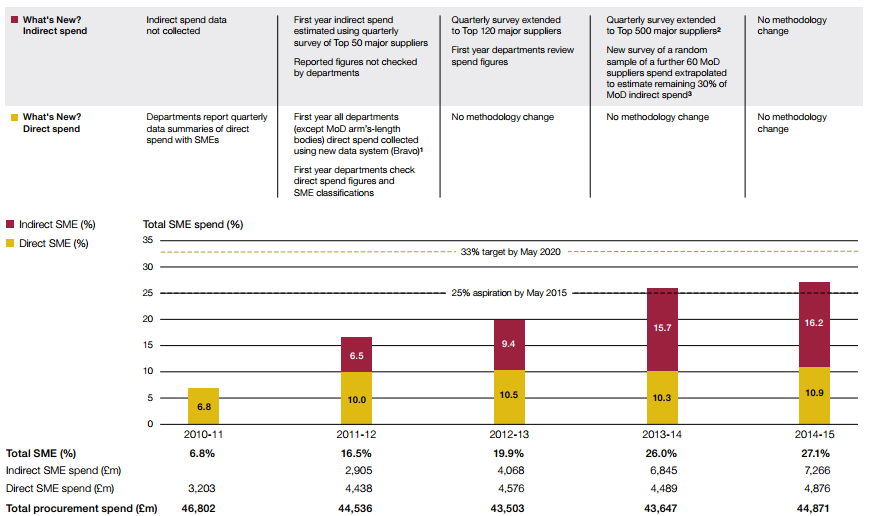
1.16 We cannot be certain that the amount of spending going to SMEs has increased since 2010 as the annually-reported numbers are not directly comparable. Since 2010-11, the Cabinet Office has changed its approach to measuring performance every year except 2014-15 (Figure 3 on pages 19 and 20).
1.17 The CCS's approach for estimating direct spending changed from using departments' quarterly data summaries in 2010-11 to using its tool for analysing spending (Bravo) in 2011-12. Data in Bravo are taken directly from departments' accounting systems. Bravo uses the Dun and Bradstreet database to identify SMEs within the data.8 The data in Bravo are known to be incomplete but this is gradually improving as more central government bodies are added to it and inconsistencies resolved. Since the CCS started using Bravo the estimate of direct spending with SMEs has been between 10% and 11%.
1.18 The CCS has improved the way it estimates indirect spending several times. It did not report indirect spending at all before 2011-12. Between 2012-13 and 2013-14, it increased the sample size for its survey of government's suppliers from 120 to 500, capturing a wider pool of expenditure. In 2013-14, it started to use a separate methodology for MoD, extrapolating findings from a survey of 60 MoD suppliers. This added a further 2% of SME spending, allowing government to report that it had met its target.
1.19 The CCS relies on departments to validate figures on direct spending. This validation process has led to the figures being revised both upwards and downwards over time. The Foreign & Commonwealth Office and the Ministry of Justice have reported large increases in direct SME spending performance following changes in approach to data validation. Across government in 2014-15, departmental validation resulted in an overall addition of £61 million of spending that Bravo had not classified asspending with SMEs.
1.20 Overall, the CCS now has a better understanding of government's spending with SMEs. The latest estimate is more reliable than the 2010-11 estimate of 6.8% or the 2005 estimate of 22% (see paragraph 1.6). However, the government's understanding of its indirect spending with SMEs remains incomplete. Departments told us that they rely on the goodwill of large suppliers to report spending accurately to the CCS as departments usually have no way to verify the accuracy of the figures. Suppliers may only have data on their spending with the next tier of their supply chain, so may not report spending with SMEs in lower tiers. Furthermore, suppliers may have different approaches to collecting and validating data and identifying SMEs, leading to inconsistent measurement.
Figure 3 Government has changed its approach to reporting SME spending in four of the last five years
Notes 1 CCS collects data on procurement spending using a third party system called Bravo. Bravo collects data from departments' invoices, identifies SMEs within the data using Dun and Bradstreet classifications and provides monthly data reports on SME spending by department. 2 In 2013-14, to estimate indirect spend, the Cabinet Office asked a stratified random sample of central government's 500 largest suppliers to report their spending with SMEs. 3 Of the MoD spend, 30% is not included in the indirect spending sample. The CCS introduced a further survey of 60 MoD suppliers to gather data on spending with SMEs through the MoD supply chain. It conducted this survey in January 2015 and used the data as the basis for estimating indirect spending in 2013-14 and 2014-15. 4 In 2011-12, 27 of the 50 suppliers surveyed responded. In 2012-13, 87 of the 120 suppliers surveyed responded and in 2013-14 350 of the 500 suppliers responded. 5 The figures for SME spend and total procurement spend have not been adjusted for inflation. Source: National Audit Office analysis of Crown Commercial Service data |
__________________________________________________________________
8 Dun and Bradstreet provides the SME classifications used in the matching process to identify new SMEs and monitor classifications of SMEs.