Barriers to SMEs winning government contracts
2.28 Sector experts continue to raise concerns about the barriers to winning government contracts faced by SMEs. In February 2015, the Prime Minister's Enterprise Adviser, Lord Young, highlighted some of the barriers faced by small businesses, including:
• a lack of SMEs with the digital capability to make use of opportunities;
• a lack of accountability if contracts fail; and
• fragmented support to SMEs.17
Figure 5 Complaint type
Notes 1 It was not possible to identify from the mystery shopper data if the complaint was made by an SME. To identify which complaints were most likely to relate to the SMEs, we compared a list of issues commonly identified as barriers by SMEs contracting with the public sector with complaints reported by mystery shopper. 2 In complaints where more than one barrier to an SME was identified, only the barrier connected to the main focus of the complaint was selected. 3 The figures are based on our analysis of mystery shopper complaints from February to October 2011 and January to September 2015. Source: National Audit Office analysis of Cabinet Office data |
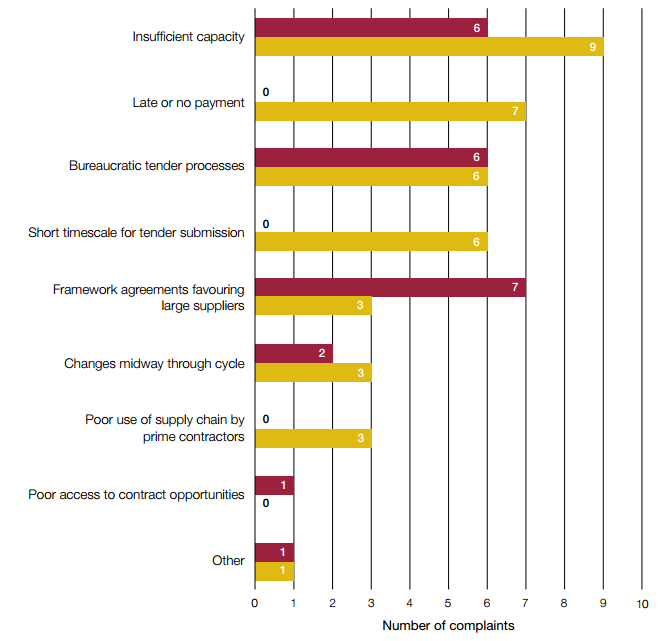
 2011
2011 2015
20152.29 We spoke to sector representatives and SMEs about their experiences of finding and bidding for public sector contracts. We also asked departments about barriers SMEs may face. Overall, the feedback we received suggests that the government's initiatives are directed at key issues facing SMEs, but that the initiatives are not being consistently implemented across the public sector.
2.30 We collected this feedback in 2015, after some of these initiatives had been running for some time. However, it is possible that the impact of the various initiatives may take time to be felt by the sector. Nonetheless, we noted that the challenges SMEs think they face remain the same as those recorded for many years (Figure 6).
Figure 6
Source: Discussions with departments and sector stakeholders |
____________________________________________________________________
17 Lord Young, The Report On Small Firms 2010–2015, February 2015.