The greater use of government's collective buying power
3.9 The government is increasingly using its collective buying power to drive down the costs of what it buys. This strategy has three parts: increasing government's leverage when negotiating with strategic providers; looking for economies of scale; and using standardisation to promote price competition. The latter two affect SMEs.
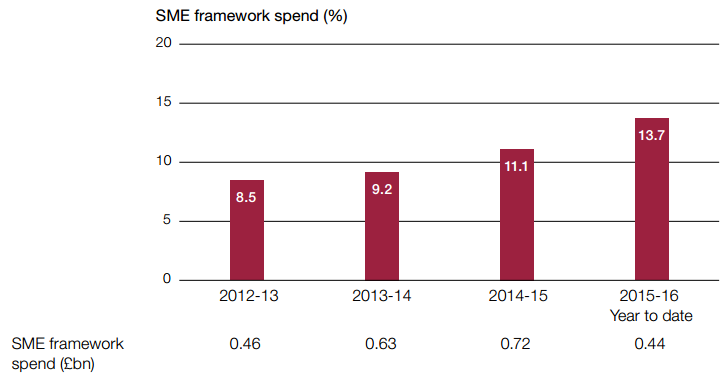
3.10 For common goods and services (such as office supplies, energy and travel), departments have transferred responsibility for procurement to the CCS, which acts on behalf of government as a whole.21 Collective procurement can make it harder for SMEs to compete, as they may not have the capacity to deliver bulk contracts or meet the criteria to qualify for a national framework. The CCS has taken steps to ensure SMEs are represented on its framework agreements. In 2014-15, 62% of the 7,000 providers on the CCS's 178 framework agreements were classified as SMEs. Of the £3.2 billion spent through CCS frameworks between April 2015 and January 2016, 14% was spent with SMEs (Figure 8). Even though overall spending through these frameworks has decreased in 2015-16, the proportion of spending with SMEs has increased steadily since 2012-13.
Figure 8 The proportion of spend through CCS frameworks going to SMEs has increased
Notes 1 Frameworks data includes spend by departments using CCS frameworks. 2 Year to date 2015-16 figure based on data as at 11 January 2016. Source: National Audit Office analysis of Crown Commercial Service data |
3.11 Government has also sought to encourage price competition, by standardising products and services. Providers compete on the basis of price, rather than their distinguishing features. This is sometimes associated with an attempt to consolidate the market and number of providers. It means providers of these products and services can no longer rely on pre-existing relationships or the specialised nature of their product to secure business. For example, providers delivering training courses under the Civil Service Learning contract are not allowed to offer training courses directly to departments that compete with common cross-government courses. Therefore, any training provider building their business around strong relationships with particular public bodies or by differentiating their training for a particular subject, may find the new arrangements a direct threat to their business model.22
3.12 Promoting price competition benefits some types of SMEs and not others. It also affects the likelihood of SMEs delivering benefits for the public sector, as procurement based on standard products and services is less likely to lead to economic growth or encourage innovation (paragraph 3.19). Some SMEs are able to flourish as providers of standard products and services. For example, government's G-Cloud provides a web platform for advertising a catalogue of IT-related products and services, mostly provided by SMEs, that departments can use (paragraph 3.24).
____________________________________________
21 As at January 2016, seven departments have transferred responsibilities to the Crown Commercial Service.
22 National Audit Office, Our enquiries into Civil Service Learning's contract with Capita, March 2015.