Background to Aspire
1.5 HMRC's technology estate is one of the biggest in government with around 650 systems, six major datacentres and 1.1 billion transactions. HMRC used its technology to collect £506 billion of tax revenue in 2013-14. The systems already let the public and businesses submit much of their tax information digitally. HMRC's strategy depends on enhancing its technology to make its services 'digital by default'.
1.6 HMRC set four objectives, when it let the Aspire contract:
• to ensure continuity of HMRC's ICT systems at all times;
• to continuously improve the performance of HMRC's ICT services;
• to provide rapid access to up-to-date skills and technologies to meet HMRC's requirements; and
• to facilitate change to HMRC's business processes, in line with its strategy, supporting other government departments where necessary.
1.7 HMRC let Aspire in 2004 to run until 2014, with an option to extend it for a further eight years. In 2007, HMRC extended the contract for three years, so it is now due to expire in June 2017.
1.8 From the beginning of Aspire in 2004, until the end of March 2014, HMRC had spent £7.9 billion through the contract. In 2006, the former Inland Revenue and HM Customs and Excise merged and HMRC's annual spend through Aspire increased by around 25 per cent. Between April 2006 and March 2014, Aspire accounted for about 84 per cent of HMRC's total spending on technology.
1.9 The £7.9 billion total spend comprises:
• £4.9 billion on maintaining and running technology services, including datacentres, desktop computers and laptops, telecommunications, networks, business applications, and printing; and
• £3.0 billion on technology projects to develop and improve HMRC's systems. The £3.0 billion included major work to increase the online processing possible for income tax and VAT, and to reduce manual processing by HMRC's staff.
1.10 Aspire is a 'prime supplier' contracting model (Figure 1) through which HMRC contracts solely with Capgemini. Capgemini provides all services and has two main subcontracts: one with Fujitsu (worth £2.8 billion from July 2004 to March 2014); and one with Accenture (worth £0.3 billion in the same period).
Figure 1
Source: National Audit Office review of the Aspire contract and supply chain |
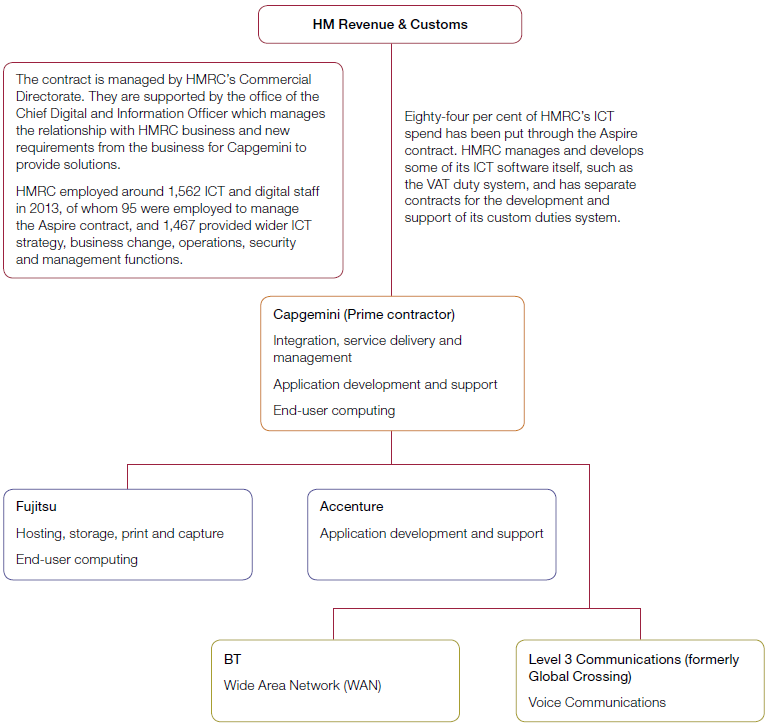
1.11 Capgemini and Fujitsu both have subcontractors. In total there are over 360 suppliers and Capgemini and Fujitsu have spent £2.5 billion with subcontractors to March 2014. Since 2011-12, 7 per cent of total contract spend has been with small and medium-sized enterprises.4
1.12 Aspire is important to Capgemini's global business. It accounts for 9 per cent of its global revenues for the year ending 31 December 2013, and 64 per cent of its UK public sector revenues.
________________________________________________________________________________________________
4 Data only exists from 2011-12 onwards.