Performance of Aspire projects
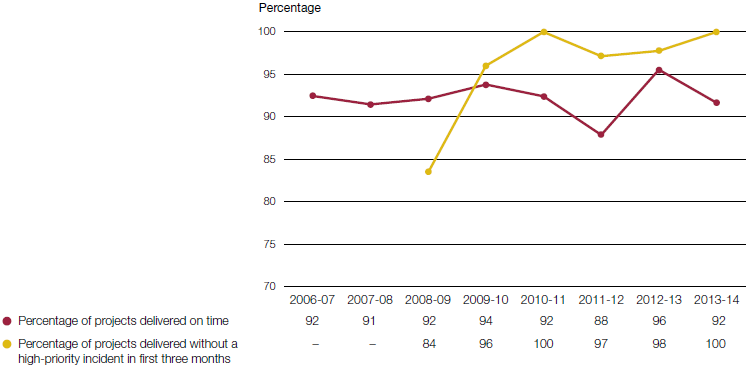
2.8 We examined whether the 380 major projects that had been implemented since April 2008 had been delivered to time and quality.15 We found that HMRC has a very high level of success in delivering to time and quality with an average of 93 per cent delivered on time and 95 per cent without a high-priority incident occurring in the first three months after implementation (Figure 5).
2.9 Despite this generally strong performance there have been a few cases of well-documented problems. For example, in 2009, HMRC created the National Insurance and PAYE Service to replace 12 separate regional databases. Delays and errors following the implementation of the system affected millions of taxpayers, cost HMRC £78.9 million to fix and resulted in an estimated £953 million in tax foregone.16 However, HMRC had engaged a supplier outside of the Aspire contract, and reviews of the project attributed the problems to HMRC and not the performance of the Aspire suppliers.
Figure 5 Since April 2008, over 380 projects have been implemented with 93 per cent on time and 95 per cent without a high-priority incident in the first three months after implementation
Notes 1 A deadline for delivering a project is set at the end of a detailed design phase. 2 High-priority incidents include events such as more than 499 users not being able to access a service or slower processing speeds affecting more than 5,000 users. There was no consistent measurement of the quality of project delivery before April 2008. 3 Numbers have been rounded to no decimal places. Source: HM Revenue & Customs |
2.10 HMRC told us the main reasons for its good performance in delivering projects were the strong processes it operates, its close collaboration with the suppliers, the continuity of staff in key positions and the investment it has made in project management staff. HMRC told us that all programme managers and more than 80 per cent of project managers have a recognised project management qualification.
2.11 We also found that these factors were important to the successful delivery of projects:
• HMRC works with the supplier to agree scope, budget and timing before contractual targets are set. HMRC has a phased approach to developing projects with each phase being progressively more detailed than the previous one. Through analysing 42 projects completed between April 2006 and December 2013 we found that it took an average of seven months to complete the final, most detailed, phase which culminates in a contract between HMRC and the supplier. The available data suggests that at least an additional nine months is spent on the early phases, including time spent by HMRC on prioritising the portfolio of projects and other governance activities.17 This approach to scoping allows both HMRC and the suppliers to reduce the risk of later slippage.
• After the contractual targets and detailed design has been approved, HMRC continues to adjust the scope, time frames and resources dedicated to a project. We examined 23 projects delivered in 2013-14 and found that, after the detailed design had been approved, changes were agreed in 19 (83 per cent) of these cases.18
• Most projects are put into service through major releases. Since October 2013, HMRC has moved to a monthly release programme so that it can be more flexible and responsive in the way that it introduces technology. It is too soon to know what impact this may have on the timeliness or quality of projects by potentially removing any contingency.
________________________________________________________________________________________________
15 There was no consistent measurement of the quality of project delivery before April 2008.
16 Comptroller and Auditor General, HM Revenue & Customs 2012-13 Accounts, National Audit Office, June 2013.
17 See Appendix Two for detail on how these numbers have been calculated.
18 These 23 projects represent all of the 2013-14 projects for which a detailed design was undertaken. A further 29 projects followed a different process for which this analysis is not possible.