The Aspire Replacement Programme
4.6 In January 2014, HMRC began a new project, which it called the Aspire Replacement Programme. A new director general led the programme; recruited from the private sector to head ICT and digital transformation in HMRC. HMRC published its new IT strategy in February 2014 setting out significant changes to how it plans to provide its services.23 HMRC aims to collect more tax, while reducing costs by providing easy-to-use digital services that all customers can choose to use. The strategy aims to give every UK customer a personalised digital tax account. New systems will increasingly interact with customers in real time, as they put data on to the system. This is expected to improve compliance through automated checks to detect fraud and reduce human error. HMRC will therefore be able to focus more on tackling criminal activity, evasion and avoidance.
4.7 HMRC recognises the scale of this change and the challenge, which requires new organisational skills and technology. It is developing a new operating model for its technology provision. This involves HMRC becoming more directly involved in managing services, projects and more commercial relationships. HMRC plans to hasten the business change, using agile project management methods where appropriate, which it expects to give benefits more quickly.
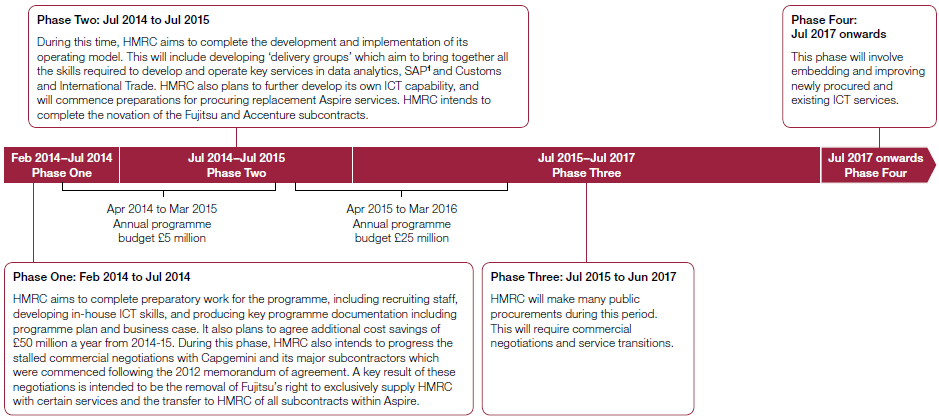
4.8 The Aspire Replacement Programme will implement this new model for providing technology. The programme has four major phases and includes significant internal transformation and commercial activity (Figure 12 overleaf).
4.9 The programme is at an early stage. During our fieldwork, HMRC had blueprints outlining the intended future state. It had yet to develop a formal business case and overall project plan. HMRC, therefore, has much to achieve and there is little time to complete the first three phases by June 2017.
4.10 HMRC recognises there are substantial risks associated with the programme. During our fieldwork the management response concentrated on the tactical short-term risks of mobilising the Aspire Replacement Programme rather than the more strategic risks arising from changing the Aspire contract. However, the risks noted in HMRC's 2014 IT strategy include:
"Not delivering to budget because of the need to balance year-on-year cost savings and an increase in demand for IT services and digital transformation."
"The impact of transforming the IT delivery model at the same time as developing services and infrastructure."
There are, therefore, critical and ongoing dependencies on improving organisational agility, technical exploitation, strong leadership, professional skills and staff motivation, to achieve these ambitions.
Figure 12
Note 1 HMRC uses SAP ERP, a finance, human resources and other resource planning software licensed by SAP AG. Source: National Audit Office review of HM Revenue & Customs' blueprints |
________________________________________________________________________________________________
23 HM Revenue & Customs, Information Technology Strategy, February 2014.