Summary
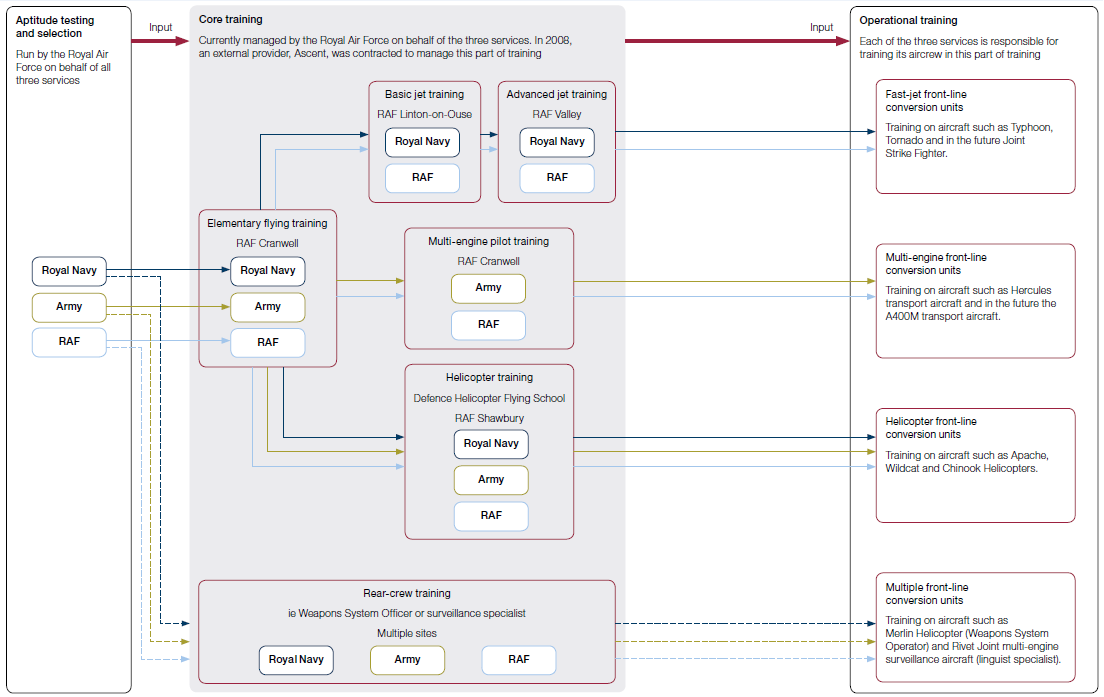
1 The Ministry of Defence (the Department) trains aircrew for each of the armed services. For example, Wildcat helicopter pilots for the Royal Navy, Apache helicopter pilots for the Army, and Typhoon fast-jet pilots for the Royal Air Force. The process involves several stages:
• Aptitude testing and selection
Students are selected based on their performance in a range of tests that measure mental agility, hand-to-eye coordination and situational awareness.
• Core flying training
Student pilots learn the basics of flying and progress on to training to prepare them for their future role (for example, helicopter training). Rear-crew students learn skills such as navigation, surveillance and use of weapons systems.
• Operational flying training
Students that complete core flying training join operational training units. Here they are trained on specific front-line aircraft, such as a Wildcat helicopter, Apache helicopter or Typhoon fast-jet (Figure 1 on pages 6 and 7).
2 The Royal Air Force manages aptitude testing and core flying training on behalf of the Department. This involves personnel from all three armed services and many contractors. From civilian flying instructors to aircraft engineers and air traffic controllers. Each of the armed services run operational training for their aircrew once they complete core training.
3 Our 2000 report, Training new pilots, found:1
• existing core flying training was taking too long;
• training costs were increased due to student failure rates and delays in students moving through training; and
• monitoring of training performance was limited.
Figure 1 Military flying training
Notes 1 Elementary flying training: Aircrew who pass aptitude testing (and flying grading for the Army and Royal Navy) begin elementary flying training. Students learn the basics of flying, such as navigation and basic handling in a light aircraft. Successful students progress on to other courses based on flying ability and military need. 2 Basic jet training: Prepares students for advanced jet training by teaching more advanced manoeuvring and tactics on more powerful aircraft. 3 Advanced jet training: Students learn handling, night flying, low level navigation as well as weapons and tactics training on a jet-driven aircraft. The training prepares them to move to front-line fighter jets, such as the Typhoon. 4 Multi-engine pilot training: Students learn how to fly large, multi-engine propeller and jet driven aircraft, such as the Hercules transport aircraft. They learn general handling, navigation and asymmetric flying (where an engine on one side of the aircraft is not functioning). 5 Helicopter pilot training: Students learn basic manoeuvring, such as hovering, through to more advanced training such as night flying and mountain flying. 6 Rear-crew training: Training for rear crew varies by service and aircraft. Rear-crew do not fly aircraft, but operate weapons systems, navigate or undertake surveillance activities. 7 Operational training: Students learn to fly on front-line aircraft such as a Typhoon fast-jet or an Apache attack helicopter. Students learn handling, tactics and weapons systems operation. Once competent, students are declared combat ready and join a front-line squadron. Source: National Audit Office |
4 The Department recognised core flying training was complicated, disjointed and inefficient. It concluded that new core training, run by an external training provider, could help it reduce the time and cost of training aircrew. It would also help it replace obsolete training equipment that was leading to greater use of more expensive front-line aircraft in operational training. The external provider would have no role in aptitude testing or operational training.
5 In 2008, the Department contracted an industry provider, Ascent, to develop and manage a new approach to core training. The new approach is called the United Kingdom Military Flying Training System (UKMFTS). The Department's objective is for industry to provide training to meet three high level aims. These are to:
• optimise time in training;
• close the gap between the skills of aircrew finishing training and the skills needed to use front-line aircraft; and
• reduce the overall cost of flying training.
6 Under the new approach, Ascent is responsible for providing aircraft and simulators for training, running training courses and training an agreed number of aircrew each year. The Department remains responsible for many aspects of core training. These include providing military instructors, determining the number of students it needs and setting the training input and output standards. The Department considered that having an external provider would enable it to:
• transfer risk (for example, buying and making available enough aircraft for training);
• increase flexibility to respond to changes;
• promote continuous improvement and innovation; and
• integrate better the different stages of core training.
7 Ascent's contract is for 25 years. The Department is moving from existing core training in phases, through five different training packages, to minimise disruption. In 2011, the forecast cost was £6.8 billion, with the majority of the costs for providing new aircraft to support training. The new core training was expected to be running by 2012 and at full capacity by 2014.
________________________________________________________________________
1 Comptroller and Auditor General, Ministry of Defence, Training new pilots, Session 1999-2000, HC 880, National Audit Office, September 2000.