How flying training works
1.3 The Department needs to train aircrew for the aircraft flown by each of the armed services. For example:
• Royal Navy fast-jets and helicopters;
• Army helicopters and transport aircraft; and
• Royal Air Force fast-jets, helicopters, and transport and surveillance aircraft.
1.4 Currently, around 250 UK aircrew (150 pilots and 100 rear-crew) begin training.2 Trainee aircrew may be direct officer recruits, selected serving officers, senior non-commissioned officers or, in the Army, selected non-commissioned officers. The process involves several stages:
• Aptitude testing and selection
Students are selected based on their performance in a range of tests that measure mental agility, hand-to-eye coordination and situational awareness.
• Core flying training
Student pilots learn the basics of flying and progress on to training to prepare them for their future role (for example, helicopter training). Rear-crew students learn skills such as navigation, surveillance and use of weapons systems.
• Operational flying training
Students that complete core flying training join operational training units. Here they are trained on specific front-line aircraft, such as a Wildcat helicopter, Apache helicopter or Typhoon fast-jet (Figure 1).
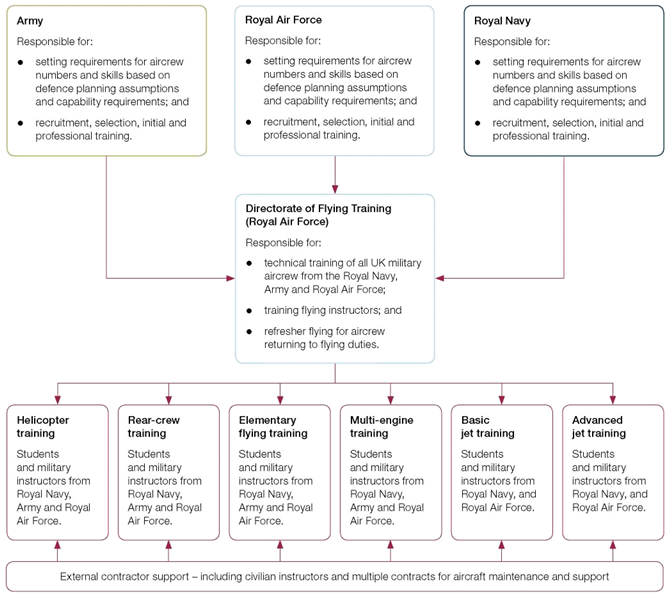
1.5 The Royal Air Force is responsible for managing aptitude testing, and core flying training. However, this involves personnel from all three services and many contractors, ranging from civilian flying instructors to aircraft engineers (Figure 2). Each of the armed services run operational training for their aircrew once they complete core training.
| Figure 2 Organisation of core flying training
Source: National Audit Office |
_______________________________________________________________________________
2 In this report the term rear-crew is used to refer to all Royal Navy, Army and Royal Air Force non-pilot aircrew.