Progress in moving to the new core training
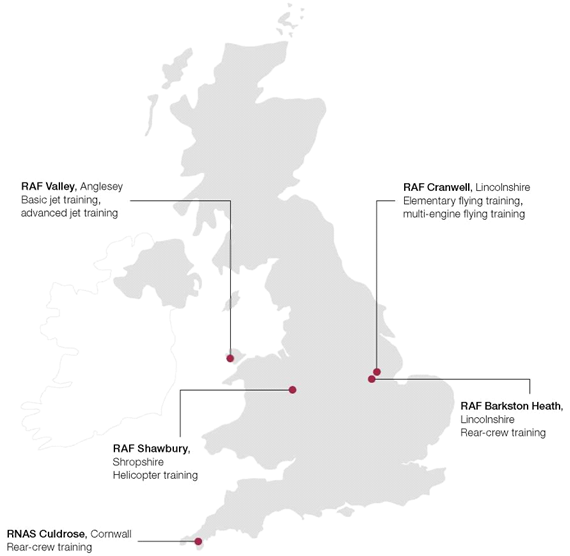
1.13 The Department is moving from existing core training in phases, through five different training packages, to minimise disruption:7
• Advanced jet: advanced flying training on jet aircraft for Royal Navy and Royal Air Force fast-jet pilots.
• Rear-crew stage 1: ground school, introductory flying, elementary navigation and tactically orientated training for Royal Navy Observers.
• Rear-crew stage 2: will replace stage 1 and provide rear-crew training for all non-pilot aircrew. Includes intelligence gathering, electronic warfare and weapons systems operation.
• Fixed-wing: elementary training, multi-engine training and basic jet training.
• Helicopter: basic and advanced helicopter training.
Figure 6 Locations for new core training
Source: National Audit Office |
1.14 The new core training was to be running by 2012, and at full capacity by 2014. However, there have been delays. Ascent has introduced two training types: advanced jet and rear-crew stage 1. The remaining elements of training are now scheduled to be in place by 2018, and running at full capacity by December 2019 (Figure 7 overleaf). Delays were due to contractor performance (paragraphs 2.13 to 2.16), changes to funding assumptions (paragraphs 2.31 to 2.34) and substantial decreases in the number of students to be trained following the 2010 Strategic Defence and Security Review (paragraphs 2.19 to 2.28).8
1.15 To avoid gaps in training provision the Department must have capacity to provide personnel and supporting infrastructure for both training systems during the change. Military instructors will have to move from the existing system to be trained for their new role about six months before the new core training starts. Any gap in training during the move to the new core training could affect the military's ability to train enough aircrew. For example, without mitigating action, the Department has forecast a 30% to 54% drop in the number of aircrew it can train through fixed-wing training during the change.
1.16 Any delays in setting up the new contracts will increase the risk of gaps in training. Although the fixed-wing training contract is to be awarded in 2015, initial course capability is not expected until late 2017. This is when elementary flying training will start after a three-year construction and service development phase. The Department can extend existing arrangements for fixed-wing training if the new core training is delayed. However, it may not be possible to support some ageing training aircraft for use beyond 2019.
1.17 Even without any further delays in procurement, there may be a three- to six-month gap in helicopter training. This is because of the time it will take to complete the procurement, certify the new aircraft and prepare the infrastructure and personnel required to run the new system. The helicopter training contract is expected to be awarded in 2016. Any delay in this procurement could create a longer training gap.
1.18 The Department is seeking to temporarily increase the number of aircrew trained by using existing core training to create a surplus of aircrew to cover any shortfall during the changes. The plans are at an early stage and cannot be formally agreed until the fixed-wing and helicopter training contracts are agreed. The Department will then have greater clarity on the timing of the change and the surplus of aircrew needed.
1.19 The rest of the report examines how well the Department can achieve and measure the expected benefits of:
• an external training provider (Part Two); and
• new core training (Part Three).
Figure 7 Changes to the timetable to introduce the new core training
Source: National Audit Office |
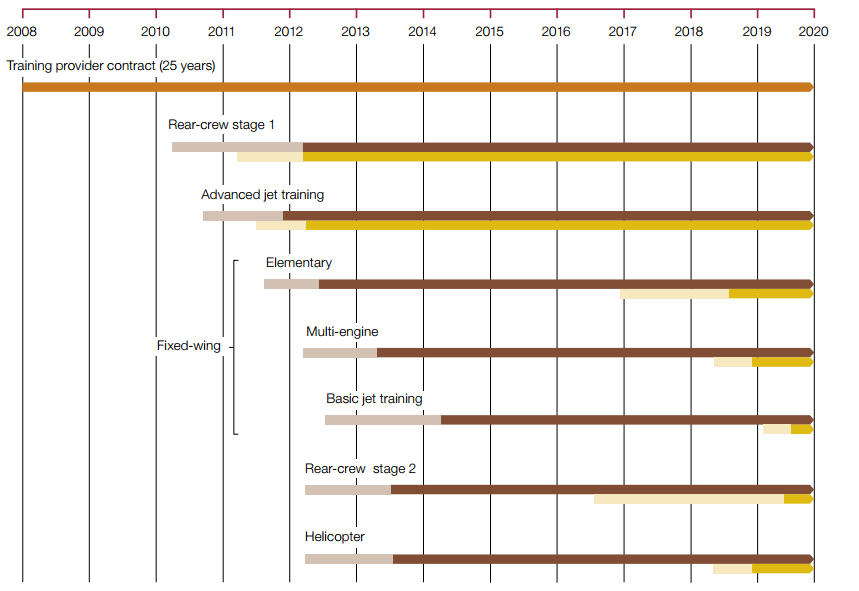
 Original timetable – initial launch
 Original timetable – full capacity
 Current timetable – initial launch
 Current timetable – full capacity
___________________________________________________________________________
7 Each new training package is issued as an amendment to the Department's original contract with Ascent.
8 HM Government, Securing Britain in an Age of Uncertainty: The Strategic Defence and Security Review, Cm 7948, October 2010.