Risk transfer
2.4 Several factors affect the time, cost and success of flying training. These include aircraft and instructor availability, runway conditions and available airspace. Each may be the responsibility of the Royal Air Force as the lead service for core flying training, the wider military or Ascent. Some factors, such as weather, are beyond anyone's control. The Department has sought to transfer several risks associated with core flying training. These include:
• Aircraft availability
Ascent must make aircraft available to fly a specified number of hours (excluding the advanced jet and rear-crew stage 1 training aircraft already owned by the Department).
• Running training courses
Ascent must run an agreed number of training courses each year.
• Training an agreed number of aircrew
Ascent designs and runs training for an agreed number of aircrew, trained to an agreed standard, each year.
Figure 8 Expected benefits of an external provider
Source: National Audit Office |
2.5 The Department has transferred risk for core training to Ascent, but it has retained responsibility for several important factors. The Department still provides military instructors, determines the number of students it needs and sets the training input and output standards (Figure 9). The risk to UK military capability of not training enough aircrew to meet the military's needs rests with the Department and cannot be transferred.
2.6 The Department's ability to fully transfer risk for core training is subject to several constraints within its contract with Ascent. For example:
• training must be conducted within a military command structure; and
• training must meet Department regulations.
2.7 Ascent also require approval from the Department for:
• training design and course documentation;
• launching procurements for equipment or services;
• annual flying training plans; and
• use of new training equipment and starting new courses.
Figure 9 Responsibilities for flying training
Note 1 An orange circle within a red rectangle represents areas which are controlled by both the Department and Ascent. Source: National Audit Office |
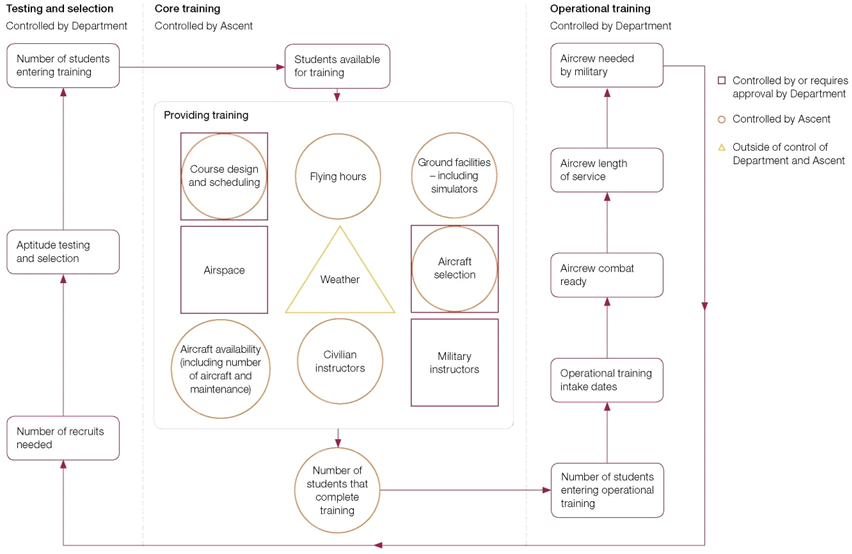
2.8 To achieve the benefits of the new core training, the Department must understand the factors that affect flying training, their relative impact and who can best control them. It must also understand the risks it has transferred to Ascent. The Department has faced issues during the implementation of advanced jet training that demonstrate the challenge of combining military and industry involvement in core flying training.