Reduction in aircrew needed
2.19 The Department sets the number and quality of aircrew needed in two documents: a 10-year forecast of aircrew needed and a specification of required skills. The Department can only amend these through consultation with Ascent. If the required changes affect training packages already contracted for they must be agreed through the contract's change process.
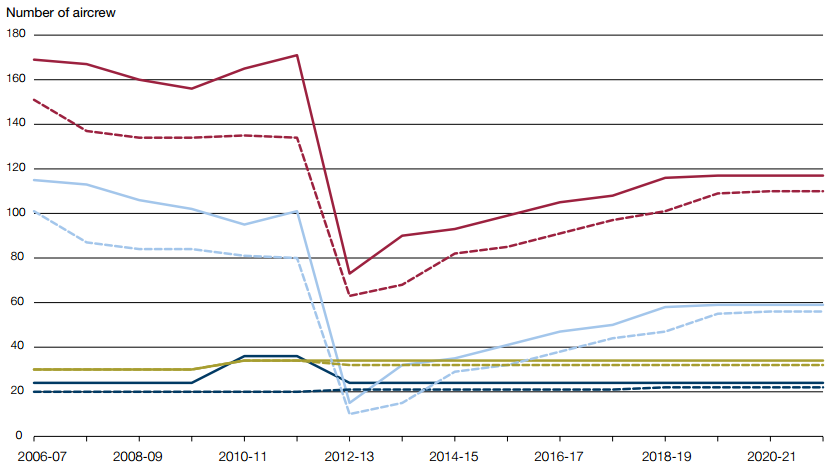
2.20 After the October 2010 Strategic Defence and Security Review, the government reduced the size of front-line flying squadrons. It also planned to remove certain aircraft types from service, such as the Harrier and Tornado fast-jets, earlier than previously expected. The changes resulted in a substantial fall in the number of aircrew needing to be trained each year (Figure 10 and Figure 11 on page 30).
2.21 Retiring the Harrier and phasing out the Tornado early meant that the greatest reductions were in the numbers of pilots the Royal Air Force needed to train, which fell by 50%. In comparison, the number of pilots the Army needed to train was reduced by only 19% because of the number of helicopters then needed to support operations in Afghanistan. Reductions in the number of rear-crew that needed to be trained were also greater for the Royal Air Force.
2.22 The changes the government made to its aircrew requirement were made as part of a wider review of defence expenditure. One of the main objectives was to reduce the estimated gap between planned government funding and the forecast cost of defence over ten years. The government planned to do this by reducing spending on equipment and its support, and the size of the armed forces. The changes were to help the Department make the savings it needed to balance its budget.
| Figure 10 Changes in number of pilots expected to start and finish core training The 2010 Strategic Defence and Security Review resulted in a substantial fall in the number of pilots needing to be trained each year
Source: Ministry of Defence |
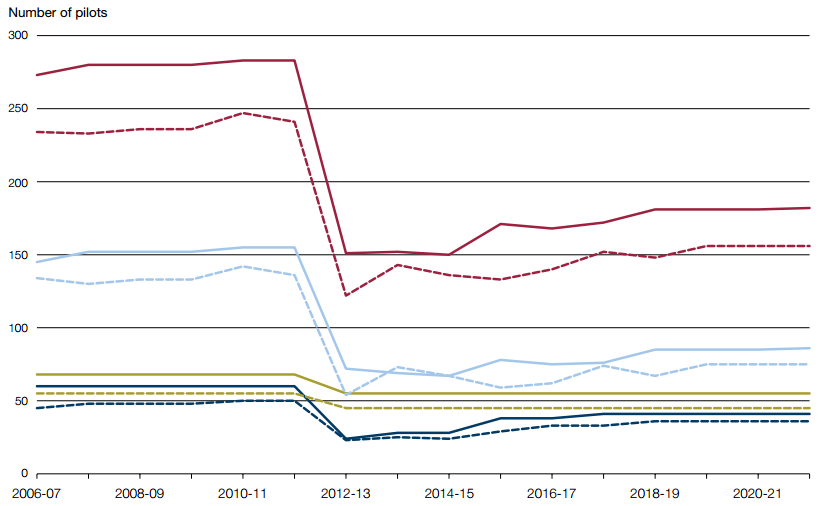
 Total
Total  Total
Total  Royal Air Force (pilot input)
 Royal Air Force (pilot output)
 Army (pilot input)
 Army (pilot output)
 Royal Navy (pilot input)
 Royal Navy (pilot output)
| Figure 11 Changes in number of rear-crew expected to start and finish core training The 2010 Strategic Defence and Security Review resulted in a substantial fall in the number of rear-crew needing to be trained each year
Source: Ministry of Defence |
2.23 The reduction in aircrew needed affected existing core training and the introduction of new core training. For example:
• Existing core training
In 2011, the Department announced it would remove around 170 newly trained or partially trained Royal Air Force pilots from training for redundancy. It retained around 150 of the highest performing pilots but had to stagger their progression through training against a reduced requirement for pilots at the front line. This led to an increase in the number students in training 'holds'. It took around three years to reduce the number of training holds to previous levels (Figure 12 overleaf).
• New core training
The Department and Ascent had invested in the infrastructure for advanced jet and rear-crew stage 1 training based on pre-2010 aircrew requirements. The Department therefore invested in excess training capacity. The Department can reduce the aircrew it asks Ascent to train each year but fixed infrastructure costs (for example, the cost of classrooms built) cannot decrease and training cost per pilot will therefore increase. The government had also already directed the Department to buy 28 Hawk T2 advanced jet trainers (paragraph 1.12). The reduced training need will result in extra aircraft capacity in advanced jet training.
2.24 The reduction in aircrew needed has also affected industry interest in providing services for the new core training. Two bidders withdrew from the fixed-wing procurement competition. The Department told us this was because of the bidders' inability to meet the affordability targets set for the programme and the impact that would have on potential earnings. This adversely affected the level of competition and the tendering process became a single bidder process.
2.25 Ascent's potential earnings have also been reduced because:
• implementation of new core training has been delayed and much of its payments are linked to training being available for use;
• the incentives it can now earn are lower (paragraph 2.42); and
• the overall value of the programme to introduce new core training has reduced significantly, while planning and infrastructure costs for implementing new core training are largely unaffected by reductions in student numbers.
2.26 The flexibility of training in response to changes in need is constrained, as aircrew training takes many years. This lag between aircrew beginning and finishing training, and having to rebalance the infrastructure and personnel required to train them, means the system requires time to respond to changes.
| Figure 12 Impact of changes on Royal Air Force pilot training The number of students in training 'holds' increased following the 2010 Strategic Defence and Security Review
Notes 1 Data are taken from Air Pipeline Management Group (APMG) meetings which occur around every six months. 2 Data are unavailable for quarter three 2011. 3 Consistent data are not available for earlier dates. Source: National Audit Office analysis of Ministry of Defence data |
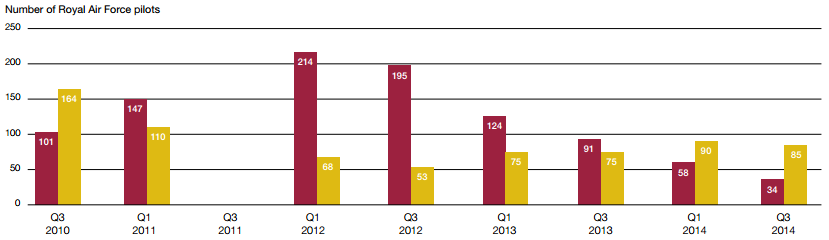
 Students in 'holds' (non-productive periods between courses)
 Students on courses
2.27 The Department benefited from not having contracted for training aircraft and infrastructure for other training - fixed-wing, helicopter and rear-crew stage 2 - because of its incremental procurement strategy. The Department is working to reduce the likelihood of over-investing in the fixed-wing and helicopter contracts before the next strategic defence and security review (scheduled for late 2015).
2.28 The Department plans to buy training on the assumption that the number of aircrew it needs to train will be lower following the next strategic defence and security review. It can buy more training if needed using the contract change process. This approach carries a cost if capacity needs to be increased beyond the limits of existing equipment and infrastructure, but mitigates the risk of over-investment. Any decrease in the number of aircrew needed will require renegotiations using the contract's change mechanism as it would affect Ascent's return on any investment in training infrastructure.