Performance baseline
3.11 When the Department decided to contract an external provider, it had no robust baseline on training time. As part of its work on the fixed-wing training contract, it sought to establish the time to train multi-engine and fast-jet pilots, to compare against the forecast training time in Ascent's system. It lacked readily available data (paragraphs 3.7 to 3.10) and struggled to develop a baseline reflecting actual training time. The Department also said it was difficult to set a baseline as training had evolved as it had tried to improve it since 2000.
3.12 Instead, the Department has developed 'best-case' comparisons that compare the time taken to train multi-engine and fast-jet pilots. It developed these scenarios by assuming courses ran sequentially with minimal gaps in between. The Department's analysis includes 2008 and 2014 baselines, which it compared with Ascent's training. Ascent's model is also 'best-case' and assumes no gaps between training courses.
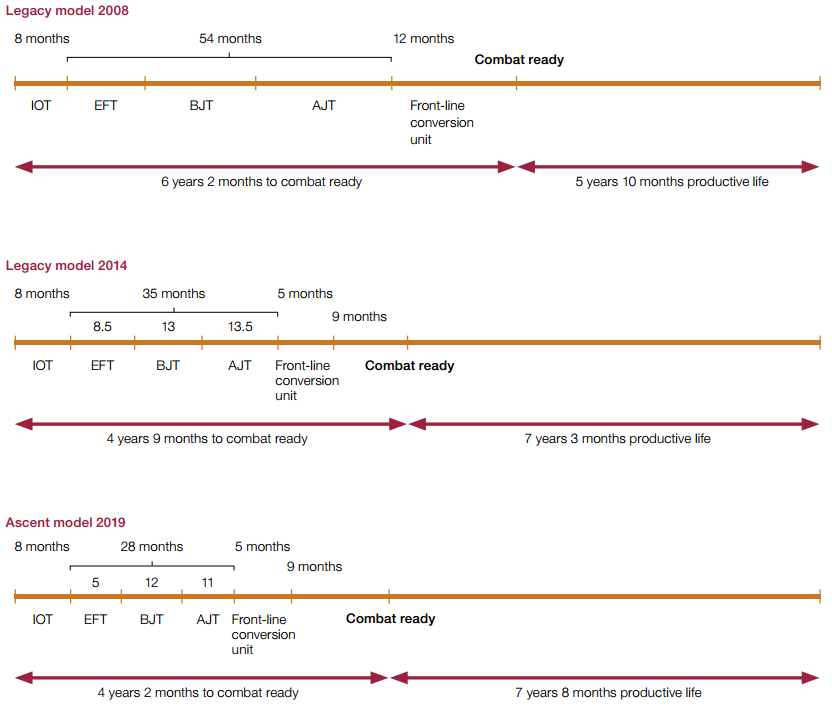
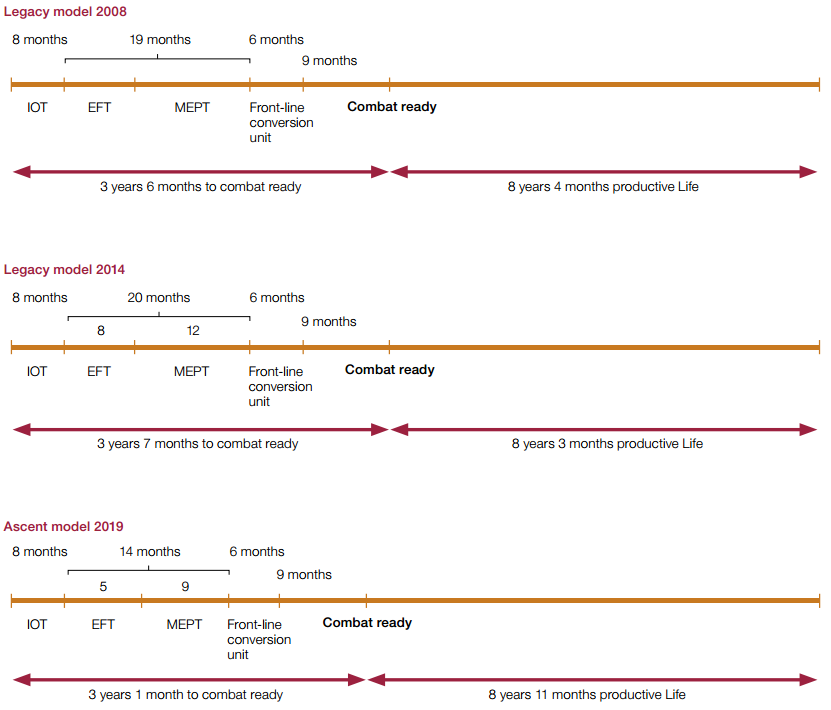
3.13 The Department's analysis indicates that potential training time has been reduced by the military since 2008 (Figure 17 on pages 44 and 45). It also indicates that further marginal improvements could be made once Ascent is running the system at full capacity. Sequencing training completion with front-line intake requirements, the timing of which Ascent does not control, will be critical to reducing training time.
3.14 The Department's baselines indicate potential performance, but they assume constant performance and do not reflect actual training time which varies significantly between students. We explored factors that may affect training time. We asked the Royal Air Force to analyse a random selection of 30 pilots from the 224 who had completed training in the past two years. The analysis showed wide variations of many months in the time to train aircrew in the same training streams. Actual training time can be much longer than the Department's baselines show. For example, the Department's 2014 baseline for training a fast-jet pilot is 48 months (Figure 17) compared to actual training time of between 55 and 83 months (Figure 18 on page 46).
3.15 The Royal Air Force pointed to some likely influencing factors, such as course overruns and issues with aircraft availability. It also noted that the 2010 Strategic Defence and Security Review had affected training time during the period covered by the sample (paragraphs 2.19 to 2.23).12 However, it could not quantify the actual impact of these factors on training time or explain all the variations in training duration.
3.16 Without understanding performance and what affects training, the Department cannot be certain what level of performance it is contracting for. It assumes that training time will reduce. However, its current approach to assessing reductions in training time may lead to it underestimating the benefits of new core training. For example, by assuming there is less scope for improvement. Or it may lead to Ascent having difficult time-in-training improvement targets, with limited incentives (paragraphs 2.39 to 2.43).
| Figure 17 Expected reductions in training time Training time and return of service for a fast-jet pilot
Training time and return of service for a multi-engine pilot
Note 1 IOT = Initial officer training; EFT = Elementary flying training; BJT = Basic jet training; AJT = Advanced jet training; MEPT = Multi-engine pilot training. Source: Ministry of Defence |
| Figure 18 Analysis of aircrew training time
Notes 1 Based on a random selection of 30 aircrew (from a total population of 224) who had completed their training during the last two years. 2 Sample contains a minimum of 2 aircrew within each training category. 3 Training times are not comparable between services as course content and duration varies. Source: National Audit Office analysis of Ministry of Defence data |
______________________________________________________________________________
12 HM Government, Securing Britain in an Age of Uncertainty: The Strategic Defence and Security Review, Cm 7948, October 2010.