Fee payments to Sellafield Limited
2.24 To the end of the first five-year term of the contract, the Authority has paid a total of £237 million in fees to Sellafield Limited for meeting its targets and objectives, from which Nuclear Management Partners receives payments as dividends. This is in line with the £230 million the Authority previously advised the Committee it could be (Figure 9). The Authority has not yet finalised the level of fees that Sellafield Limited will receive in 2014-15, against its assessment of maximum fees available for 2014-15 of around £53 million.
2.25 According to updated information provided to us by the Authority, which we have not audited, the Authority has now agreed that Sellafield Limited actually delivered efficiency savings of £715 million over the period 2008-09 to 2013-14.9 At the time of our October 2013 report, Assurance of reported savings at Sellafield, the Authority was forecasting that Sellafield Limited would achieve total efficiency savings between 2008-09 and 2013-14 of £691 million compared to a target of £699 million (in 2012 prices). Efficiency savings drive one of the main incentive based fee categories, alongside performance in meeting project milestones and identifying work that can be removed from the programme without affecting overall progress on the site. In October 2013 we reported, in response to a request for assurance from the Committee, that the Authority's systems for recording, scrutinising and challenging claimed site-wide savings at Sellafield provide moderate assurance of reported overall savings.
Figure 9 Fees paid to Sellafield Limited The Authority paid £31.5 million in fees to Sellafield Limited in 2013-14, a similar amount to 2012-13
Source: National Audit Office analysis of Authority information |
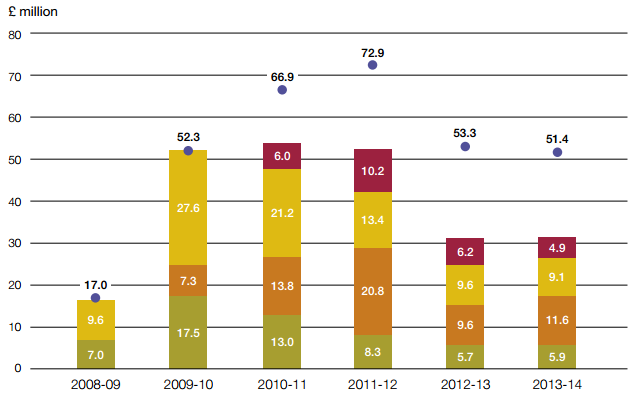
 Other fees: for example, payments for identifying work that can be removed from the plan without affecting the achievement of objectives, and providing security on the site, less abatement.
 Performance based incentive fee: earned on achievement of specific project milestones. The
  Efficiency fee: earned for outperforming the contract baseline and achieving project and operational efficiency milestones.
 Base fee: a predetermined amount earned regardless of performance.
 The
The
__________________________________________________________________________________________
9 The original target for site-wide savings was £796 million over the period (2012 prices). During 2012-13, the Authority removed legacy ponds and silos from the efficiency fee mechanism as it sought to incentivise progress on the ground rather than cost efficiency. It is for this reason that the efficiency savings target was reduced.