Improving staff capabilities and skills
2.2 DE&S has long-standing skills gaps, including airworthiness, engineering roles, commercial, logistics and project and programme management. Building on the work of an independent review for the Department,20 DE&S estimated that enhancing DE&S's skills and improving its interface with commands could deliver between £1.03 billion and £1.45 billion of financial savings from the Equipment Plan each year.21 Skills gaps emerged primarily because DE&S could not recruit and retain enough skilled staff, exacerbated by a requirement to cut staff to meet Departmental efficiency savings.
2.3 DE&S must use existing skilled staff more effectively to eliminate gaps. DE&S has no system to routinely collect accurate and timely information on what skills it has and requires, or how staff spend their time. A DE&S report noted that in 2011 of the 300 accountancy posts it required, 25% were filled by unqualified staff and a further 9% vacant, despite having 400 qualified accountants.22 In late 2013 DE&S employed a specialist private sector company to do a 'zero-baseline review' of its organisational structure. It found a structure that was not transparent, with inefficient allocation of skills to tasks and unclear accountabilities among staff.
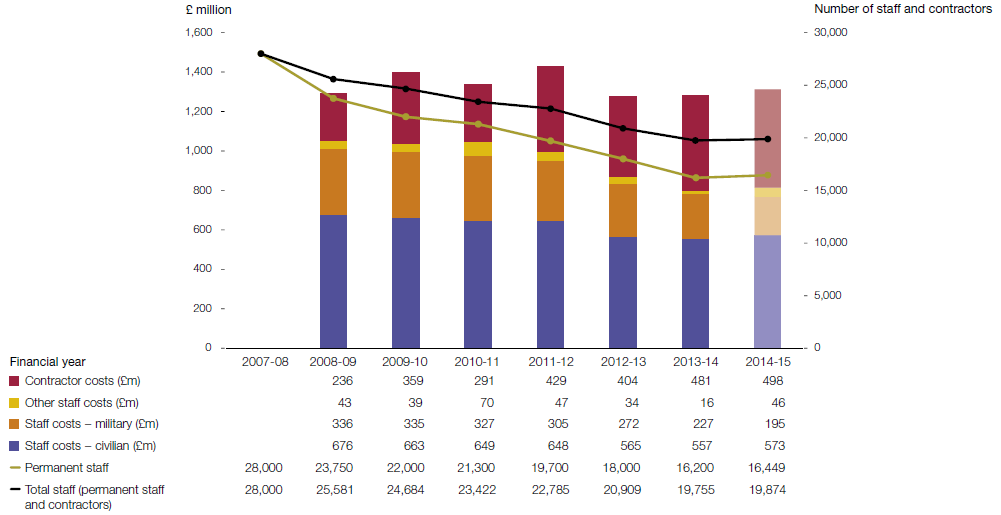
2.4 DE&S reduced permanent staff numbers by nearly half between 2007 and 2014 to try to reduce operating costs. Potential savings, however, have been offset by employing contractors who, on average, cost between three and four times more than permanent DE&S staff. The overall costs of DE&S's permanent staff and contractors fell by £9 million between 2008-09 (£1,290 million) and 2013-14 (£1,281 million) (Figure 3). In 2013-14 we estimate that contractors' costs comprised 37% (£481 million) of overall operating costs.23
2.5 Employing contractors can be beneficial, allowing more flexible working practices as well as providing essential skills that are not available in-house. Contractors have been employed to address gaps in specialist roles, such as technical and engineering.24 However, DE&S lacks robust information on how project teams are using contractors, and the cost of doing so. DE&S has also had to reduce permanent staff numbers to meet Departmental efficiency savings. These two points prevented management from getting a strategic view, and risks achieving value for money from how it gets skills from the private sector.
2.6 To address continued skills gaps at DE&S, the Materiel Strategy set out a need for greater freedoms, including:
• paying market rates to compete with industry. For some specific skills, DE&S assessed it was offering salaries between one-fifth and three-quarters less than industry;
• incentivising people to improve performance;
• allocating staff to tasks where their skills are most required; and
• better matching the workforce to suit the tasks demanded of them.
2.7 Since May 2014, DE&S has gained more freedom from a number of standard civil service rules to offer greater financial rewards to attract and retain certain skills. In addition, they no longer have to meet the headcount reduction target. DE&S now has a target operating cost of £1.3 billion for 2014-15, reducing to £1.2 billion by 2016-17.
| Figure 3 Staffing numbers and costs at DE&S
Notes 1 Figures exclude inflation. 2 Numbers are full-time equivalents. Average contractor day rates of £500 and £638 were used. 3 DE&S lacks robust staff or contractor costs for 2007-08. 4 Contractor costs in 2008-09, 2009-10 and 2010-11 only include consultancy support through corporate contracts and not consultancy support directly procured by project teams as the Department lacks this information. Contractor costs for 2011-12 and 2012-13 are based on retrospective consultant-led assessments of contractor costs incurred for the Materiel Strategy. Before 2014-15 DE&S did not budget for, or monitor, contractor costs in their entirety. 5 Other staff costs include messing, food and overseas allowances and redundancy costs. 6 2014-15 data are September 2014 forecasts, including £31 million of managed service provider costs. 7 2014-15 data includes costs and staff numbers associated with naval bases, Information Systems and Services organisation and commercial directorate for comparative purposes, as they transferred out of DE&S in April 2014. Source: National Audit Office analysis of Departmental data |
2.8 DE&S has contracted industry to provide a project and programme service provider role for £215 million over 3.5 years. DE&S has agreed contracts with the managed service providers so part of their fees are, in principle, linked to milestones and a set of metrics. However, DE&S has not defined these metrics and agreed a baseline to track progress in carrying out reforms and transferring skills and capabilities to DE&S staff. It has not yet decided whether different pay scales will increase staff costs without a net increase in capability.
______________________________________________________________________________
20 Review of Acquisition for the Secretary of State for Defence (the Gray Review) 2009.
21 Materiel Strategy Outline Business Case, January 2013. Financial savings include both current costs saved and future costs avoided. The remaining savings would come from addressing the overheated equipment programme.
22 DE&S, Way forward on DE&S Organisation Design: The Materiel Strategy supporting report, January 2012.
23 DE&S estimates that if it had recruited all posts in-house the cost would have been between £111 million and £148 million.
24 Chief of Defence Materiel evidence to the Defence Select Committee, 12 December 2013, Q22.