Improving the systems and tools
2.9 DE&S faces several challenges in reforming its systems and processes, including:
• relatively weak business capabilities and business management;
• poor financial information;
• lack of integration between different information systems; and
• poor contract and inventory management.
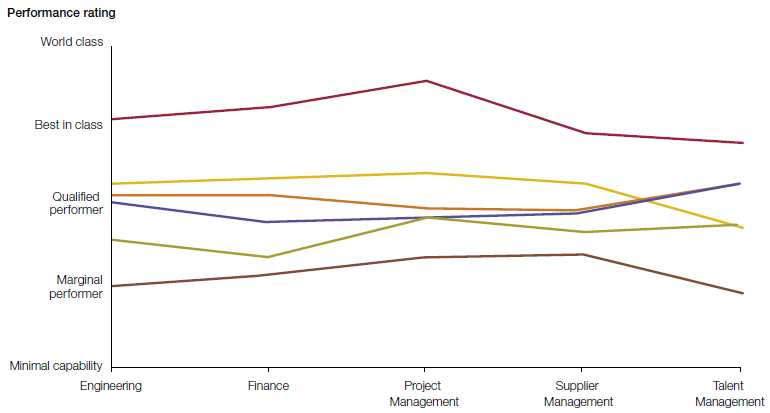
2.10 A 2011 independent assessment of DE&S's business capabilities in five categories scored DE&S in the lower quartile against 160 capital-intensive projects in government and international private sector organisations (Figure 4).25 There is a difference between how the review assessed DE&S's skills and DE&S's self-assessment. The former was based on the reviewer's established methodology, the latter on a DE&S staff survey.26
2.11 Poor integrated systems hinder effective scrutiny of equipment project costs.27 DE&S uses its management information system to monitor project performance, including costs. However, it does not reconcile these costs with the same projects reported on the Department-wide planning budget and forecasting system used for in-year budget monitoring and Departmental scrutiny of its financial position. The poor quality of the business information the Department had, which consortia were required to base their bids on, was partly why one of two consortia withdrew from the bidding process in November 2013.28
2.12 DE&S also lacks systems and expertise on most equipment projects to link industry payments to progress, even though this technique, known as earned value management, has been mandated since the 1990s. Similar techniques have been used on Crossrail.29 Lack of such a system reduces critical financial information, such as whether projects are on budget and managing in-year budgets. DE&S has also struggled to quantify why there have been underspends in the Equipment Plan.30 There may be several reasons for underspends, such as delays or delivering equipment more cheaply, but a lack of information makes it more challenging to respond effectively. Our review of a sample of major defence projects found that most underspend had not come from efficiencies, but from poor project team or contractor performance.31
Figure 4 Business capability summary assessment
Source: Departmental-commissioned analysis, conducted in autumn 2011, of more than 160 capital intensive projects |


2.13 DE&S is now implementing a forecasting improvement programme to address poor financial management in project teams.32 It has introduced several other changes to improve internal processes, including:
• A new board-level quarterly review of performance, finance and risk has been instigated to increase scrutiny. The resources of DE&S's Cost Assurance and Analysis Service, responsible for providing semi-independent advice on project costings has also been bolstered. DE&S has enhanced its finance function by appointing a director-general of resources from industry and four financial controllers working with the chiefs of materiel.
• DE&S has sought to enhance its commercial expertise. A director of commercial operations was appointed from industry, and there is a greater focus on contract management and establishing strategic engagement with key suppliers. DE&S has set up a graduate recruitment scheme for commercial skills, one of the first government organisations to do so.
• DE&S has enhanced its inventory management by setting up a dedicated inventory management team, commissioned a specialist private sector company to review holdings, and put in place a new inventory management system.33 DE&S is currently running a competition to contract out parts of its inventory management system to improve value for money.34
• DE&S let a £43 million, three-year contract in November 2014 with a managed service provider to identify an optimum organisational structure for DE&S and support its implementation by creating an in-house human resources function.
2.14 DE&S has postponed securing a managed service provider to deliver enhanced financial controls and a single source of accurate and timely management information until summer 2015. It has postponed this part of reform so it can better understand the requirement as it develops support in other areas.
______________________________________________________________________________
25 This work built on previous assessments of DE&S's capabilities and skills. For example, the Department commissioned a review in 2010 which benchmarked DE&S's project and programme management performance against similar companies. This review, although limited in scope, found DE&S was relatively strong compared with peer organisations.
26 Categories were: engineering, finance, project management, supplier management and talent management. Evidence taken before the Defence Committee of the House of Commons, 4 September 2013. Available at: www.publications.parliament.uk/pa/cm201314/cmselect/cmdfence/652/c65201.htm
27 The corporate management information system only reports on new projects, not equipment in-service (around half of the Equipment Plan), with this being monitored via offline spreadsheets.
28 The third bidder had previously withdrawn from the GoCo competition as it was involved in another Departmental transformation programme and had insufficient resources to bid on both.
29 Comptroller and Auditor General, Department for Transport: Crossrail, Session 2013-14, HC 965, National Audit Office, January 2014.
30 The equipment programme underspent by £850 million in 2011-12 and £1.355 billion in 2012-13. To avoid a 2013-14 underspend the Department used over-programming by planning work above the budgeted level to compensate for predicted underspending in-year. When the Department became concerned that an underspend against the Defence budget would emerge in-year, a further £213 million of additional work was added to the equipment programme. Taken together, this resulted in an £185 million overspend against the equipment programme. Against the combined work programme (including the additional programming added in-year), the Department underspent by £948 million in 2013-14.
31 Comptroller and Auditor General, Major Projects Report 2014 and the Equipment Plan 2014 to 2024, Session 2014-15, HC 941-I, National Audit Office, January 2015, paragraph 2.12.
32 Comptroller and Auditor General, Major Projects Report 2014 and the Equipment Plan 2014 to 2024, Session 2014-15, HC 941-I, National Audit Office, January 2015, paragraph 2.13.
33 DE&S estimates that it has reduced inventory purchases by £1 billion between 2011-12 and 2013-14, and disposed of more than £10 billion of inventory during this period.
34 DE&S's logistics and commodity service.