Appendix Three Implementing a GoCo
1 In 2011 the Ministry of Defence (the Department) launched the Materiel Strategy to reform defence acquisition. It consisted of several business models for running Defence Equipment and Support (DE&S). Ultimately, the Department chose to contract out the running of DE&S to the private sector, with the Department retaining strategic direction and ownership of DE&S's assets. This is known as a government-owned, contractor-operated organisation (GoCo) (Figure 8).
2 The Department expected the GoCo to address long-standing weaknesses in DE&S by:
• giving DE&S greater freedoms to introduce private sector practices, skills and tools;
• formalising and introducing rigour in dealings between DE&S, the Armed Forces (the commands) and head office; and
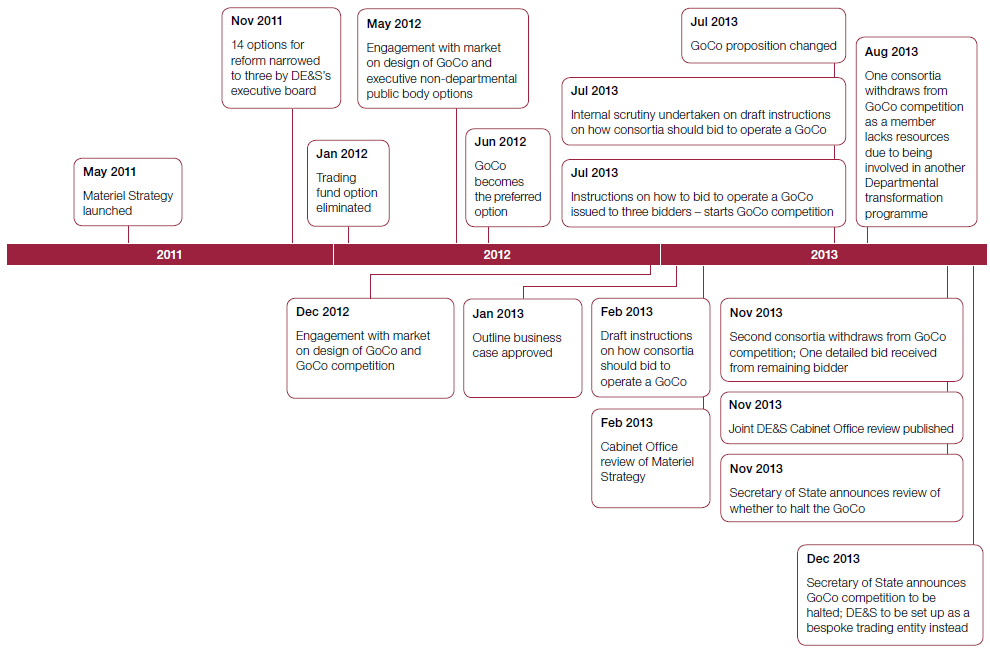
• improving DE&S's efficiency, as the private sector would be incentivised to manage the organisation and deliver the Equipment Plan for less.
Figure 8 Characteristics of a government-owned, contractor-operated organisation Organisation providing equipment and/or services to government, but outside the government boundary; ring-fenced as a private sector entity. Government retains ownership of the strategic direction and assets, but the GoCo is operated on a for-profit basis by a private company accountable to its shareholders. Relationship between government and the GoCo is through a contract, with the GoCo incentivised through commercially negotiated fees. Employees are private sector workers. Accounting officer role for all Departmental expenditure on equipment and services provided by the GoCo remains with Department's accounting officer. Source: The Department |
3 Contracting with the private sector, however, put extra responsibilities on the Department. It had to act as an intelligent customer of the GoCo, and the deal would have been complex to secure.
4 Lower-risk options, including an incremental approach to improvement used elsewhere in the Department, were dismissed. The Department's internal scrutiny team, as part of their routine assessment of investment business cases, advised that the Department had pre-judged its preference for a GoCo and there were major weaknesses in the evidence supporting the proposal's benefits.
5 The timeline setting out the key events during the Department's implementation of a GoCo is outlined in Figure 9 overleaf.
6 In April 2013 the Department launched a competition to secure a proposal to operate DE&S as a GoCo. Three consortia met the Department's requirement and the Department invited them to participate in the competition. In August 2013 a consortia withdrew from the competition because a constituent member lacked resources to bid. This company was already participating in another Department transformation programme. In November 2013 a further consortia withdrew from the competition, and in December 2013 the GoCo was halted due to a lack of competition, as only one detailed bid was received from industry. This was partly because:
• poor governance arrangements exacerbated the different expectations that had emerged within the Department and DE&S on the timing and nature of financial savings from the proposition; and
• there remained a lack of clarity on the level of risk being transferred to the private sector.
Figure 9 The Materiel Strategy
Source: National Audit Office analysis of Departmental data |