Part One Background
1.1 In June 2014, we published a report on the Thames Tideway Tunnel project.2 Our report outlined six areas that we considered most critical to achieving value for money for customers and the taxpayer, and criteria that we would use if we were to undertake a value-for-money study in future (Figure 1). We did not evaluate the value for money of the project at that point, to avoid influencing the outcome of ongoing competitions for the construction and financing of the Tunnel.
Figure 1 Areas we identified in our 2014 report | |
Setting clear project objectives | Are the aims of the project clear, measurable and achievable? Is there a clear definition of success? |
Appraising the options | Has the preferred option been shown to be the most cost-effective way of meeting the project objectives compared with the alternatives? |
Choosing the right delivery model | Does the choice of delivery model maximise value for money in procuring the project? |
Managing taxpayer risk | Will a government contingent financial support package help secure private finance at a good price without undermining investors' incentives to deliver a successful project? |
Managing project costs and risks | Are costs and risks well understood and do all parties have incentives to keep these as low as possible? Where the interests of private parties are not aligned with those of taxpayers or consumers, is there effective independent scrutiny and challenge of costs? |
Setting the right charge for consumers | Is the amount consumers will pay subject to appropriate scrutiny to protect consumers' interests? |
Source: National Audit Office, Thames Tideway Tunnel: early review of potential risks to value for money, 2014 | |
1.2 Large parts of London's sewers combine the collection and transfer of sewage and rainwater in the same pipes. By design, these combined sewers discharge into the River Thames via 57 Combined Sewer Overflows (CSOs) when sewers reach their holding capacity, rather than overflowing into, and flooding, London's built-up areas. Public concern about the impact of these discharges on the environment has grown as their frequency has increased over time, notably after discharges killed large numbers of fish in 2004 and 2011.
1.3 Figure 2 sets out the timeline of events in developing a solution to the problem of CSO discharges. In 1991, the European Union adopted the Urban Waste Water Treatment Directive (the Directive). The Directive aims to protect the environment from wastewater discharges, with the expectation that large conurbations in member states would comply by 2000. In 2000, Thames Water funded a study aimed at finding a solution to this issue in London, which reported in 2005. In part based on the findings of this study, the European Commission issued a 'reasoned opinion' in 2006 stating that the UK was failing to comply with the Directive. The Department for Environment, Food & Rural Affairs (the Department) announced support for the Tunnel as the preferred option in 2007.
1.4 In 2012, the Court of Justice of the European Union found the UK in breach of the Directive due to the frequency of spills. We estimate that the UK could therefore face the possibility of a lump sum fine of between £9 million and £177 million, and recurring daily fines amounting to between £11 million and £227 million per year (in 2016 prices), until compliance is verified by the Commission.3 A package of measures designed to improve water quality in the Tideway concluded in January 2016 with the completion of the Lee Tunnel, but Thames Water estimates that spills will by 2021 still reach 59 for the highest-spilling CSO in a 'typical year', with discharge volumes at 18 million cubic metres.4
1.5 The Department has overall policy responsibility for water and sewerage in England, overseeing compliance with European Union environmental directives, and is the lead government department for the project. Other public bodies have responsibilities in relation to the problem and action to find a solution:
• The Environment Agency is the environmental regulator in England. It is responsible for requiring Thames Water to identify and implement solutions to limit pollution.
• The Water Services Regulation Authority (Ofwat) is the economic regulator of the water industry in England and Wales. Ofwat has duties to protect the interests of consumers, and to ensure that efficient companies can finance their functions. In doing so, Ofwat must also promote economy and efficiency by water companies.
• Other public bodies have been involved during development of the project, including HM Treasury, and the Infrastructure and Projects Authority.
Figure 2 Development timeline for the Thames Tideway Tunnel | ||
1991 | May | European Urban Waste Water Treatment Directive signed into law. |
2000 | December | Deadline for London's compliance with the Directive. |
2005 | February | Thames Tideway Strategic Study issued its final report recommending a full-length tunnel. |
2005 | March | European Commission first wrote to the Department citing complaints received around high level of spills in the Tideway. |
2006 | February | Ofwat-commissioned Jacobs Babtie report published, suggesting a shorter, two-tunnel alternative solution to the Tunnel. |
2006 | April | European Commission issued a Reasoned Opinion against the UK government for failing to comply with the Directive. |
2006 | December | Thames Water published analysis considering 'Full Tunnel' and 'East-West Tunnel' solutions, concluding that the latter would fail required environmental standards. |
2007 | March | The Department announced that a full-length tunnel was the preferred option. |
2010 | July | European Commission lodged a court application against the UK for breach of the Directive. |
2010 | September | Thames Water Needs Report published, concluding that the Tunnel is the most cost-effective way of securing environmental objectives. |
2012 | March | National Policy Statement for Waste Water was presented to, and approved by, Parliament, setting out government's view that the national need for the Tunnel had been demonstrated, and that a tunnel-based solution was the only viable option. |
2012 | October | Court of Justice of the European Union found the UK in breach of the Directive for London, due to unacceptably high spill frequency along the Tideway. |
2013 | October | Thames Water announced shortlists of consortia bidding for the three main construction work packages. |
2014 | September | Ministers granted Development Consent for the Tunnel. |
2015 | August | Ofwat granted Bazalgette Tunnel Limited a regulatory licence; Government Support Package agreed; project achieved financial close. |
2016 | January | Bazalgette began pre-construction work at various sites. |
2018 | May | Tunnelling to begin. |
2021 | August | Tunnelling to be completed. |
2022 | October | System commissioning to begin. |
2024 | March | Tunnel expected to be fully operational (subject to testing). |
2027 | February | Commissioning and systems acceptance completed, triggering expiry of the government's contingent support package. |
Source: National Audit Office analysis of documents provided by the Department | ||
1.6 Thames Water, a privately-owned company, is responsible for sewerage infrastructure in London, and for developing a solution to the overflows problem. As the licensed sewerage undertaker for London, Thames Water has duties to ensure that its sewerage system meets the Directive requirements. The government is involved owing to the scale of the issue and because it would be liable for fines for Directive breaches.
1.7 Government developed strategic objectives for a solution: to secure compliance with the Directive, and to improve the environmental quality of the Tideway by reducing sewage overflows. In 2014, the government added a third objective, to ensure sufficient strategic sewer capacity to accommodate London's growth for at least the next hundred years.
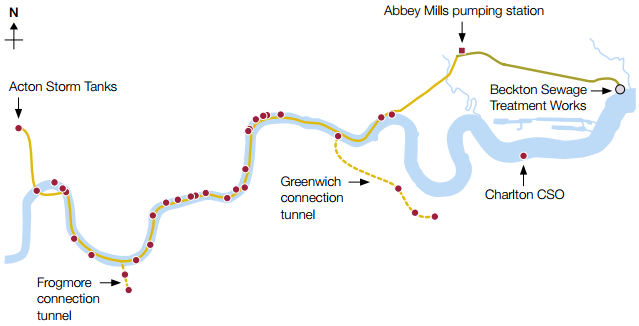
1.8 The Thames Tideway Tunnel has been identified as the government's preferred option to address the environmental impact of residual storm sewage overflows into the Tideway and meeting its objectives. The planned Tunnel project will build a large sewer running under the River Thames for 25 kilometres from Acton in West London to Abbey Mills in East London (Figure 3).
Figure 3 Planned route of the Thames Tideway Tunnel The Tunnel will actively manage flows from 34 Combined Sewer Overflows (CSOs) | |
| |
| CSO controlled by the Thames Tideway Tunnel |
| CSO controlled by the Lee Tunnel |
| Thames Tunnel |
| Lee Tunnel |
Note 1 Charlton CSO is to be controlled by operation changes at Greenwich pumping station and improvements at Crossness sewage treatment works. Source: Bazalgette Tunnel Limited | |


1.9 While the project will be delivered and financed privately, the government has provided a contingent financial support package (the GSP) to enable this. Thames Water undertook planning, design of tenders and overall system design. A separate infrastructure provider will deliver the project, overseeing the work of three consortia which will each undertake detailed design, and construction of, separate sections of the Tunnel. Thames Water's customers are expected to meet the project's costs through their water bills.
1.10 Since our 2014 report:
• a specially-created private company, Bazalgette Tunnel Limited (Bazalgette) has won Thames Water's infrastructure provider procurement competition, to build, finance, own and operate the Tunnel. Thames Water also awarded three tunnelling works contracts following procurement competitions;5
• a regulatory framework has been established covering Bazalgette. Ofwat issued Bazalgette with a project licence in August 2015;
• government has provided a contingent financial support package to Bazalgette;
• the project has received development consent; and
• Bazalgette began preparations for construction work in 2016.
1.11 Thames Water and the Department considered the merits of three alternative models for delivering the project, alternatively by: Thames Water; an independent 'Infrastructure Provider'; and the public sector. The Department's financial consultants (Ernst & Young) appraised the costs and benefits of these delivery models, concluding that a separate Infrastructure Provider was the most cost-effective way of delivering the Tunnel while satisfying policy preference to minimise calls on government capital, and limiting customer bills.
1.12 The Thames Tideway Tunnel has attracted opposition from a range of local authorities and individuals who have variously considered that:
• environmental performance thresholds set for the Tideway go beyond the requirements of the Directive;
• government has not properly considered whether a mix of solutions could achieve environmental objectives more cheaply;
• the cost-benefit analysis for the Tunnel is flawed; and
• the Tunnel is no longer needed owing to upgrades to the London sewerage system since the Tunnel was first proposed, or due to the prospect that the UK will leave the European Union.
1.13 In this report we update developments since June 2014, including programme progress and estimates of costs. We examine how the Department and the Environment Agency have managed risks in areas which are now substantively complete, particularly in setting objectives and appraising options. We also look at the risks to customers and the taxpayer which the public sector need to manage to protect value-for-money during the construction phase. It is too early to form a value-for-money conclusion on the whole project but this report, together with our 2014 report, outlines what we would expect to see when the project is complete.
1.14 The methods of this report are detailed in Appendix One.
_________________________________________________________
2 Comptroller and Auditor General, Thames Tideway Tunnel: early review of potential risks to value for money, Session 2014-15, HC 168, National Audit Office, June 2014.
3 These ranges are based on our application of the European Commission's advisory formula for calculating non-compliance fines. The level of fines is ultimately a matter for the Court.
4 Thames Water, Needs Report, 2010.
5 A contract has also been awarded to a 'Systems Integrator', which will be responsible for installing, testing and maintaining communications and monitoring equipment.