Project cost estimates
3.4 If costs are in line with current expectations, Thames Water's customers will fund the £4.2 billion capital costs over the project's expected economic life (in 2016 prices), plus ongoing running costs. Thames Water's customers will ultimately pay less or more than this, depending on whether total costs are lower or higher than current expectations.
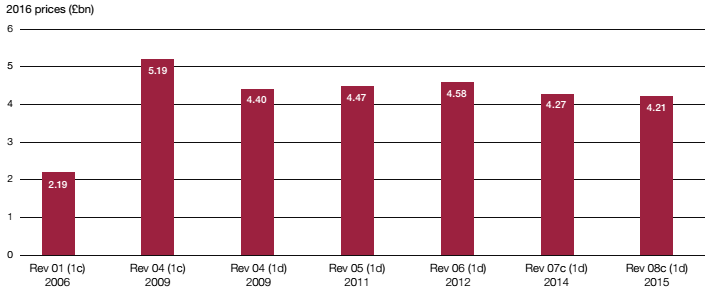
3.5 Cost estimates have risen over time during planning, but have remained relatively stable since 2009. The initial costing for a full tunnel option in 2006 was £2.2 billion, although the cost of the Tunnel increased significantly to £5.2 billion by 2009 (Figure 11). Ofwat's consultants, Mott MacDonald, attributed the increases primarily to more realistic cost estimates for carrying out required works, and a greatly increased level of contingency for risk, which had increased to £1.2 billion. The current £4.2 billion estimate consists of £3.2 billion to be undertaken by Bazalgette (£1.9 billion base construction costs, £0.8 billion indirect costs and £0.5 billion contingency), and Thames Water's enabling works estimated at £1.0 billion. Bazalgette is targeting a saving on this estimate, through completing construction early and therefore reducing headcount and time-related construction costs sooner.
| Figure 11 Changes in the estimated cost of the Tunnel over time The Tunnel's estimated cost has stayed relatively stable since 2009 (2016 prices) |
|
|
| Notes 1 Option 1c refers to a longer configuration of the Tunnel which was the previously preferred option. 2 Option 1d refers to the shortened 25km tunnel which is the current specification of the Tunnel. Source: Ofwat analysis of Thames Water costings |
3.6 Factors affecting cost estimates' maturity in major projects include improvements in information, scope changes and unexpected developments.12 Since 2009, estimates of the Tunnel's cost have periodically increased (largely due to scope changes aimed at mitigating the risk of failing to achieve planning consents) and decreased (owing to Thames Water's modelling refinements after 2007 which allowed the design of a shorter tunnel - see paragraph 2.18). Ofwat's consultants have not raised material cause for concern over the current cost estimate. Experience from costs on the Tunnel's 'sister' project, the Lee Tunnel, has been used to improve understanding of costs.
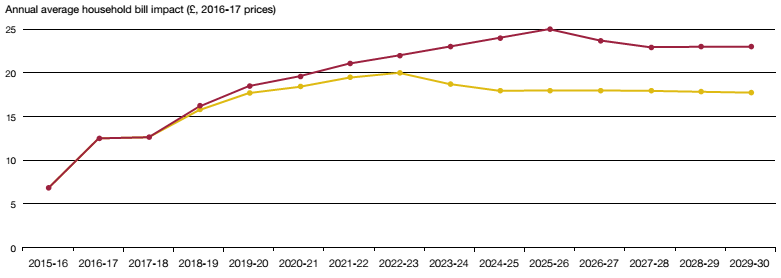
3.7 Thames Water customers are already paying for the project, and will continue to do so over its expected 120-year economic life. Thames Water's modelling indicates that the charge on the average annual household bill will rise from £13 in 2016-17 (in 2016-17 prices) to a peak of between £20 and £25 (in 2016-17 prices), before declining gradually (Figure 12 overleaf). This projection assumes that cost overruns are no higher than 30% of the £3.2 billion target price for the project works, although the Department considers the probability of this occurring to be below 5%.13 Bazalgette will invoice Thames Water on a monthly basis according to a charging formula similar to that used to calculate water bills in England and Wales. Thames Water is obliged under the terms of its regulatory licence to collect the required revenues from its customers and pass these to Bazalgette. Ofwat reviews and approves Tideway charges annually.
3.8 In 2015, the government put in place the GSP, which transfers some potential project risks from customers and investors to taxpayers (paragraphs 3.15 to 3.17). By reducing potential risks to investors, the GSP was key to Bazalgette financing the project on a lower regulated return than would have been possible otherwise (2.497%). Arrangements put in place in 2015 governing how Bazalgette would earn revenues also provided greater certainty around expected costs. To date Bazalgette has arranged £1.27 billion of equity finance and £2.2 billion of debt.14 The lower than expected cost of finance has helped to reduce the expected impact of Tunnel costs on household bills - in 2011 the Department announced an estimated annual impact on bills at between £70 and £80.15
| Figure 12 Forecast customer bill impacts for the Thames Tideway Tunnel Average annual household bills for Thames Water customers already include £13 for the Tunnel, with peak bill impact expected to reach £20 to £25 | ||||||||||||||||
|
| ||||||||||||||||
|
| High case | 7 | 13 | 13 | 16 | 18 | 20 | 21 | 22 | 23 | 24 | 25 | 24 | 23 | 23 | 23 |
|
| Low case | 7 | 13 | 13 | 16 | 18 | 18 | 19 | 20 | 19 | 18 | 18 | 18 | 18 | 18 | 18 |
| Notes 1 Illustrative profiles show potential impact on average household bills over time of variations in construction cost and market interest rates. 2 The declining profile of the Tunnel's bill impact after each peak reflects the assumed contribution of land sales to lowering customer bills. Source: Thames Water | ||||||||||||||||


_______________________________________________
12 Various past reports identify common contributory factors, for example: Comptroller and Auditor General, Delivering major projects in government: a briefing for the Committee of Public Accounts, Session 2015-16, HC 713, National Audit Office, January 2016.
13 European Commission, State Aid SA.37045 (2015/N) - United Kingdom, Government support to the Thames Tideway Tunnel project, August 2015.
14 Equity is provided by a consortium of investors: Allianz, Dalmore Capital Limited, INPP, DIF and Swiss Life. Debt investors include a £700 million European Investment Bank loan, a £1 billion committed revolving credit facility provided by several banks, and bond issues totalling £450 million.
15 Written Ministerial Statement, Hansard, 3 November 2011. Available at: www.publications.parliament.uk/pa/cm201011/cmhansrd/cm111103/wmstext/111103m0001.htm