The Government Support Package
3.15 The government's provision of the GSP to Bazalgette is aimed at mitigating some risks, and transferring liability to the taxpayer if those risks materialise. The Department concluded that private delivery of the project would not be financially viable without some form of government support, because of the scale of the project risks and the implications for financing costs that customers would face. Support is being made available to the building of the new nuclear power station at Hinkley Point, for similar reasons.
3.16 Under the terms of the GSP, which expires when the three-year post-construction project testing period is expected to be complete in February 2027, the Department has agreed to provide financial support in certain limited circumstances:
• Cost overruns. The project's target price is £3.2 billion. The Department concluded that Bazalgette's potential investors needed to know the risks of cost overruns and the extent of their liability. The Department has set a cost overrun threshold of £4.1 billion, or £960 million (30%) above the target price: if Bazalgette's costs exceed this threshold, the Department agrees (under the 'Contingent Equity Support Agreement') to either provide equity to Bazalgette; or discontinue the project and pay compensation.
• Disruption to capital markets. The Department agrees to lend to Bazalgette if economic or political events make it unable to access debt capital markets as planned. A 'Market Disruption Facility' commits the Department to providing short-term liquidity on commercial terms. In the event of disruption to capital markets, the Department would be liable to provide a short-term loan of between £100 million and £500 million, exposing it to the risk of Bazalgette not repaying the loan.
• Indemnity. The Department agrees to provide an indemnity to Bazalgette on commercial terms to cover for liability claims which exceed the company's commercially arranged insurance limits or where insurance is unavailable. Bazalgette requires an indemnity for accidental third party injuries or deaths, or damage to project assets or third party property. A 'Supplemental Compensation Agreement' (SCA) sets out the terms under which this indemnity is provided. The Department would be liable for claims above £2.26 billion per event for damage to construction works, and £750 million per event for third party death, injury or damage.
• Compensation for discontinuation. The Department agrees to pay specified compensation to investors in the event that it decides to discontinue the project. The Department has rights under specified circumstances, to withdraw the GSP, which would likely mean that the project could not be completed. Compensation would be linked to allowed project spend incurred, and the cost of breaking investors' hedging contracts.
• Special administration. A regime is in place if Bazalgette goes into special administration and remains there for 18 months. The 'Special Administration Offer Agreement' provides for the Department to offer to purchase Bazalgette on whatever terms the Department feels appropriate (or to discontinue the project and pay compensation, as above).
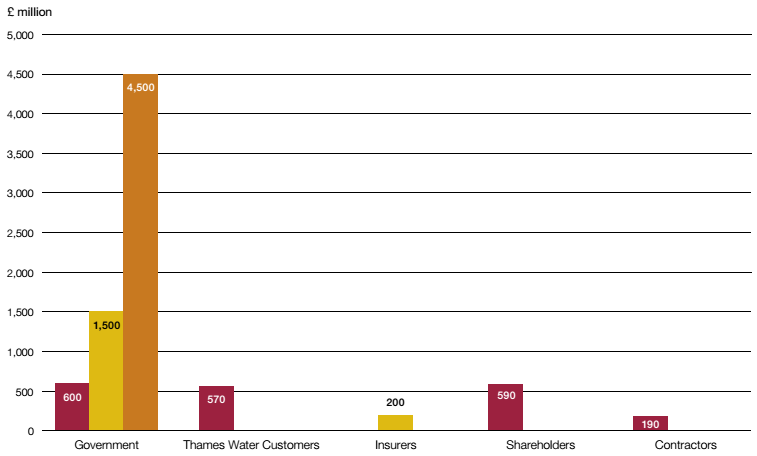
3.17 The Department considers that a call on the GSP is highly unlikely, although it estimates that the impact could be very large if risks materialise. Because some support package elements involve lending or equity finance, which would attract fees, the net financial impact on the taxpayer of providing the GSP is difficult to predict. The Department estimates that government's total exposure in the event of its 'reasonable worst case' scenario could be as high as £6.6 billion if several risks materialised. This 'reasonable worst case scenario' would also result in customers, shareholders and contractors experiencing financial losses (Figure 15 overleaf).
3.18 The Tunnel is one of a number of major infrastructure projects where the government has provided contingent support to facilitate private delivery. The National Infrastructure Plan indicates that the government is becoming increasingly dependent for delivery of major public infrastructure on private finance, and on government support to ensure that sufficient private finance is raised. This can be seen in both taxpayer-funded infrastructure, and in other projects paid for by customers such as the planned nuclear power station at Hinkley Point. As we stated in our 2015 report on the UK Guarantee Scheme,18 government needs to maintain rigorous and objective approaches to ensure that guarantees - and other support - are genuinely needed and that the projects supported bring significant public value.
| Figure 15 Costs incurred in the Department's 'reasonable worst case' scenario Government would bear £6.6 billion of the costs in its 'reasonable worst case' scenario, with customers funding another £0.6 billion | |
|
| |
|
| Overspend |
|
| Insurance/Indemnity |
|
| Cancellation |
| Notes 1 The scenario envisioned assumes government indemnity is called on and a late discontinuation of the project, in which customers only fund their share of overspends up to the 30% threshold, whereupon government provides contingent equity. 2 Cancellation costs include £0.4 billion hedging breakage costs. Source: National Audit Office analysis of the Department's estimates | |


_______________________________________________________________________
18 Comptroller and Auditor General, UK Guarantees scheme for infrastructure, Session 2014-15, HC 909, National Audit Office, Janauary 2015.