Innovation and focus on outcomes
The output/performance focus of government specifications for most PPPs provides greater scope for the private sector to bid innovative solutions which can deliver the required services at a lower whole of life cost. As government is more concerned about service levels and outcomes over the applicable period of time rather than the form of physical assets used to deliver them, bidders have an opportunity to think laterally and identify opportunities to provide the required services in new ways that improve outcomes and/or reduce costs.
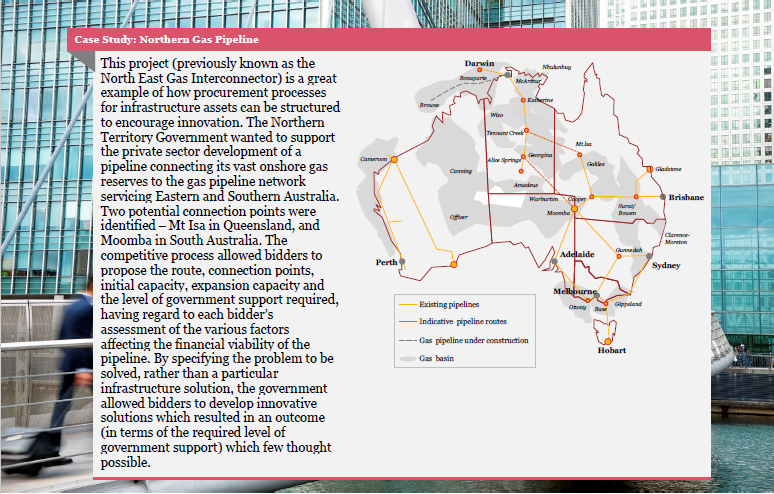
The use of a PPP model is not a prerequisite to obtaining innovative solutions to service needs. There is no reason why government cannot secure similar levels of private sector innovation during the bidding process for a D&C or DCM contract. A key to greater innovation is to give thought to framing the project objective in such a way that bidders may come up with a variety of different means to achieve the desired outcome. A minimalist output specification at tender will generate greater innovation than a prescriptive input specification, regardless of the contract model used to deliver the ultimate product. That said, a contracting model that bundles operation and maintenance into the contract can help drive operator led innovations.
Similarly, after contract award, the scope for private sector contractors to innovate in the delivery of design, construction, maintenance and other services is often identical under PPPs and many traditional delivery models. Having selected the winning bidder based, in part, on its proposed solution, government will wish to lock that solution into the contract, to prevent the contractor from providing an inferior solution that nonetheless meets the government's output specification. Government typically does this by ensuring that the contract requires the design developed by the successful bidder after contract award to not only satisfy the output specification but also be at least 'as good as' the design solution proposed in the bid. This approach, which applies equally to both PPP and more traditional delivery models, intentionally limits the innovation that can occur after contract award.
The high level of risk transfer that PPPs and other fixed-price delivery models seek to achieve actually stifles innovation. Innovative solutions often involve more risk than tried and tested ones. Contractors and investors will play it safe if the financial consequences of an innovative approach failing are disproportionate to the benefits they gain if the innovative approach succeeds. If risky innovation is critical to the success of a project, government should consider other delivery models that share this risk, such as alliancing.