5.3 INVESTIGATIONS AS TO THE CAUSE OF THE COLLAPSE AT OXGANGS SCHOOL
5.3.1 Following a series of investigations of the wall in question undertaken in February by WRD, they produced a structural report, setting out their views as to the reason for the wall failure at Oxgangs. The Report was dated 29th February 2016.
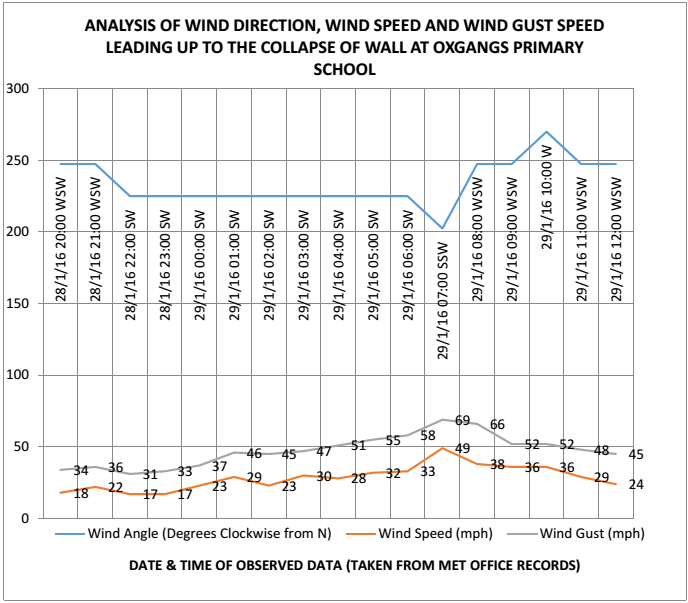
5.3.2 Their Report concluded that the wind strength of Storm Gertrude at the time of the collapse, as advised by the Met Office, should alone not have been sufficient to lead to the failure of the brickwork panels if the panels had been designed and constructed correctly. The Claim Check Service of the Met Office recorded gusts of up to 69 mph around the time of the collapse of the wall, which were at a level 20% lower than the design requirements as specified in the British Standard BS 6399 on wind loadings, for which the walls should have been designed and constructed to be capable of resisting.
5.3.3 The graph presented at the end of this section shows a representation of the wind speed over the period during which the wall collapsed. This indicates that the strongest gusts recorded occurred at 7.00 am on the morning of 29th January 2016. It was thought that the collapse occurred sometime around this period although no one is recorded as actually witnessing it. This would only be shortly before children would have started to arrive at the school.
5.3.4 The WRD Report, the remit for which at the time did not extend to other parts of the external walls of Oxgangs School, identified the primary contributory factor for the collapse of the wall to be insufficient embedment of many of the wall ties in the external leaf of brickwork, as a result of incorrect construction and/or installation.
5.3.5 On receipt of the Report ESP instructed its lawyers to issue what is called a 'defect notice' to the main contractor, originally Miller Construction, now Galliford Try, inviting them to remediate the defects at Oxgangs and encouraging them to investigate the other Phase 2 schools to ensure similar defects did not exist. The defects liability period had not expired for the four Phase 2 schools and so the original contractor was still contractually bound to make any defects good.
5.3.6 The conclusions of the WRD Report on the Oxgangs wall included the following statements:
"Cavity width is variable in width and would not consistently allow the minimum 50mm of embedment of wall tie to be achieved with the specified 250mm wall ties"
"Wall ties not being positioned central to the cavity, thus not consistently allowing the 50mm embedment into the outer leaf"
"A combination of excessive cavity width, related non-verticality, incorrectly constructed wall ties, has resulted in a cavity wall construction which in many of the ties had insufficient embedment of the wall ties in the outer leaf. This in our view was the primary contributory factor."
5.3.7 The following are some of the more specific findings of the WRD Report based on site investigations and measurements undertaken by WRD:
• wall ties were generally found to be spaced at 450mm vertically and 900mm horizontally in accordance with standard guidance;
• WRD assessed the width of the cavity to the collapsed wall to have ranged from between 15mm to 40mm wider than the width specified in the design of 120mm;
• measurements of the projecting length of 19 wall ties left in the inner leaf after the collapse showed that over 50% of these would have been insufficiently long to have provided the required minimum embedment of 50mm in the outer face assuming a cavity width of 120mm; and
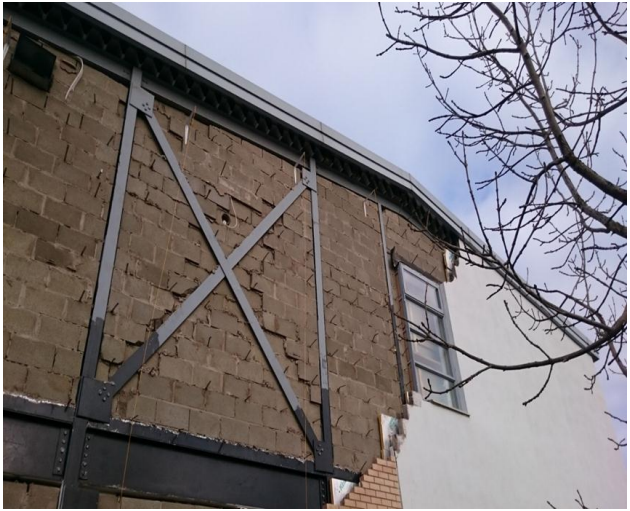
• in one of the structural bays in the gable wall containing additional diagonal flat bar steel bracing, the blockwork to the inner leaf had been reduced from 140mm to 100mm locally around the steel bracing effectively increasing the cavity width to 160mm at these locations.
5.3.8 The WRD Report contained the following four recommendations:
1. "The gable wall is rebuilt to match the existing with particular attention paid to cavity widths, wall tie specifications and connections to the steelwork."
2. "Strengthening to the 100mm blockwork areas around the cross-bracing should be provided."
3. "The results of this investigation may be indicative of generic defects by the same build team. An intrusive investigation into all other similar external walls in the school should therefore be carried out to determine cavity widths and wall tie embedment at other locations. As we have a sample wall tie that has distinctive markings it may be possible to achieve this investigation by borescope survey, as opposed to removing areas of outer leaf masonry. We would recommend that this is carried out within the next three-month period."
4. "Ensure management plan is in place with regard to Meteorological Office advice and 'Take Action' recommendations."
5.3.9 The last of these four recommendations related to the view previously expressed by WRD in their Report that the school should check to ensure that it had a management plan in place for any re-occurrence of severe weather events.
5.3.10 The "'Take Action' recommendations", mentioned in recommendation 4, refers to the advice given by the Meteorological Office as to how people should respond when that office issues 'Red' level warnings. This advice includes the following recommendations:
• "Stay indoors as much as possible"; and
• "If you do go out, try not to walk or shelter close to buildings or trees."
Image 5: Photograph of exposed inner blockwork leaf of gable after removal of insulation demonstrating the recessed blockwork in the braced bay which resulted in extending the width of the cavity. |
Figure 1: Graph showing an analysis of wind direction, wind speed and wind gust speed leading up to the collapse of the gable wall at Oxgangs Primary School. |