6.2 REPORTS OF DEFECTIVE FIRE-STOPPING PPP PROJECTS
6.2.1 During the period of the closure of the PPP1 schools the City of Edinburgh Council had sought and received assurances from ESP as to the on-going safety of the schools and their compliance with all statutory requirements in this regard in accordance with the contract.
6.2.2 In April 2016, the City of Edinburgh Council had become aware of a number of projects in the UK that had been procured using similar Public Private Partnership arrangements, for which reports had indicated the discovery of significant incidents of inadequate fire-stopping. Following the discovery of the issue of the lack of head restraints, the City of Edinburgh Council wrote to ESP on 14th April 2016 seeking confirmation from them that they had no concerns as to defects other than that relating to the wall ties and head restraints.
6.2.3 For readers of this Report, fire-stopping is the process of sealing any spaces or holes in fire-rated walls or enclosures with approved fire resistant materials in order to protect means of evacuation and prevent the spread of smoke or flame from one area to another that could otherwise lead to avoidable risk to life and unnecessary damage to property. Proper implementation of fire-stopping to fire compartment enclosures is a mandatory requirement of the Scottish Building Standards.
6.2.4 The concerns of the City of Edinburgh Council were further raised following a programme on BBC Radio 4 broadcast on the 5th July 2016 called 'The Price of PFI'.
6.2.5 The programme, as well as discussing the problems being experienced by the City of Edinburgh Council in relation to the Edinburgh Schools, identified problems with fire-stopping in PFI schools and hospitals around the United Kingdom, particularly in regard to the required provision of proper compartmentation in the spaces above ceilings.
6.2.6 Amongst those school buildings reported on was a group of eight schools provided as part of a PPP project in Knowsley, Merseyside. Following a kitchen fire at one of the schools in 2015, in which smoke had penetrated to an adjoining protected staircase, a review of fireproofing was undertaken at all eight schools. In every case, the fireproofing was reported to have been found to be sub-standard. This was particularly problematic in relation to the absence or condition of fire-dampers in ducts passing through fire-walls. The programme also stated that similar defective fire-stopping had been reported by fire-brigades in schools from all parts of the country and that the problem was widespread. It also pointed out that these problems were not restricted to schools.
6.2.7 Peterborough Hospital, a hospital acquired using PFI, was specifically identified as having seriously inadequate fire-stopping. It was estimated that the required remedial work would not be completed until 2019. The programme also identified that the Chief Fire Officers Association had advised them that this was one of ten NHS PFI Hospitals that had experienced similar defects. It was estimated that some millions of pounds would be needed to undertake the required remedial work to the defective fire-stopping.
6.2.8 Having been alerted by the information provided in this programme, the City of Edinburgh Council wrote a further letter to ESP on 14th July 2016 stating:
"In our letter to you dated 14th April we asked you for confirmation that neither ESP nor its officers were aware of or had any concerns about defects at the schools other than the issues with wall ties and head restraints.
In the light of the publicity about fire safety in PFI buildings, including schools, we should be grateful for your assurance as to the fire stopping and fire alarm position in the schools, in particular that ESP is satisfied that each school is fully compliant with all applicable laws and regulations and is safe from a fire safety perspective. Please can you revert to me on this within 7 days."
6.2.9 These issues were subsequently discussed at monthly liaison meetings with the Council representatives. At one such meeting, held on 18th August 2016, it was reported that Amey had commissioned a specialist firm to undertake surveys of the PPP1 schools to establish the adequacy or otherwise of the fire-stopping within the schools. ESP subsequently confirmed in an email to the City of Edinburgh Council that Amey had advised the meeting that:
"There were a number of remediation measures required across the estate but these were considered to be minor in nature and, importantly, did not impact on the safe operating of the sites or any requirement to revisit the fire exit strategies for any of the sites."
6.2.10 On becoming aware at the end of October 2016 of the existence of these surveys, this Inquiry requested that it receive copies of the fire-stopping surveys from ESP.
6.2.11 On 4th November 2016 ESP confirmed the following by email:
"I am pleased to confirm that AMEY has advised that the majority of works (circa 95%) were completed on or before the October break and the remaining outstanding works should be completed before the end of the month."
6.2.12 Following a further request from the Inquiry, copies of the fire-stopping surveys were received on 18th November 2016.
6.2.13 The survey reports identified a significant number of, what were described in the reports as, breaches of fire-stopping across all 17 PPP1 projects ranging from minor gaps around pipes and cables to some larger holes or gaps in what were described as fire compartmentation. Most of these reported breaches occurred in the roof spaces of the schools.
6.2.14 Photographs had been taken during the surveys of each breach identified, however the survey reports also stated that due to the limitations of access they could not guarantee that all breaches had been spotted and recorded. Photographs of examples of these breaches of fire compartmentation taken from the reports of the surveys together with the extracted related comment in the reports are shown below.
|
Image 21: Example of a breach of fire compartmentation from fire-stopping survey of Oxgangs School, dated 22nd August 2016: "there is no plasterboard above the fire door, therefore creating a large breach in the compartment. the area is not fire stopped and a breach exists." |
|
|
Image 22: Example of a breach of fire compartmentation from the fire-stopping survey of Royal High School, dated 22nd August 2016 : "the pipe has not been fire stopped and a breach exists." |
|
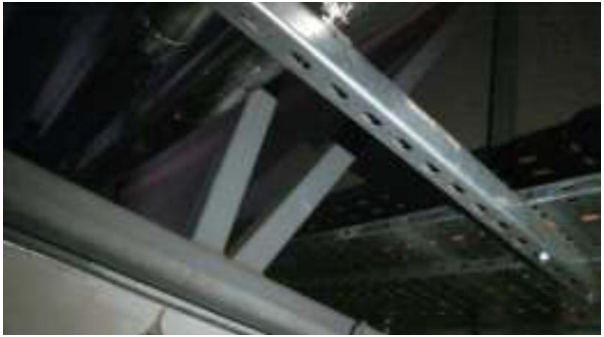
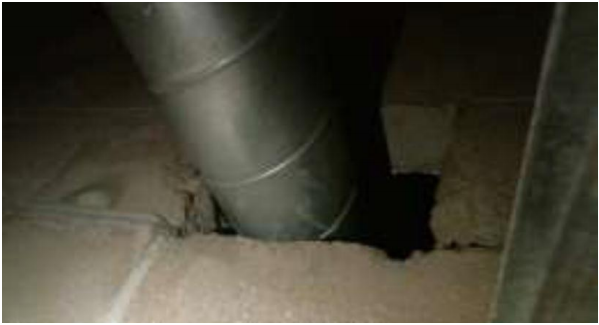
6.2.15 It was difficult to determine from the photographs how many of these breaches dated from inadequacies in the original construction or had happened as a result of any subsequent alterations carried out to the premises in the intervening years. However, from the nature of many of the breaches shown in the photographs, it would appear that a significant number are more likely to have resulted from the time of the original construction of the schools than from any subsequent work carried out in the roof spaces since the opening of the schools.
6.2.16 Despite the reference by ESP, in the above email to the City of Edinburgh Council, that these breaches had been considered by Amey to be "of a minor nature", the Inquiry was surprised at the extent and nature of the breaches indicated in the surveys. It was also surprised that these breaches had not been identified through a process of regular inspections of the integrity of fire-stopping in the buildings.
6.2.17 Finally, it was surprised that the results of these surveys had not been shared by ESP earlier in the process with the City of Edinburgh Council and that Council representatives had not been offered the opportunity to inspect these defects before they were fixed.
6.2.18 On receiving the survey reports, the Chair of this Inquiry felt it necessary to bring this matter to the attention of the Chief Executive of the Council, with a recommendation that the remedial work, required to ensure the integrity of the fire-stopping, should be subjected to independent scrutiny by appropriately qualified personnel appointed by the City of Edinburgh Council. Further it was recommended that an inspection be undertaken of any fire-dampers within the schools to ensure that they were in place and operating effectively, as these had not been specifically referred to in the reports, yet represented a significant element of the type of breaches that had been reported in the BBC programme.
6.2.19 It was also suggested that, in light of the evidence from the PPP1 school surveys, it might be appropriate to undertake a series of reviews of the comprehensiveness of fire-proofing and fire safety provision in other school projects in Edinburgh, including those procured through the later and completely separate PPP2 contract for schools in Edinburgh.
6.2.20 In early December, the City of Edinburgh Council appointed an independent specialist to undertake a review of the PPP1 schools, which process is still underway at the time of writing. While the final outcome of this process is not finalised, on the basis of the examination of two of the schools by the Council-appointed specialist, a number of further examples of defective fire-stopping to compartment walls were identified. This specialist also pointed out that not all of the gaps and holes that had been repaired in walls on the basis of the earlier ESP surveys appeared to be in compartment walls and that some of the repairs already carried out might not have been required.
6.2.21 In January 2017, as the writing of this Report was nearing completion, the Inquiry was advised by a representative of ESP that they had just undertaken a review of the findings of the fire-stopping surveys that had originally been provided by themselves, ESP, to the City of Edinburgh Council in November 2016. Following this second review they too were of the opinion that not all of the defects reported, despite the fact that they had already undergone remedial work, had been located in fire-compartment walls or enclosures. However, they did fully accept that there had been defects present.
6.2.22 It would appear, from the information currently available to the Inquiry, that the two photographs above, taken as examples from the original ESP surveys provided to the City of Edinburgh Council in November, are in compartment walls and would have required the remedial action undertaken.
6.2.23 As a consequence of ongoing discussions in relation to this issue, ESP has agreed to the joint appointment with the Council of a further independent fire safety expert to undertake a full review of all the PPP1 schools to determine the overall position in relation to fire safety matters (whether relating to fire compartmentation or otherwise) and to identify any aspects of fire safety in the buildings that may remain to be remedied. This is being progressed as a matter of urgency at the Council's insistence and rectification and/or other fire safety measures will be implemented as matters progress.
6.2.24 The Council is also undertaking an appropriate fire safety review in relation to the wider Council estate, including the PPP2 schools.
6.2.25 The ultimate responsibility for the safety of pupils, staff and members of the public who may be present in their buildings must lie with the City of Edinburgh Council. Any delegation by the Council of responsibility for ensuring an appropriately safe environment to commercial organisations must include the provision of appropriate mechanisms to ensure that these companies are fulfilling all their obligations.
6.2.26 The application of financial penalties after the fact, as provided for in PPP contracts across the United Kingdom, has clearly not been a sufficient mechanism in the reported cases to ensure the prevention of such defects in the original provision and maintenance of compliant fire safety installations.
6.2.27 A best practice guide on the subject of fire-stopping, published in February 2015 by the British Research Establishment, contained the following comments:
"The fire protection of concealed spaces is of prime importance because any deficiencies in installation and materials are not readily apparent and may quickly be covered over. Any inadequacies in such fire protection cannot be observed by the building users and, unlike other engineering provisions within the building, will not be directly apparent by its impact on every-day life. Any inadequacies in the fire protection of concealed spaces will only become apparent during the very time that their effectiveness is required - during a fire."
Compartmentation in roof voids is a particular issue with respect to hidden fire spread. The biggest issue remains that of quality of construction. The research presented here and supported by the case studies shows that poor workmanship with inappropriate materials are the main reasons for the inadequate protection of concealed spaces.
There is a clear and demonstrable need to ensure that buildings are designed and constructed so that the unseen spread of fire and smoke within concealed spaces within its structure and fabric is inhibited, as required by the Building Regulations. There is adequate guidance available in the public domain to allow this to be achieved."
6.2.28 The discovery of the significant number of defects in fire-stopping across the 17 PPP1 projects coupled with the reports from other parts of the United Kingdom raises a further question mark as to the level of reliance that can be placed on the current arrangements under PPP schemes for the proper inspection and quality assurance of projects. This is clearly at its most important in relation to aspects of the construction of buildings that can have an impact on the safety of occupants.
6.2.29 The final position in relation to the fire safety aspects of the construction of the PPP1 schools and of other schools in Edinburgh, including the PPP2 schools, will not be known until the appropriate independent investigations are carried out.
6.2.30 In relation to the current estate, this Report recommends:
• that the Council reviews its current arrangements in terms of ensuring the adequacy of fire-stopping in the buildings it owns or operates based on a sound fire strategy for each building;
• that in relation to the completed surveys or those currently being undertaken of the schools, the Council seek confirmation that the presence and condition of any fire-dampers in ducts penetrating fire compartments is satisfactory;
• that a risk-prioritised programme of remedial work is established to address any further defective installation or absence of fire-stopping identified; and
• that once remedied, an appropriate protocol for the checking of the effective maintenance of fire-stopping through the life of buildings is implemented.
6.2.31 Amey advised the Inquiry that Amey FM are required to carry out visual inspections of fire-stopping materials annually and that records of inspections are maintained by Amey FM.
6.2.32 The issues in relation to the proper installation and inspection of fire-stopping in the construction of new buildings is addressed in the wider recommendations of this Report.