9.1 BEHAVIOUR OF WIND AROUND BUILDINGS
9.1.1 Before addressing the specifics of the PPP1 schools it may be useful to demonstrate briefly how the wind behaves when a building is in its path.
9.1.2 The wind will flow around and over the building and will exert positive pressures on some parts of the building and negative pressures (suction) on other parts. The building acts as an obstruction to the flow of the wind, in the same way as a boulder in a river or stream, interrupting the flow of the water and causing turbulence around the boulder. Diagram 5 below illustrates the flow of air over and around a simple building.
Diagram 5: Wind related pressure around a building.
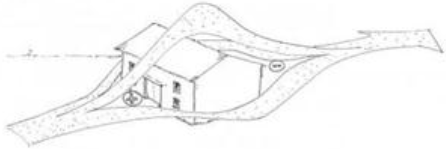
9.1.3 As the wind flows around and over the building it is forced to accelerate around the corners and over the ridge of the roof, causing high suction pressures to develop.
9.1.4 This is the reason ridge tiles are blown off buildings and why the leading edges of roof and the corners of buildings suffer the most damage in strong winds. It is also why in the case of Oxgangs Primary School the gable wall sustained damage.
9.1.5 Diagram 6 below illustrates where high pressure positive and low pressure negative zones are created around a simple rectangular structure.
Diagram 6:
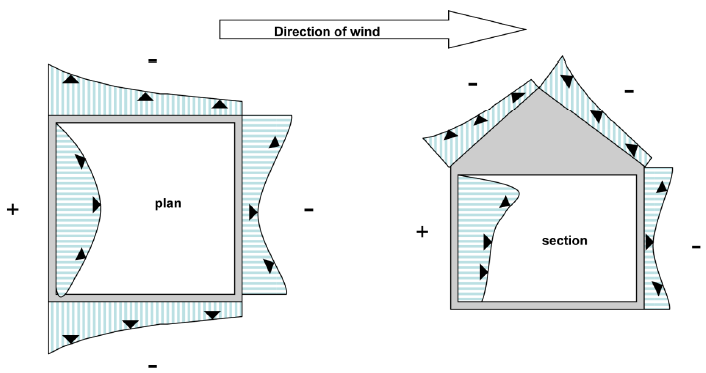
9.1.6 If the wind was to blow in the opposite direction, then the areas that are subject to the high local pressures will change; likewise, if the wind turns through 90 degrees, then the pressure distribution around the building will change and areas that were previously subject to positive pressure will be subject to suction.
9.1.7 When the wind blows directly onto a wall panel it exerts a positive pressure, effectively trying to push the panel into the building. If the panel is at a corner then depending on the direction of the wind, the masonry panel may be subject to high local suction forces, which try to pull the wall away from the building.
The behaviour and strength of the panel is a direct function of:
• the way in which the panel is restrained at the top, sides and bottom;
• what the wall is constructed from;
• what reinforcement has been added to the panel to strengthen it, if any; and
• in the case of a cavity wall how well the inner and outer leaves are tied together.