Foreword
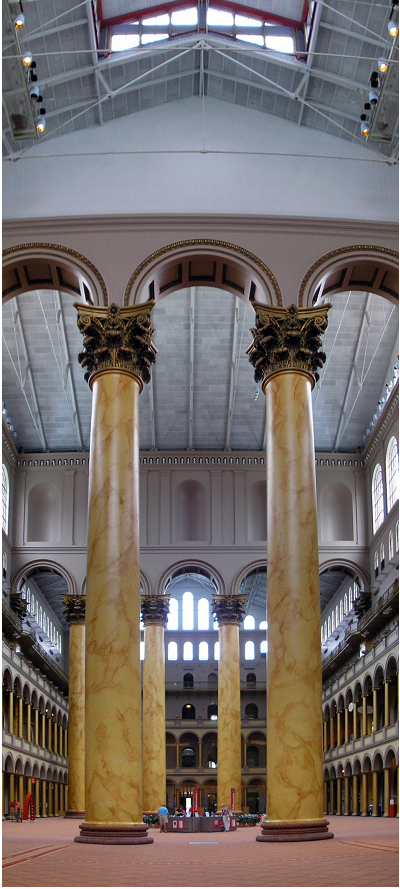
The Pension Building, home of the National Building Museum, in Washington, D.C.
Gryffindor/Wikimedia Commons
Donald Trump has signaled that infrastructure will be a top priority in his administration. His policy documents indicate a focus on pursuing "an 'America's Infrastructure First' policy that supports investments in transportation, clean water, a modern and reliable electricity grid, telecommunications, security infrastructure, and other pressing domestic infrastructure needs" and state an intent to "leverage new revenues and work with financing authorities, public/private partnerships, and other prudent funding opportunities."1
Much has been written about the state of public infrastructure in the United States. Most objective analyses conclude that this issue is serious; many facilities are in need of replacement or repair and many more are poorly maintained. This situation is true for both the civil works infrastructure-roads, bridges, tunnels, airports, railroads, ports, and waterways-and federal real estate that the government owns and occupies, including buildings, bases, and hospitals.
Although civil works infrastructure has begun to see benefits from innovative financing and public/private programs authorized by Congress, the fiscal and political environment has made it difficult for the federal government to participate in partnership funding opportunities for federal real estate under the present budgetary rules for scoring projects.
The National Council for Public-Private Partnerships (NCPPP) and the Public Development and Infrastructure Council of the Urban Land Institute (ULI) undertook this project to explore the opportunities and options for responsible reform of the federal project scoring rules as they relate specifically to one asset class-federal real estate-as a way to propose solutions that may be applicable to other asset classes. A small Advisory Group of leading experts on federal budgeting and public/private partnerships was convened to guide the project. Its findings and recommendations, as well as a description of the project, are included in this report.
ULI and NCPPP wish to acknowledge the work of the members of the project Advisory Group in developing these recommendations, in participating in the various events, and in writing this report. We especially wish to thank Dan Tangherlini, chair of the Advisory Group, for his leadership, insights, perseverance, and work as principal author of this report. We would also like to thank those who participated in both the Advisory Group discussion sessions and the special Experts Roundtable held in conjunction with the 2016 ULI Spring Meeting.
In addition to the members of the Advisory Group, we want to thank Marta Goldsmith for her work in organizing this effort, Sandy Apgar for his input and research, David Haun for his willingness to participate in various events and to serve as a capable foil, and Susan Irving of the U.S. Government Accountability Office for her steadfast efforts to explain the current approach. Finally, ULI and NCPPP express their appreciation to Alvarez & Marsal Public Sector Real Estate Services, the Association for the Improvement of American Infrastructure, Booz Allen Hamilton, and Hunt Companies Inc. for their generous support of this project.
It is our hope that the new administration will consider these ideas as it explores strategies to address our serious infrastructure deficit and to support growth in the American economy.
|
Sandra Sullivan, President |
Wes Guckert, Chair |