The Current Model and Unintended Consequences
As an example, the current regime of scoring capital expenditures (or capital leases) fully, in the first year of obligation-as required by OMB budget scoring Circular A11, Appendix B-has the potentially unintended effect of favoring operating costs, entitlements, or tax expenditures over capital or other asset-based funding priorities. More starkly put, these rules tilt spending toward transfers over investments, bypassing a first principle of infrastructure financing-user pays.
This approach is exacerbated by exceptions to the rules that allow certain leases and investments to be scored on an operating basis as annual recurring funding rather than with a single upfront appropriation. Perversely, this exception-primarily built into GSA's Federal Buildings Fund-makes a multiyear lease a more attractive strategy than a capital investment, because the lease is scored only at the time of obligation on the basis of the annual expenditure versus the full cost of the capital investment. In other words, a building that would cost $100 million to build would be scored at that level in the first year of obligation, whereas the lease of an equivalent building over ten years-even if it were more costly on a net present value basis-would require funding for only the first year's rent.
An excellent example of this unintended consequence is the former David Nassif Building in Washington, D.C. The Nassif Building was built in 1969 with the express purpose of housing the then new U.S. Department of Transportation (DOT). It would be the first agency headquarters not owned by the government and the largest privately owned building in Washington. The land for the building was purchased from a quasi-federal agency, the Redevelopment Land Authority, for $5.9 million, and construction was financed for $38 million (with an actual cost estimate of $27.5 million). The initial 20-year lease cost a total of $98 million. DOT extended its lease several times until 2000, when it announced it would leave the building, which it did in 2007. After a two-year renovation costing $250 million and two years of lease-up, the building was renamed and sold fully leased for $734 million. It is appraised as the most valuable privately owned building in Washington. It is occupied exclusively by federal agencies with ten-year term leases at $50 per square foot.
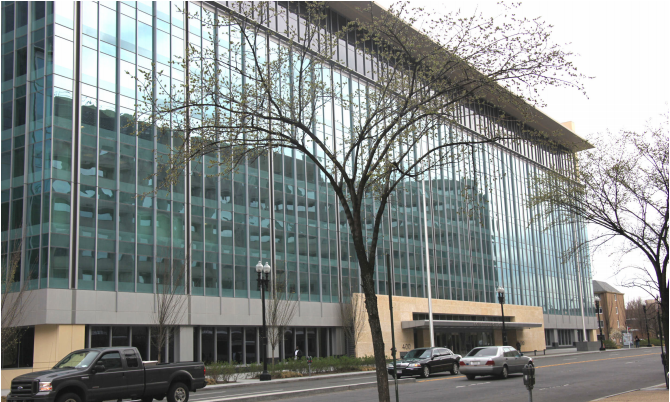
Constitution Center, the former David Nassif Building, in Washington, D.C.
©Tim1965-Own work, CC BY-SA 3.0/Wikimedia Commons
To avoid this outcome, the Advisory Group discussed a variety of alternative scoring regimes and exceptions, some of which are described below. However, they concluded that the best approach would likely be to place the various options-such as construction of the building by the federal government, leasing from the private sector, or some hybrid-on an equal analytical and scoring footing so that the net present value of each option could be calculated and a decision made, based on the best long-term value to the federal government at the lowest overall-not annual-cost.