Policy Development & Enforcement
A key role of the PPP Authority is the development of policies and procedures for guiding ministries, agencies and private sector investors during the process of developing and implementing PPP projects. Effective policy development and its enforcement is the key to the establishment of an enabling environment to promote PPPs. The strategic approach taken by the PPP Authority has been the development of a comprehensive legal framework for PPPs, followed by the introduction of procedural guidance to give stakeholders a step by step process for delivering the projects. Supplementary rules, regulations and policies have since been introduced, focused on giving subject matter based guidance on areas where more detailed clarity and guidance was required. |
Contract Signing with Tansaction Advisor |
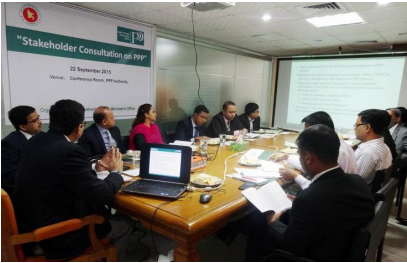
Drafting of the regulatory framework involves a substantive process of development including testing against known international benchmarks, review by PPP experts and practitioners, peer review through an inter-ministerial meeting and legal vetting (as applicable) prior to processing for final approval. This exhaustive development process ensures that documents are suitably tested prior to being introduced for application.
In order to insure effective enforcement of PPP regulations it is important to carry out activities that help awareness creation and capacity development. The PPP Authority has the responsibility to review and check that the relevant PPP requirements are being followed by the agencies and ministries, as well as ensuring that bidding documents and the proposed provisions in the PPP contracts are in line with market standards, are bankable, and can attract private sector investors. To facilitate this process the PPP Authority is developing draft model documentation and templates on a sector specific basis as well as working closely with agencies and ministries to ensure that their input is provided at an early stage to prevent delay in project delivery.