1.1 Transparency of the process
Lifecycle cost assessment [Brazil: Lei 11.079, Art. 10] Public-private partnerships shall be procured by competitive tendering. The opening of the tendering process requires: II - estimate of budgetary and financial impact in the periods in which the public-private partnership contract shall be in effect; III - statement by the party responsible for authorizing the expenditure that the obligations undertaken by the Public Administration in a partnership contract are in line with the Budget Guidelines Act and have been considered in the Annual Budget Act; IV - estimate of long-term flow of public funds, necessary for fulfilling, throughout the term of the contract and in each fiscal year, the financial obligations undertaken by the Public Administration; V - the project is included in the Multi-Year Plan in effect; |
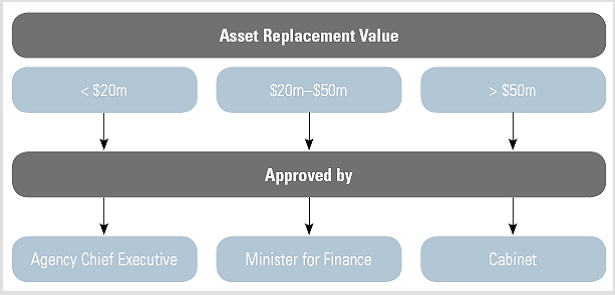
Approval process [Australian Government, Department of Finance and Deregulation Introductory Guide to Public Private Partnerships - December 2006] The PPP Principles set out the approval processes for projects considered to be PPP arrangements. Appropriate approval is required before engaging the market in a tender process. |
|
Transparency of procedure and decision- making [Peru - Decreto Legislativo n. 1012 Art. 5] Transparencia. Toda la información cualitativa y cualitativa que se utilice para la toma de decisiones durante las etapas de evaluación, desarrollo, implementación y rendición de cuentas de un proyecto de inversión llevado a cabo en el marco de la presente norma deberá ser de conocimiento ciudadano, bajo el principio de publicidad establecido en el Art. 3 del Texto Único Ordenado de Ley de Trasparencia y Acceso a la Información Pública, aprobado por Decreto Supremo N. 043-2003-PCM. [Brazil: Lei 11.079, Art. 4] The following guidelines shall be observed when contracting public-private partnerships: V - transparency of procedures and decision-making; Transparency of the value for money assessment [Brazil: Lei 11.079, Art. 10] Art. 10. Public-private partnerships shall be procured by competitive tendering. The opening of the tendering process requires: I - authorization by the public authority, based on a technical study that shall demonstrate: a) the convenience and appropriateness of contracting a public-private partnership, by identifying the reasons that justify the choice of a partnership model; [Mexico: Acuerdo Secretaria de Hacienda Diario Oficial 9 Abril 2004] 20. Las dependencias y entidades deberán presentar las solicitudes de autorización de proyectos para prestación de servicios ante la Secretaría, a través de las Direcciones Generales de Programación y Presupuesto sectoriales. En el caso de entidades sectorizadas, la solicitud deberá ser presentada por la dependencia coordinadora de sector y, en el caso de las entidades no sectorizadas, la solicitud deberá presentarse por la entidad, directamente a las citadas Direcciones Generales. 21. Las solicitudes a que se refiere el numeral anterior deberán acompañarse de la siguiente información: IV. El análisis costo y beneficio a que se refiere el numeral 15 de estas Reglas; Transparency of the budgetary and fiscal affordability of the PPP and compatibility with the multi- year fiscal strategy of the Government [Brazil: Lei 11.079, Art. 10] Art. 10. Public-private partnerships shall be procured by competitive tendering. The opening of the tendering process requires: b) that the expenses created or increased shall not affect the targets in terms of fiscal results provided for in the Annex referred to in § 1 of art. 4 of Complementary Act 101, dated May 4th, 2000, such that its financial effects, in subsequent periods, shall be compensated by a permanent increase in revenues or by a permanent reduction in expenditures; and c) when applicable, in accordance with art. 25 of this Act, the compliance with the limits and conditions resulting from the application of art. 29, 30 and 32 of Complementary Act 101, dated May 4th, 2000, in relation to the payment obligations undertaken by the Public Administration in partnership contracts; II - estimate of budgetary and financial impact in the periods in which the public-private partnership contract shall be in effect; III - statement by the party responsible for authorizing the expenditure that the obligations undertaken by the Public Administration in a partnership contract are in line with the Budget Guidelines Act and have been considered in the Annual Budget Act; IV - estimate of long-term flow of public funds, necessary for fulfilling, throughout the term of the contract and in each fiscal year, the financial obligations undertaken by the Public Administration; V - the project is included in the Multi-Year Plan in effect; [Mexico: Acuerdo Secretaria de Hacienda Diario Oficial 9 Abril 2004] 9. En el proyecto de Presupuesto de Egresos de la Federación de cada ejercicio fiscal, se señalarán las obligaciones de pago previstas en los contratos de servicios de largo plazo vigentes tanto para el ejercicio fiscal correspondiente como para los subsecuentes, conforme a la información que proporcione la dependencia o entidad contratante. 20. Las dependencias y entidades deberán presentar las solicitudes de autorización de proyectos para prestación de servicios ante la Secretaría, a través de las Direcciones Generales de Programación y Presupuesto sectoriales. En el caso de entidades sectorizadas, la solicitud deberá ser presentada por la dependencia coordinadora de sector y, en el caso de las entidades no sectorizadas, la solicitud deberá presentarse por la entidad, directamente a las citadas Direcciones Generales. 21. Las solicitudes a que se refiere el numeral anterior deberán acompañarse de la siguiente información: II. La justificación de que el proyecto es congruente con los objetivos y estrategias establecidos en el Plan Nacional de Desarrollo y en los programas sectoriales, institucionales, regionales y especiales que correspondan a la dependencia o entidad solicitante; 27. LA solicitud de autorización, las dependencias y entidades deberán anexar los siguientes documentos: I. El proyecto de contrato de servicios de largo plazo, que deberá contener, entre otros términos y condiciones, los establecidos en la fracción VI del numeral 21, así como los siguientes: b) Una estimación de las obligaciones de pago, a precios del año, a cargo de la dependencia o entidad contratante, tanto para el ejercicio fiscal correspondiente como para los subsecuentes. g) Las garantías, coberturas y seguros que serán contratados obligatoriamente por parte del inversionista proveedor; IV. La justificación de que la celebración del contrato de servicios de largo plazo se apegará a los objetivos y metas establecidos en los documentos que se presentaron para obtener la autorización para realizar el proyecto para prestación de servicios; VI. Un documento que demuestre que, en su caso, la obligación de pago para el ejercicio fiscal vigente cuenta con la previsión presupuestaria correspondiente en el Presupuesto de Egresos de la Federación; |
A differentiation based on the dichotomy public vs. private finance may be misleading as it implies a concept of off balance-sheet financing for public infrastructure and services. PPP are not a way for facing budgetary restrictions. Yet this misbelieve has been caused by the same origin of PPPs and the financial structure that have been used for developing them. In fact, PPP have grown up in parallel with the concern by some government (particularly, the European countries signatory of the Maastricht Treaty) to avoid increasing government debt, which created incentives to enter into off-balance sheet financing arrangement. Moreover, the use of financial technique in PPP, such as project finance (that at least at the beginning was permitting some form of off-balance sheet financing) have reinforced the perception of PPP as a mean for reducing the incidence of infrastructure expenditure on public finances. This wrong perception was further implement by the association of PPP to self-sustainable concession, whereby the payment for the service/product provided by the user is able to cover the financing and to generate sufficient rewards to the operator.