Cost Plus Payment (CPP) and Fixed Price Payment
This payment mechanism is based on documented proof of cost to reimburse the contractor. The public-sector party agrees to reimburse construction and operation costs associated with the infrastructure project plus a fixed and in some cases a variable fee. Formally, the payment P would be a linear function of the cost level P =F+(1+m)C, where C is cost, F>=0 is a fixed fee and m>=0 is the mark up the private-sector party can charge on each unit of documented cost. Since the private-sector party is fully insured against any cost increase that can happen in the construction and operation phases, a cost-plus payment gives no incentives to the private-sector party to exert any extra effort to reduce cost, as lower cost implies lower profits for the private-sector party (Albano et al., 2006a).
This is particularly problematic when large infrastructure projects are settled to cover CPPs because the private party will always gain from charging the documented cost, which are large if the total cost of the project is a proportion to accrue the construction and operation costs. When project is in an advanced stage these cost can indeed be substantial to the government and the society. A cost-plus payment may therefore not be an appropriate mechanism when the project's total costs heavily depend on the private partner's actions, precisely because incentives to save on costs are weak. The mechanism has also a negative effect on the tendering process to select a private partner when there is a high degree of uncertainty about the bidders' efficiency.
Cost Payment Schemes
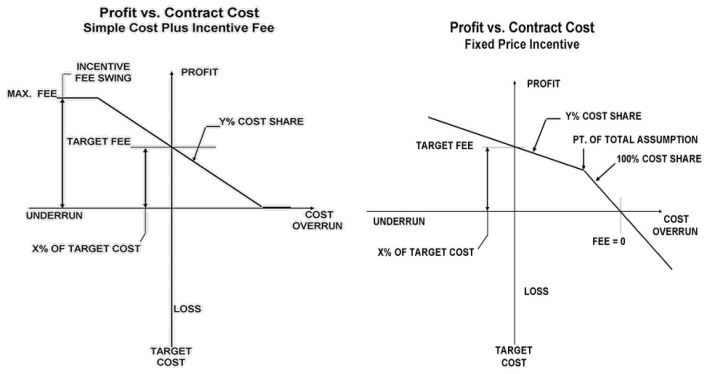
Source: Montague, D. 2002
In the case of the fixed price payment, it does not require disclosure of the costs by the contractor. The public-sector party agrees to pay the private-sector party a fixed amount for the service provision that must achieve certain quality standards. It is then critical that a scheme of deductions is in place to guarantee that the quality standard is respected, so that payment scheme will be P = F - d(Qs-Q), with the previously clarified notation. Since payment do not change with cost, the private partner bears all the costs associated with the project and fully appropriates the benefits of cost-savings activities. Hence, a fixed-price payment gives the private-sector party strong incentives to undertake cost-reducing efforts.
Transparency of the payments to the private partner and gain sharing [Brazil: Lei 11.079, Art. 5] The clauses of public-private partnership contracts shall be in accordance with the provisions of art. 23 of Act 8987, dated February 13th, 1995, as applicable, and shall also state: IX - the sharing with the Public Administration of the economic gains of the private partner resulting from the reduction of credit risk related to the funding contracted by the private partner; [Mexico: Acuerdo Secretaria de Hacienda Diario Oficial 9 Abril 2004] 27. LA solicitud de autorización, las dependencias y entidades deberán anexar los siguientes documentos: I. El proyecto de contrato de servicios de largo plazo, que deberá contener, entre otros términos y condiciones, los establecidos en la fracción VI del numeral 21, así como los siguientes: c) La forma, términos y condiciones de pago |