External Conditions affecting the Institutional Mechanisms of PPP contracts
Institutional barriers and opportunities are very important for encouraging private sector financing and participation in PPPs long-term contracts. In a survey carried in 200877 by Freshfields, Bruckhaus and Deringer (2008) [Outlook for Infrastructure: 2008 and Beyond] the firm asked participants to identify the bare minimum requirements for their private organizations to become involved in an infrastructure PPP contracts in an emerging economy. The responses illustrate why their organizations are not prioritizing the emerging economies ahead of the OECD countries: 76 per cent identify the need for a stable government and a reliable legal system, closely followed by 74 per cent identifying the need for corruption levels to be controlled and 71 per cent for supportive government policies.
Barriers to have Long-Term Infrastructure Contracts, 2007
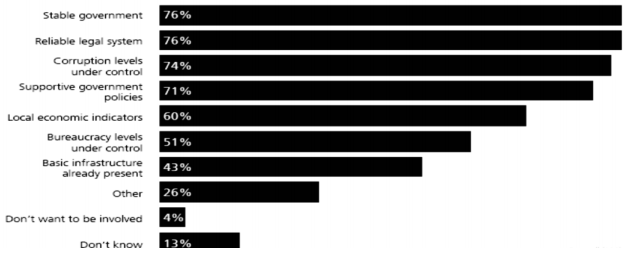
Source: Adapted from Freshfields, Bruckhaus and Deringer (2008). Outlook for Infrastructure: 2008 and Beyond. UK.
But contracts may shield some of these external aspects and provide incentives to enter into a long-run relationship when the institutional framework clearly states responsibilities, tasks and risk-bearing issues. Arrangements in the institutional setting of contracts such as safeguards on independence and on accountability provide the basis to rely on contractual arrangements by private parties. Independence requires lengthy relationships with regulated operators, consumer groups and other private-interest groups and with political authorities (Guasch, 2005). This may provide a more stable environment where external country-specific conditions may be safeguarded through the contract. Accountability prevents arbitrary behaviors and ensures that open decision-making processes are transparent. It also provides the conditions for budget scrutiny and capacity of removal from office for misconduct or incapacity (Guasch, 2005).
_____________________________________________________________
77 The majority of participants are investors and credit providers, with the balance being consultants or industrial players who operate across all sectors, from traditional or 'hard' infrastructure, such as energy and transport, to social infrastructure such as hospitals, schools and prisons projects. Interviews were carried out between 22 May and 3 June 2008. Answers are ordered according to the priority of barriers reported by survey respondents.