6.2.6 Early termination
There are circumstances that may lead the public sector78 and/or the private partner79 to terminate the contractual relationship before the contract expires. Thus, the contracting parties could agree to specify clauses determining their rights to terminate the contract earlier. Contract early termination may result from:
(i) Default of either or both parties,
(ii) Voluntary termination by the public sector,
(iii) Force majeure events,
(iv) Corrupt gifts and breach of refinancing provisions.
These factors are multidimensional and difficult to explore the root causes. The early termination of contracts can have two distinct channels. One, renegotiation, is related to a partial or complete revision of contractual clauses. The other, government takeover, is related to franchises or PPPs that are no longer financially sustainable or are at the point of bankruptcy. For instance, Guasch (2005) found that 55 percent of transport concession contracts in the Latin American and Caribbean Region between 1985 and 2000 have been renegotiated, after an average of 3 years. Renegotiations tended to favor the private sector operators, who secured increases in tariffs (62 of all renegotiations), delays and decreases in investment obligations (69 percent), increases in cost components with an automatic pass-through of tariffs (59 percent), and decreases in annual concession fees paid to the government (31 percent). So in theory, internal factors pertaining to the contract or the concession might be correlated with the incidence of renegotiation or government take over. Using the data of Guasch (2005) which has around 1,000 concessions awarded in Latin America and the Caribbean Region, an interesting correlation is found. The monetary size of concession contracts and PPP is correlated with the incidence of renegotiation and takeovers for the main infrastructure sectors (energy, water, roads, telecoms). Corruption (point (iv) mentioned above) is related to the size of the concession since private participants have incentives for corruption when contracts represent a significant amount of monetary resources80.
Size of Concession($$) and Government Take Over: All Sectors
| Concession Size ($$) and Concession Failure: Transport Sector
|
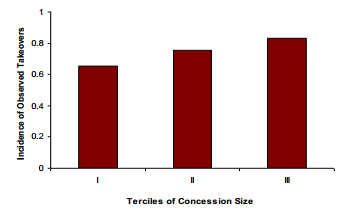
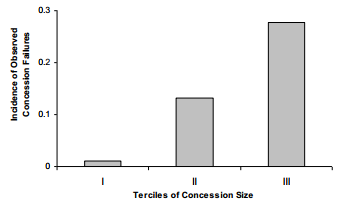
Source: Authors' calculations based on Guasch (2005) dataset.
It may happen that some of the costs incurred by a party are non-contractible, and so under-compensation occurs despite the principle of full compensation. Anticipation of the possibility of contract termination can then discourage a party from incurring in non-contractible cost such as unverifiable investment, but when the monetary value (concession size) is high enough the risk profile of the contractor shifts to risk-seeking. This may induce contracts that may not be financed in the future, leading into an upward shift on the incidence of renegotiation or government takeover.
Compensation for Early Termination The contract should envisage a scheme to address the issues of determining the compensation amount and facilitating project continuation. In the companion paper we discuss three possible alternatives: (i) No compensation, (ii) Stage-based compensation, and (iii) Market based compensation, and the benefits and costs of each of them. Depending on the project circumstances, the availability or not for a liquid market in the sector where the project develops, the cost of re-tendering and the presence of alternative private partners, the appropriate approach should be chosen. The contract should envisage circumstances under which the public-sector party has the right to voluntary terminate the contract early. In the event of a voluntary early contract termination, the private-sector party should be fully compensated, receiving a payment that leaves it in the position it would have been in had the contract not be terminated. It is recommended to set the same compensation amount payable to the private-sector party in early contract terminations triggered either by the public-sector party's default or by it exercising the right of voluntary termination. Source: Iossa, Spagnolo and Vellez (2007) |
_____________________________________________________________
78 For the public-sector party default, the contract should specify the failures that allow the private-sector party to call for terminating the contractual relationship, making sure that the public-sector party has had the opportunity to remedy the situation.
79 In the case of private-sector party default, it is recommended to entitle the public sector party to have the project's assets transferred to it. But to avoid benefiting the public sector party at the expense of the private-sector party by transferring valuable assets, the contract should also envisage a compensation for the later paid by the former. In addition, to avoid the costs for the public-sector party associated with terminating the project and interrupting the service provision, it is convenient that the contract includes procedures to facilitate the continuation of the project, e.g. transferring the project to the lenders or to a new private partner.
80 The contract should consider corrupted gifts and fraud as causes for early contract termination. In addressing this issue, it is advisable to take into account both the interest of the public-sector party in ceasing the contractual relationship with a corrupted and/or fraudulent partner, and the interest of the lenders, who may not be involved in any prohibited act, in recovering their funding to the project. The contract should specify which actions imply corrupted gifts and fraud. If the private-sector party is directly responsible for a prohibited action, the public-sector party should have the right to terminate the contract by paying the outstanding financial liabilities; in addition, the public-sector party should be compensated by the private-sector party and receive the project's assets. Instead, if the private-sector party is not directly responsible (e.g. the prohibited action is undertaken by an employee acting on his own), it should be given an opportunity to displace the responsible person and then continue the contractual relationship with the public-sector party.